TL;DR: Amazon influencer and follower insights help creators and brands decide which products deserve a recommendation, which audiences are likely to care, and whether the resulting activity supports the work involved. Start with audience questions, check relevant Amazon demand, and choose products that can be demonstrated honestly. Keep social followers, content reach, Amazon clicks, attributed sales, and creator earnings separate. A large audience is a starting point for research, not a forecast of purchases.
Key Takeaways
- Audience fit comes before audience size. Evaluate whether the creator regularly reaches people with the problem your product solves.
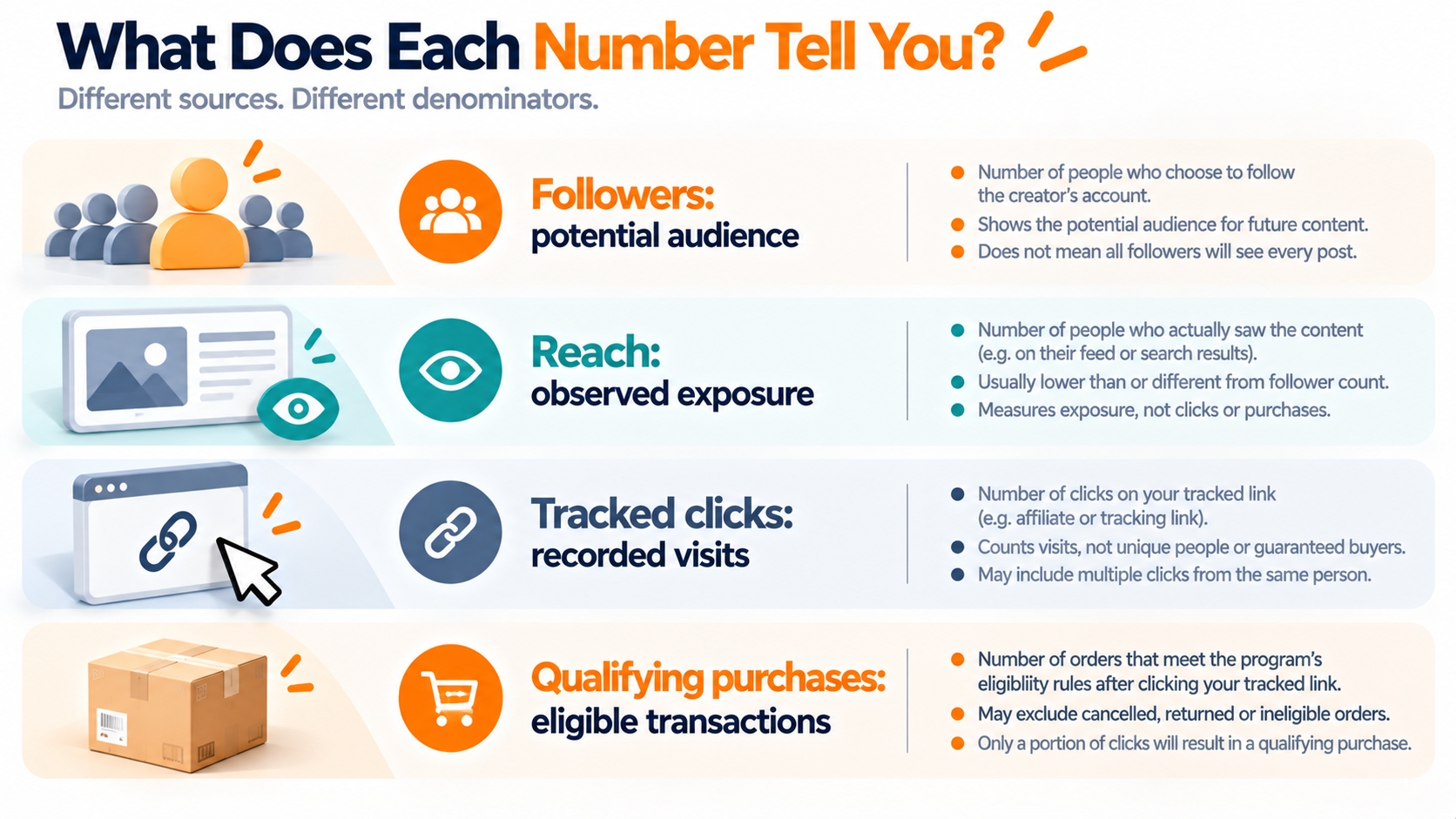
- Different data sources answer different questions. Public content, creator-shared analytics, affiliate reports, and seller campaign reports are not interchangeable.
- Search demand helps choose the recommendation. It does not tell you how many of a particular creator's followers will buy.
- Measure earnings and brand contribution separately. Product sales, Amazon-paid commissions, brand sponsorship fees, and the seller's remaining contribution describe different outcomes.
Table of Contents
- Amazon Influencer and Follower Insights: What Are You Measuring?
- Read the Audience Behind the Profile
- Use Amazon Demand to Choose the Product
- Build the Demonstration Around a Buying Question
- Choose the Reporting Route Before Sharing Links
- One Campaign, Two Different Earnings Calculations
- Keep the Recommendation Useful After Publication
- Run a Small Test You Can Explain
- FAQs
- References
Scope: This guide focuses on US-facing creator content and Amazon.com sales. "Influencer and follower insights" is used as an analytical topic, not the name of a single Amazon dashboard. Program access and reporting vary by account and campaign. The examples below are hypothetical.
Amazon Influencer and Follower Insights: What Are You Measuring?
A home-organization creator can attract thousands of viewers with a satisfying before-and-after video. That does not tell a storage brand whether those viewers have the right cabinet dimensions, live in the target market, or intend to purchase the featured organizer.
Useful insights connect the audience, the buying problem, and the product. They also identify where the evidence stops.
Social followers, Amazon followers, and shoppers are different groups
A social follower has chosen to follow an account on a particular platform. Someone following a creator within Amazon is part of a different relationship. A shopper who purchases after encountering a recommendation may belong to neither group.
Amazon distinguishes onsite earnings from traffic a creator sends to Amazon. Eligible content may be selected for shoppers already browsing Amazon, with those earnings tracked separately. An onsite sale should therefore not be presented as evidence that a creator's social followers bought the product.
Program membership is not a performance guarantee
The Amazon Influencer Program gives eligible creators a personalized storefront and ways to recommend products through content and affiliate links. Amazon's public application guidance considers follower numbers alongside engagement, rather than publishing a single universal follower threshold on that page.
Approval does not establish that a creator suits every category. A brand still needs to examine content relevance, audience evidence, and the proposed collaboration.
Label what is observed, shared, or measured
| Evidence source | What to examine | What not to assume |
|---|---|---|
| Public content | Published topics, demonstrations, visible engagement, and storefront recommendations. | That visible followers or comments disclose buyer identities, private demographics, or verified sales. |
| Creator-shared analytics | Dated, aggregated audience and content-performance information the creator can appropriately share. | That a cropped screenshot covers every channel, post, or reporting period. |
| Authorized commercial reports | Clicks, purchases or items, sales, and earnings within a defined account and measurement method. | That a creator's affiliate earnings report is automatically visible in a brand's seller account. |
For a collaboration, request aggregated evidence rather than personal follower lists, buyer details, or login credentials. Record what was supplied, its date range, and its limitations. Unknown audience information should remain unknown, not be filled in from the creator's appearance or personal background.
Read the Audience Behind the Profile
A useful creator shortlist starts with the customer's problem. For an under-sink organizer, look for content about small kitchens, cabinet storage, or making awkward spaces usable, not simply a large lifestyle audience.
Creators can apply the same test to their own recommendations: is this product a natural answer to questions the audience already asks?
Review a comparable sample, not the best-performing post
Choose a recent period and inspect several posts in the relevant category and format. Separate ordinary posts from giveaways, paid amplification, and exceptional viral hits. A median view count across comparable posts can be a more useful planning input than the largest result in a media kit.
Where available, ask for aggregated audience geography, recent reach, and relevant link activity. A US Amazon campaign needs people who can buy the linked offer; a global follower total does not establish that fit.
Read the questions inside the engagement
Comments such as "Will the drawer clear the cabinet door?" and "Can the upper shelf go around the drainpipe?" reveal buying questions worth answering. They are more actionable for this product than applause for the video's editing.
Those questions are signals, not confirmed orders. Likewise, a sudden follower increase or repetitive comments may justify further questions, but neither establishes a fraudulent audience on its own.
Keep engagement calculations comparable
An engagement rate based on followers is different from one based on reach or views. Record the numerator, denominator, platform, format, and period before comparing creators. Do not combine followers from several platforms and call the total a unique audience; the same people may follow in more than one place.
A practical selection note: "This creator regularly demonstrates compact storage, can show relevant US audience reach, and receives specific fit questions" is a stronger reason to test a partnership than "this creator has the most followers."
Use Amazon Demand to Choose the Product
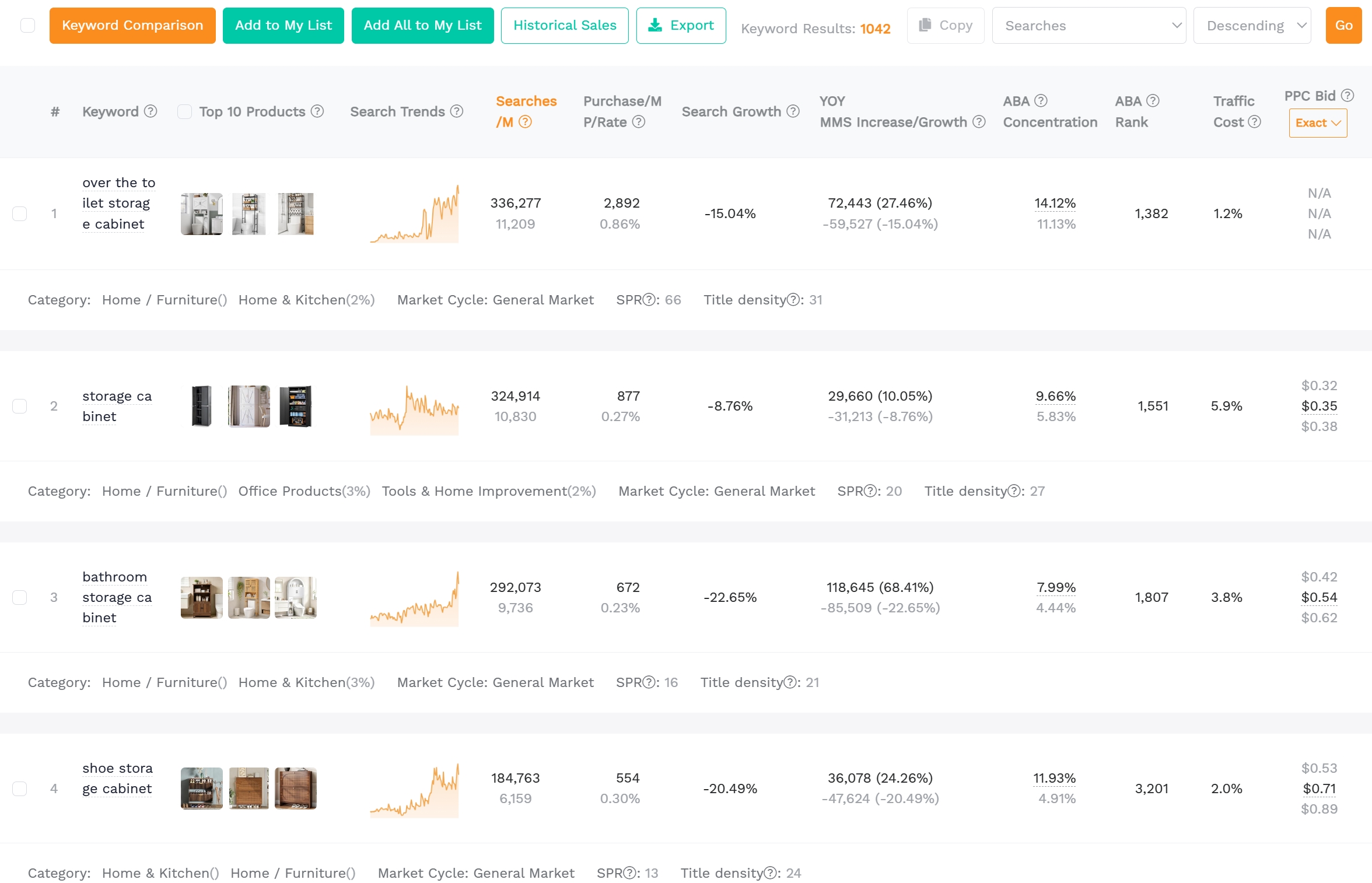
Once the audience problem is clear, check how shoppers describe it on Amazon. This connects a content idea to an existing buying decision without assuming that social interest and marketplace demand are identical.
For the organizer example, candidate phrases might concern under-sink storage, pull-out access, narrow cabinets, or drainpipe clearance. These are illustrative research directions, not claims about measured search volume.
Check the market and period behind the keyword
SellerSprite Keyword Research supports marketplace and timeframe selection, with demand and purchase-related indicators for researching candidate terms. The SellerSprite Keyword Research guide explains the available filters and results.
Compare the actual products returned for each term. A popular phrase may describe a different mounting method or product size. Marketplace purchase indicators describe that market context; they are not the expected conversion rate of a creator's followers.
Shortlist products that can support the recommendation
Evaluate five things together: search demand, purchase intent, price and commission fit, review strength, and trend velocity. A fast-growing term is not enough if the product has unresolved fit complaints or is unavailable when the content goes live.
SellerSprite Product Research can help compare product information and historical trends. Use that context to distinguish a sustained category from a short-lived spike, then verify the exact ASIN, variation, current offer, and delivery estimate on Amazon.
Strong reviews are useful evidence, but read the recurring objections as well as the average rating. A creator needs to know who should not choose the item. A storage product that works well in one cabinet can be a poor recommendation for another.
Record the decision, not just the export
A useful product shortlist contains:
Audience problem; relevant search phrases; research period; exact ASIN and variation; verified differentiator; recurring objection; current price and availability; applicable commission arrangement; and the content demonstration needed to justify the recommendation.
SellerSprite belongs on the product-demand side of this process. It should not be treated as a way to obtain an influencer's private follower demographics, personal buyer data, or affiliate earnings.
Build the Demonstration Around a Buying Question
A recommendation earns its place when it helps the viewer decide. For an under-sink organizer, that might mean showing how to measure the cabinet, compare two layouts, or recognize a situation in which neither option fits.
Give the creator accurate product facts and room to explain them naturally. A script overloaded with brand slogans can crowd out the practical information the audience came to see.
THE QUESTION
"Which under-sink organizer will fit around my plumbing and still slide out?"
THE DEMONSTRATION
Show cabinet width, usable height, pipe position, and the space needed to pull the tray forward. Explain the exact configuration being demonstrated.
THE LIMITATION
Identify the cabinet layouts or storage needs for which this product is unsuitable. Avoid "fits every sink" unless that claim can genuinely be supported.
THE NEXT STEP
Send viewers to the correct product or comparison list, with the commercial relationship disclosed and the linked variant checked.
Make the commercial relationship visible
The FTC's influencer disclosure guidance covers paid and gifted relationships. Put the disclosure with the endorsement, not only on a profile page or behind an expanded description. Video disclosures belong in the video; livestream disclosures should recur so later viewers can notice them.
For a paid demonstration that also uses affiliate links, a plain-language example is: "[Brand] paid for this demonstration. I may also earn a commission from qualifying purchases through my links." Adapt the wording to the actual relationship. A gifted product should be described as gifted, not as independently purchased.
Amazon separately requires Associates to identify their participation, including the statement: "As an Amazon Associate I earn from qualifying purchases." Its public guidance calls for appropriate disclosures near links as well as the account- or site-level identification.
A sponsored demonstration is not a purchased customer review. Do not make payment, a free product, or a refund conditional on posting or changing an Amazon customer review. Amazon's operating agreement expressly addresses compensated review activity.

Choose the Reporting Route Before Sharing Links
A creator and a brand can look at the same collaboration and report different numbers without either report being wrong. Their reports may cover different products, earning arrangements, interactions, and attribution windows.
Agree on the reporting source before publication. Do not wait until a creator posts to discover that the campaign has no usable way to distinguish its traffic.
Creator reporting: links, items, and commission
Amazon Associates reporting includes clicks, ordered items, shipped items, and earnings information. Tracking IDs let creators separate appropriate channels or merchandising strategies within their account. Define a manageable labeling scheme and use Amazon's supported link tools.
Keep externally referred activity separate from onsite content earnings. Amazon's onsite program tracks earnings under a distinct Store ID; those shoppers may have encountered the creator's content while already on Amazon.
For standard Associates links, the shopping session generally runs up to 24 hours, with earlier-ending conditions. Qualifying items added to a cart during that session may follow different completion timing. It is inaccurate to describe this as an unconditional 24-hour window for every later purchase.
Brand reporting: measured shopping activity
Eligible sellers and vendors can use Amazon Attribution to measure supported non-Amazon marketing that leads to their product pages or Store. Its public measurement guide describes a 14-day, last-touch model and metrics such as detail-page views, add-to-carts, and sales.
That measurement window is not the creator's standard commission session. Plan the permitted linking setup together; do not overwrite an affiliate tag or assume independently generated tracking parameters can simply be combined.
Where a collaboration uses Creator Connections or another supported arrangement, identify the specific campaign's compensation and reporting rules. Amazon describes several creator earning models, including bonus commissions and paid content arrangements; they should not be collapsed into one universal "influencer commission."
Keep the units and revenue scope visible
Audience performance: Report views or reach for the relevant content, with the platform's definition and any paid amplification noted.
Shopping performance: Separate clicks, orders, ordered items, shipped items, and returns. Items are not necessarily unique buyers.
Creator earnings: Review commission after applicable adjustments, separating sponsorship fees and bonuses.
Brand results: Separate the featured ASIN from other products and calculate contribution after the collaboration costs the brand actually pays.
Amazon commissions can include qualifying products other than the one linked. Ask which products generated the reported earnings before treating a creator's total affiliate sales as sales of your brand.
Do not add affiliate sales and Amazon Attribution sales together as if they were separate orders. Likewise, attributed sales are not proof of incremental sales: some customers may have purchased without the content.
One Campaign, Two Different Earnings Calculations
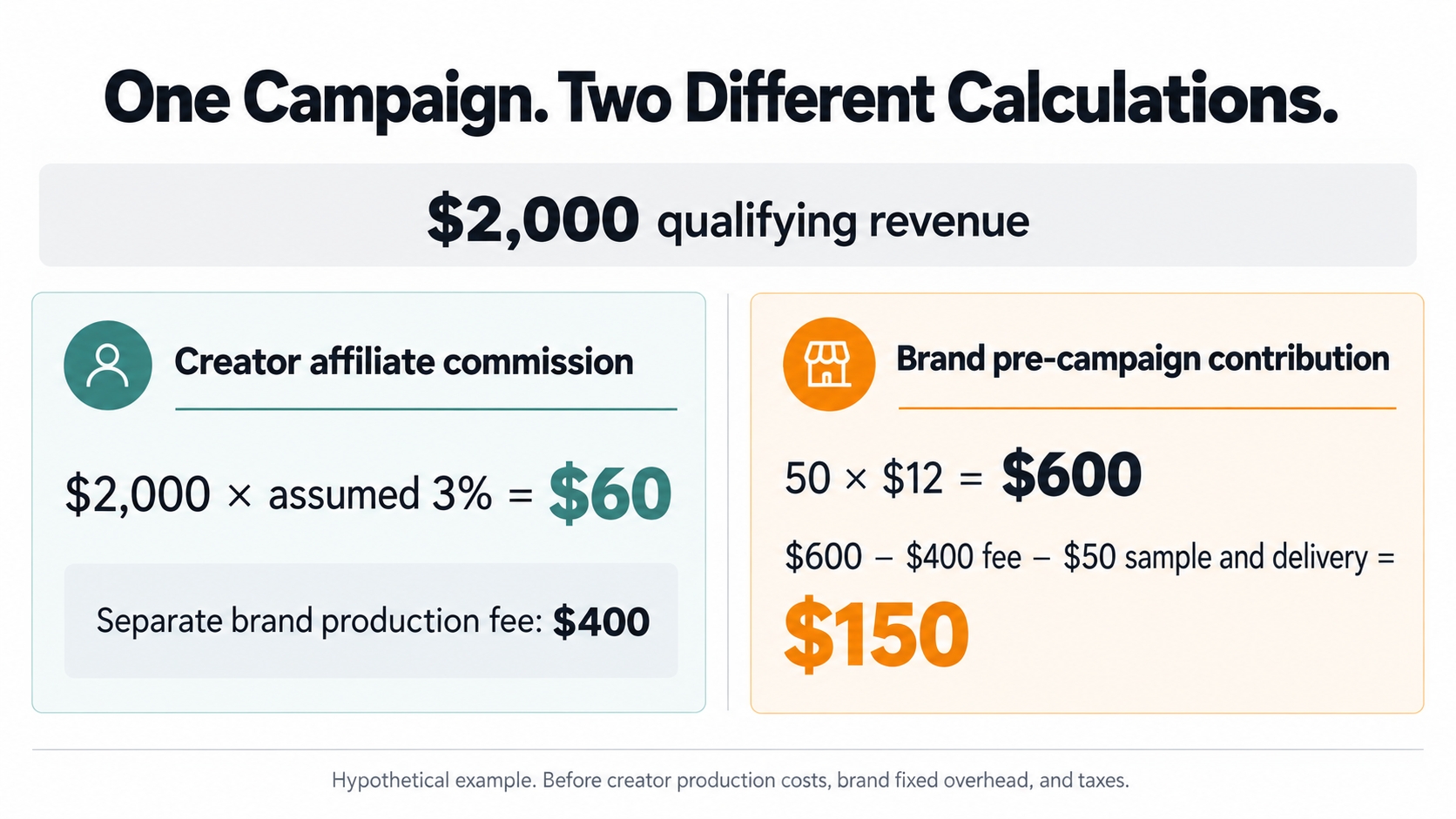
Consider a hypothetical paid product demonstration that generates 1,000 tracked affiliate-link clicks. After the relevant reporting period and adjustments, the example contains 50 qualifying, shipped units of the featured product at $40 each.
Assume all 50 units belong to the defined campaign evaluation, there are no returns, and qualifying revenue is $2,000. The assumed standard affiliate commission is 3%. This rate is illustrative, not a quoted rate for home-storage products; actual rates and eligibility follow Amazon's current terms.
The creator's affiliate calculation
50 qualifying units × $40 = $2,000 qualifying revenue.
$2,000 × 3% = $60 affiliate commission.
$60 ÷ 1,000 tracked clicks = $0.06 commission per click.
The brand's contribution calculation
50 units × $12 contribution before collaboration costs = $600.
$400 creator fee + $50 sample and delivery cost = $450 campaign cost.
$600 - $450 = $150 modeled contribution before fixed overhead and income tax.
Name who pays each amount
In this example, the $60 is standard affiliate commission paid under Amazon's program. The $400 is a separate brand-paid production fee. The creator's production expenses and taxes are not included in the $60 calculation.
The brand's assumed $12 per unit already deducts product, fulfillment, selling, and other modeled non-campaign variable costs. There is no brand-funded bonus commission or paid amplification in this example. Do not subtract the Amazon-paid $60 again as an additional brand invoice; add only the costs the brand actually incurs under its arrangement.
Use the result to decide what to test next
The creator can compare the affiliate earnings and fixed fee with the work required. The brand can compare the $150 contribution with its objectives, while recognizing that the attributed units have not been proven incremental.
If the brand also receives licensed content it can reuse, assess that deliverable separately. Do not assign an arbitrary content value simply to make an unprofitable sales test appear profitable. And do not use the 50-unit result as a forecast for the next post without considering product availability, timing, and audience overlap.
Keep the Recommendation Useful After Publication
A recommendation can outlive the product configuration that made it useful. Prices change, a variant sells out, or a listing begins offering a revised model that no longer matches the demonstration.
Treat maintenance as part of the content plan. Check links and offer conditions before publication, after major promotions, and on a recurring schedule appropriate to the category.
Recheck the exact recommendation
Review the ASIN and variation, relevant dimensions, included parts, current offer, delivery availability, and recent customer concerns. If the original product disappears, do not silently substitute a materially different item beneath an unchanged demonstration.
Label a genuine alternative as an alternative and explain what differs. Review fixed price claims and promotional wording when conditions change, following the applicable Amazon content and linking requirements.
Keep a research date and a live-offer check
SellerSprite documents different update schedules for different datasets. A report generated today can contain monthly search data from an earlier period. Save both the research period and the date you checked the live product offer.
A simple recommendation register can contain the content URL, platform, creator, ASIN, linked variation, measurement identifier, disclosure, last check, and next review owner. This makes it easier to find outdated recommendations before the audience encounters them.
Run a Small Test You Can Explain
Once the audience fit, product, and measurement route are credible, another month of profile comparisons may add less value than a tightly scoped test. Choose one buying question, a small product shortlist, a defined content format, and an affordable commitment.
Agree on deliverables, fees, samples, usage rights, reporting access, and review dates before production. Keep product availability and price under observation, and record other marketing activity that could affect the result.
EXPAND
The content answers a real buying question, the reporting is usable, the commercial result supports more work, and the product can serve additional demand.
REVISE
The audience engages, but the product fit, demonstration, destination, or offer needs a specific correction. Change one meaningful element before repeating the test.
STOP
The recommendation is poorly matched, claims cannot be supported, measurement remains unusable, or the economics cannot justify another round.
Followers help explain where a recommendation might travel. Audience questions explain what it should contain. Product research and observed shopping results determine whether the recommendation deserves to continue.
FAQs
What does Amazon Influencer and Follower Insights mean?
In this guide, it means combining audience relevance, content performance, Amazon product demand, and commercial reporting to improve creator recommendations. It is an analytical approach, not the name of one official dashboard or a method for accessing private follower information.
How many followers do you need for the Amazon Influencer Program?
Amazon's public application page considers follower numbers and engagement metrics without stating one universal numerical minimum. Do not treat a third-party follower threshold as guaranteed eligibility. Meeting an entry requirement would not, by itself, establish likely earnings.
Can a brand see an influencer's Amazon sales and follower demographics?
A public profile is not access to the creator's private analytics. Request appropriately shared aggregate evidence and use the brand reporting available for the chosen campaign. Keep creator reports and brand measurements labeled separately.
Does a larger following mean a better Amazon partnership?
Not necessarily. Compare relevant reach, audience geography where available, buying questions, demonstrated product fit, and the cost of the collaboration. A larger account may suit awareness goals while being less suitable for a specific product-sales test.
What is the difference between onsite and offsite influencer earnings?
Offsite referrals involve traffic the creator sends to Amazon. Onsite earnings can come from eligible content Amazon displays to people already shopping there. Amazon tracks onsite earnings separately, so they should not be used as a direct measure of social-follower conversion.
Why do affiliate and Amazon Attribution reports show different results?
They use different purposes and rules. Standard affiliate commissions follow qualifying-session requirements, while Amazon Attribution documents a 14-day last-touch model. Product coverage and reporting timing can also differ. Reconcile the definitions rather than assuming the reports should match.
Which metrics should creators and brands prioritize?
Creators should examine relevant content reach, tracked clicks, qualifying item activity, and earnings after adjustments and production costs. Brands should examine the appropriate product-level sales evidence and contribution after collaboration costs. Both need the same clarity about dates, scope, and denominators.
Do gifted products and affiliate links need disclosure?
Material brand relationships should be disclosed with the endorsement. Amazon also requires appropriate affiliate-link disclosure and Associate identification. A profile statement alone does not replace the disclosure needed where the recommendation appears.
How can SellerSprite help with influencer and follower research?
SellerSprite helps validate the product side: relevant Amazon search demand, product comparisons, and historical market context. Use creator-authorized reports for audience and affiliate performance. Marketplace research does not reveal private follower demographics or verify a creator's earnings.
References
- Amazon: Influencer Program Overview and Application FAQs View
- Amazon: How the Influencer Program Works View
- Amazon Associates: Earning Onsite Commissions View
- Amazon Associates: How to Use Reports View
- Amazon Associates: Using Tracking IDs View
- SellerSprite: Amazon Keyword Research New User Guide View
- SellerSprite: Product Research Quick Tips View
- SellerSprite: Data Update Frequency View
- Amazon Ads: Complete Guide to Amazon Attribution View
- Amazon Associates: Program Policies and Commission Income Statement View
- Amazon Associates: Identifying Yourself and Disclosing Affiliate Links View
- FTC: Disclosures 101 for Social Media Influencers View
- Amazon Associates: Operating Agreement View
- Amazon Associates: Shopping-Session and Cart Timing View
By SellerSprite Content Team
The SellerSprite Content Team brings together marketplace research, keyword analysis, and e-commerce editorial expertise. Our research follows the connection between shopper questions, product selection, and the evidence used to evaluate Amazon growth activity. This social-commerce guide examines audience relevance, affiliate measurement, customer expectations, and product availability, with particular attention to the difference between public marketplace signals and account-level performance.
Last reviewed: October 26, 2026