TL;DR: Amazon freebies and product testing can refer to very different arrangements. Amazon Vine provides products to invited reviewers through an Amazon-run program. A brand can also seek private usability feedback or arrange clearly disclosed creator content, but those activities are not permission to buy Amazon customer reviews. Before accepting or sending a sample, establish who provides it, what the recipient must do, and whether anything depends on a public review. For sellers, the useful outcome is better evidence about product fit, instructions, and customer expectations, not simply more people claiming a free item.
Key Takeaways
- Identify the arrangement first. An Amazon-managed review program, an independent brand study, and a gifted creator post have different purposes.
- Calling a review honest does not remove the incentive. A product or refund tied to an Amazon review is not made acceptable by neutral wording.
- Make the offer understandable before participation. Explain the item, costs, tasks, timing, and keep-or-return terms.
- A sample can reveal friction without proving demand. Separate test completion, observed problems, and purchases at the intended selling price.
Table of Contents
- Amazon Freebies and Product Testing: Four Different Arrangements
- What Vine Does, and What It Does Not Promise
- An Honest Review Can Still Be an Incentivized Review
- Read the Offer Before Accepting the Sample
- Turn a Customer Question into a Test
- What a 20-Sample Pouch Test Can Tell You
- Free Demand Is Not Full-Price Demand
- Know What You Will Do with the Answer
- FAQs
- References
Scope: US shoppers and Amazon sellers of ordinary physical consumer products. The private-testing examples are independently recruited brand research, not Amazon programs. Book review copies and regulated product testing involve separate considerations. Consumer trials do not replace required safety or compliance testing. This is practical editorial guidance, not individualized legal or tax advice.
Amazon Freebies and Product Testing: Four Different Arrangements
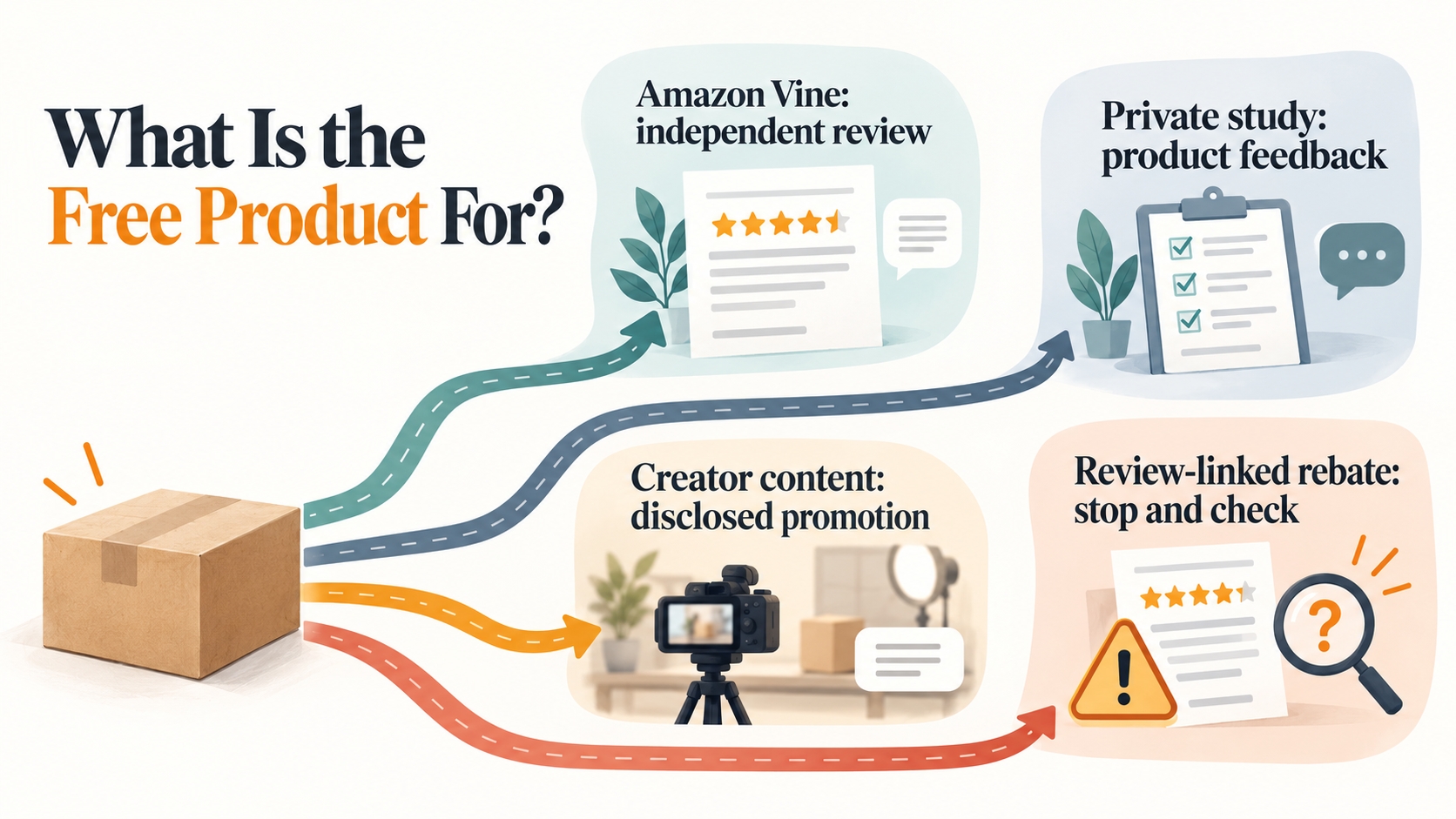
An electronics pouch arrives at no charge. Its recipient might be a Vine reviewer, someone helping a brand check its instructions, or a creator preparing a sponsored demonstration. The parcel looks similar in each case; the relationship is not.
The phrase Amazon Freebies and Product Testing does not identify one official program. Ask what the free product is meant to obtain: independent public feedback, private research, promotional content, or a review-linked transaction.
| Arrangement | What the recipient does | What a seller should understand |
|---|---|---|
| Amazon Vine | Tries an enrolled product and provides independent feedback through Amazon. | Amazon administers the reviewer relationship. It is not a seller-run review club. |
| Private brand research | Completes defined usage tasks and gives feedback directly to the research team. | Design it to investigate the product, with no public-review reward or requirement. |
| Gifted creator content | Publishes a demonstration or endorsement under a separate brand arrangement. | Disclose the material connection and keep claims truthful. This is distinct from a customer star rating. |
| Review-linked rebate | Buys a product, posts an Amazon review, and waits for the promised refund. | Do not treat this as ordinary product testing. The review is part of the exchange. |
A coupon or ordinary promotional discount is a different question from a review reward. The important boundary is whether a benefit, refund, or future opportunity is linked to posting or changing a review. Separately, a free item can still carry conditions that matter to the recipient.
What Vine Does, and What It Does Not Promise
Vine is the relevant Amazon-run program to understand here. Amazon invites reviewers called Vine Voices; sellers do not select them or control their opinions. A Vine review may be critical, and sellers are not permitted to contact Voices directly.
For shoppers: an invitation is not a job offer
A third party cannot substitute its own signup form for an Amazon invitation. Do not buy a promised route into Vine or assume that frequent reviewing guarantees acceptance. Verify any invitation through Amazon rather than a stranger's link.
Amazon also notes that Vine recipients have income-tax responsibilities for products they receive. No purchase price does not mean no possible tax consequence.
For sellers: check eligibility before allocating stock
Amazon's public Vine program overview lists a Professional selling account, eligible FBA offers, and an appropriate role for an enrolled brand or eligible generic products. Product requirements include fewer than 30 reviews, an image, and a description. Check the current product-specific requirements before enrollment.
Budget for the units and fulfillment as well as any enrollment charge. A zero enrollment-fee option is not a zero-cost launch. Treat the product as customer-ready: Vine is not a private session in which you can rewrite unfavorable findings before publication.
Choose the outcome first: Use an appropriate public-review program when you are ready for independent public assessment. Use a separately designed private study when the question is still whether people can understand, fit, or use the product. Do not quietly turn the second activity into the first.
An Honest Review Can Still Be an Incentivized Review
Consider this fictional invitation: "Buy the pouch, publish an honest Amazon review, and we will refund your order." There is no demand for five stars, but the refund still depends on a review.
For ordinary consumer products, Amazon's published position prohibits incentivized reviews outside its authorized Vine framework. The company announced that distinction in 2016, replacing its former disclosure-based exception. Adding "honest" or disclosing the sample does not recreate that old exception.
Keep private research independent of Amazon review activity
For an independently recruited brand study, request task-based feedback for the research team. Do not require an Amazon purchase, a review link, a profile screenshot, or proof that a review went live to unlock a product or payment. Do not direct only satisfied participants to Amazon while keeping critical feedback private.
These are study-design boundaries, not a blanket approval for every sampling campaign. Calling a review optional does not resolve an arrangement that is otherwise built to obtain incentivized reviews. Keep ordinary Amazon order communications separate from the external research recruitment process.
Creator disclosure and Amazon review permission are different questions
The FTC's Consumer Reviews and Testimonials Rule prohibits incentives conditioned expressly or implicitly on particular review sentiment. It does not ban every incentive in every setting. Platform rules can be stricter, so an activity that is not prohibited by that specific rule may still be disallowed on Amazon.
For a gifted social demonstration, disclose the brand relationship with the endorsement itself. For example, "[Brand] sent me this pouch free for this demonstration" explains a product-only arrangement; a cash sponsorship or affiliate relationship needs its own accurate disclosure. Video disclosures belong in the video, not only in a hidden description.
Disclosure is not a permission slip. It helps an audience understand a commercial relationship. It does not authorize an Amazon review incentive, make a false product claim accurate, or turn a promotional testimonial into an independent customer review.
Read the Offer Before Accepting the Sample
Freebie language can hide the most important details: what arrives, what the recipient owes, and what happens afterward. Sellers should resolve those questions before sending stock; participants should resolve them before providing payment or personal information.
The FTC's guidance on using the word "free" calls for material conditions to be clear at the outset. Do not leave shipping charges, required purchases, recurring payments, or keep-or-return conditions until after a person commits.
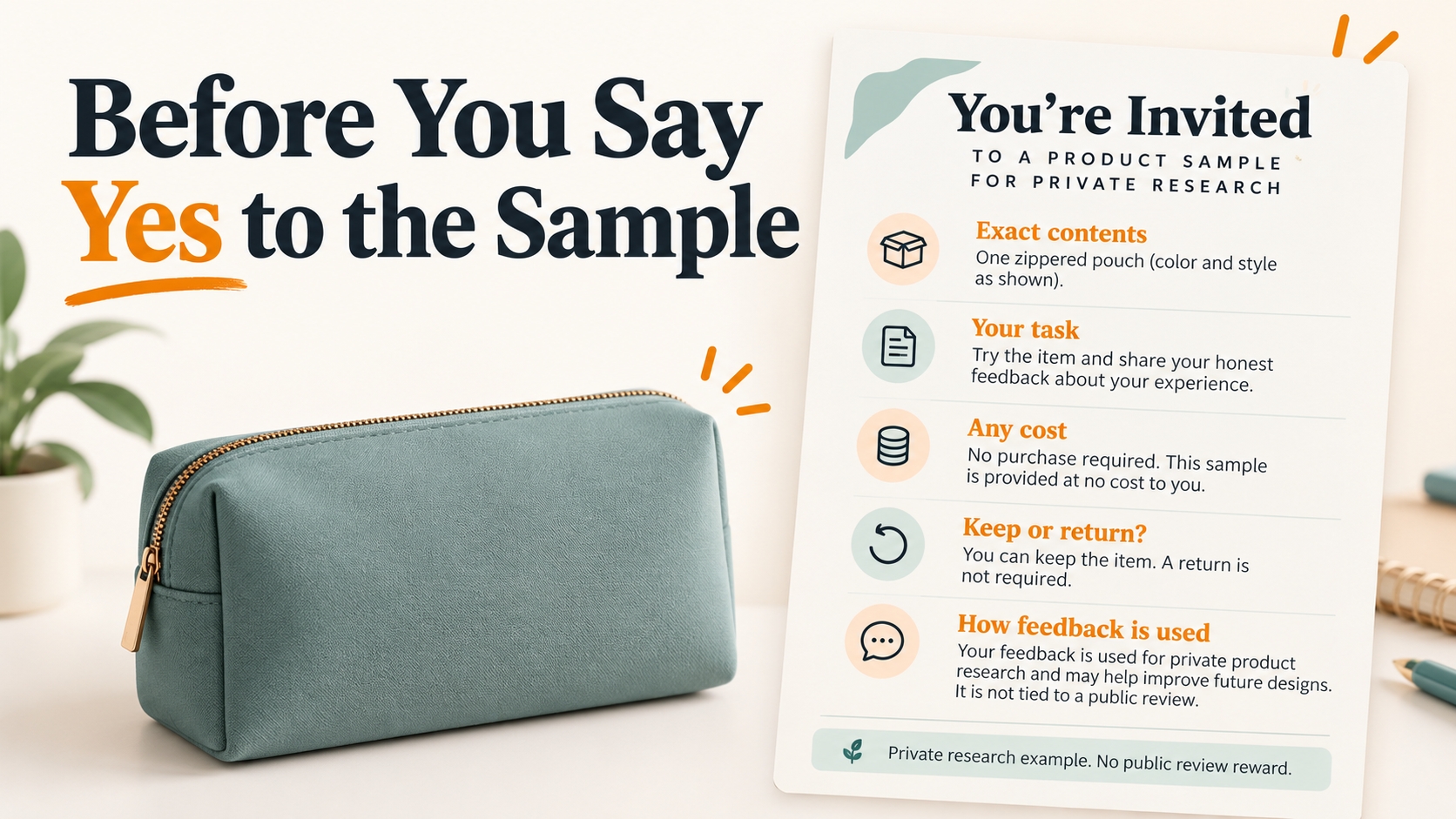
A useful independent-study invitation
Illustrative brand research brief, not an Amazon offer
What arrives: One electronics pouch in the stated size, with a list of included accessories.
Who it is for: Adults who regularly carry chargers and cables.
The task: Try a defined packing routine over one week and complete a private feedback form.
Cost and ownership: No product or shipping charge; participants may keep the pouch. No subscription or purchase obligation.
Feedback: Specific positive and negative observations are welcome. No public review or social post is requested or rewarded.
Data: Explain what contact and feedback information is collected, who uses it, and the retention period.
That example is deliberately specific. A sampler with a surprise color should still explain the product type, quantity, relevant size range, exclusions, and any recipient obligations. Mystery packaging should not conceal information someone needs to decide whether the item suits them.
An unsolicited parcel is not proof of a testing invitation
The FTC warns that unexpected parcels can be part of brushing scams: a sender uses delivery information to support fake reviews. A QR code inside may lead to a phishing page. Do not scan an unfamiliar code to claim a prize or provide login details merely because the package resembles a retailer shipment.
Check order history and possible gifts independently. When a parcel remains unexplained, contact the marketplace through its own app or website, review account security, and report suspicious activity. An unknown product's arrival also does not establish that it is safe to use.
Turn a Customer Question into a Test
A useful test starts with a problem the seller could actually fix. "Do you like it?" is too broad to tell you whether the pouch needs a larger compartment, a better zipper, clearer dimensions, or different positioning.
The workflow below is a suggested research method for an independently recruited brand study, not an Amazon program. Start with the buying question, examine comparable products, and decide what you would change after seeing the result.
Use reviews to choose the question, not to choose favorable reviewers
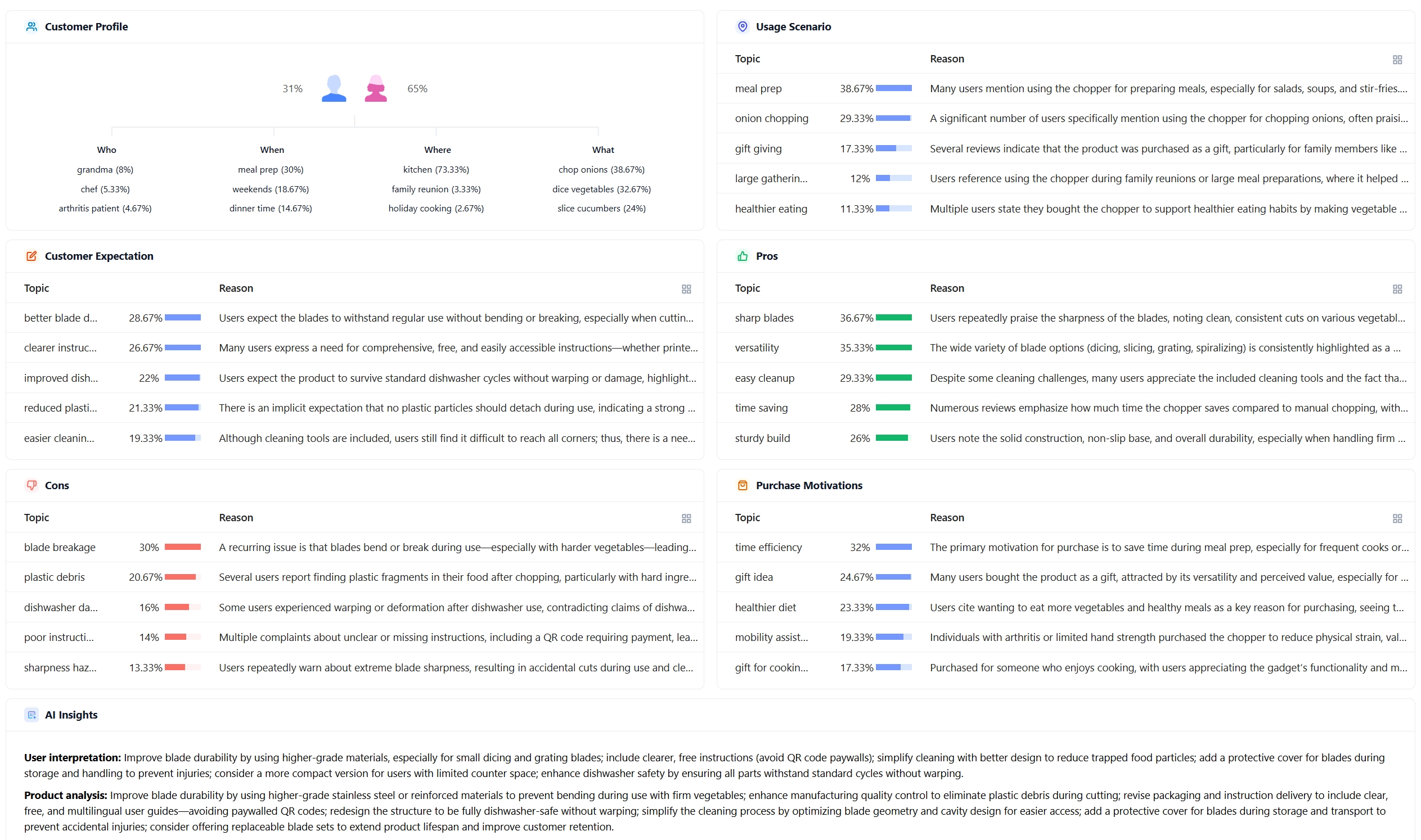
Read comparable products' listings and available customer feedback. Check whether repeated questions concern capacity, included components, setup, delivery expectations, or price. Compare the same kind of product and variation rather than treating a whole category as one customer need.
SellerSprite's AI Review Analysis guide explains how its analysis organizes available review content into usage scenarios, strengths, weaknesses, expectations, and purchasing motivations. Use those themes to prepare a short list of product questions, then verify the original comments and sample coverage.
This feature analyzes available reviews; it is not a tester-recruitment service or a substitute for direct observation. A frequently mentioned complaint is a reason to investigate, not a measured defect rate for all units sold.
Specify the task and the observation
- Capacity: Ask participants to pack the devices and cables they normally carry. Record the item dimensions and what does not fit.
- Usability: Observe how they open, pack, and close the pouch without extra coaching. Note where instructions are needed.
- Expectation: Show the proposed product images first, then ask which parts of the delivered item differed from what they expected.
- Follow-up: Record the version tested, usage period, unresolved questions, and the person responsible for checking each issue.
Recruit for relevant use, not enthusiasm for freebies. Someone who already carries bulky chargers can answer a different question from someone who only needs a small cable pocket. Keep genuine disagreement in the findings. This is a diagnostic sample, not automatically a representative consumer survey.
What a 20-Sample Pouch Test Can Tell You
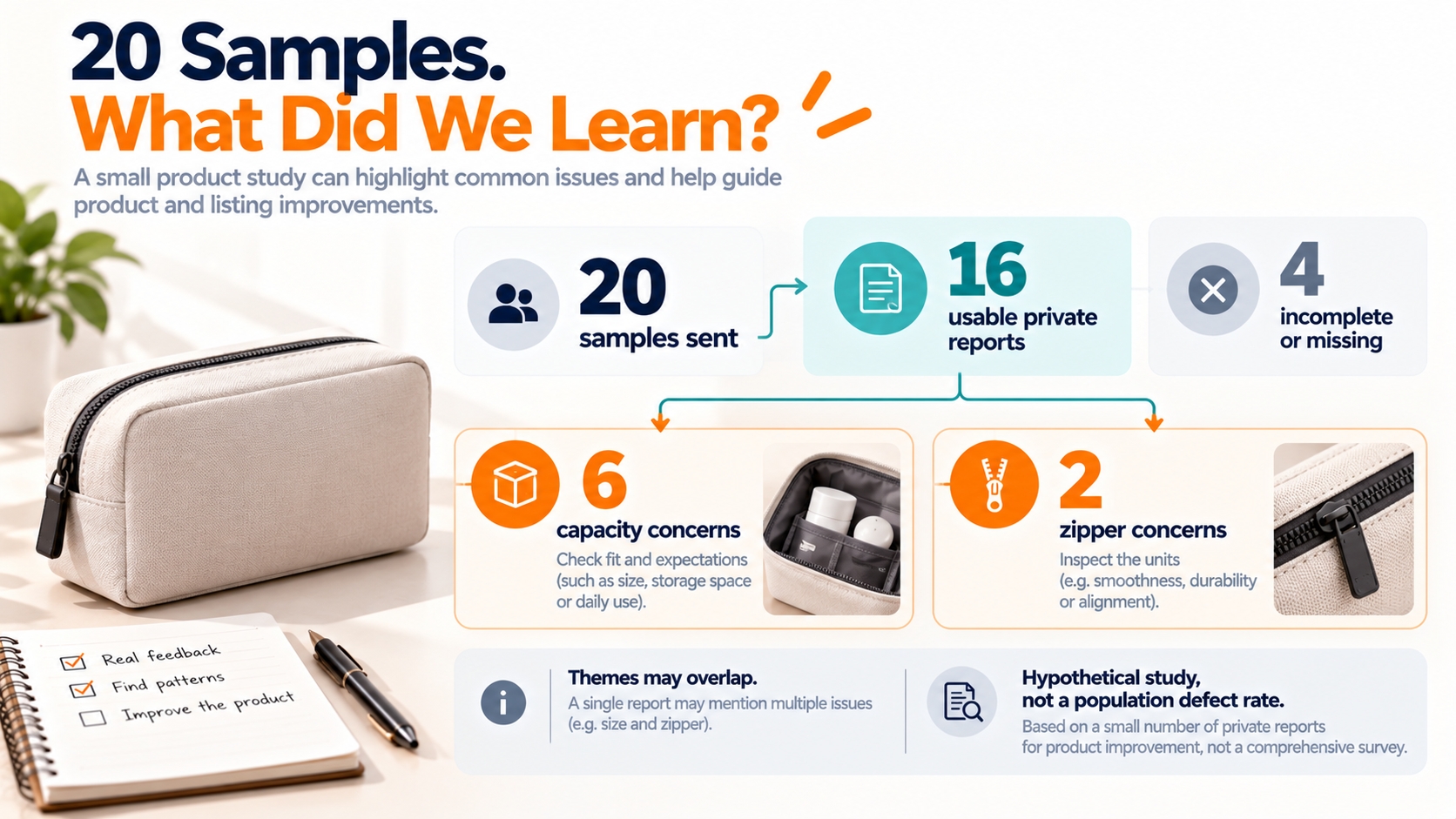
Hypothetical example: A brand sends one electronics pouch to each of 20 independently recruited participants. Sixteen return usable private feedback after the defined tasks. Six of those 16 say their normal charger does not fit comfortably; two describe a snagging zipper. These issue groups may overlap.
The immediate output is a set of questions, not a star rating. Measure the bulky chargers against the pouch's usable space. Inspect the reported zipper problems and compare the tested units. Do not assume that a packaging description can fix a real construction fault.
Name the denominator before reporting a percentage
Six of 16 completed reports is 37.5% of the reporting sample. It does not show that 37.5% of all customers will have the same experience. Four participants did not provide usable reports; their silence should not be counted as satisfaction.
Likewise, two zipper complaints do not by themselves establish a verified defect rate. Preserve the original observations, investigate the units, and record what was confirmed. A short usability study is not durability certification or a product-safety assessment.
Count the cash and the work separately
Illustrative study cost
20 samples × $9 landed unit cost = $180.
20 outbound shipments × $4 = $80.
Direct cash cost: $260.
Four hours of research work × an assumed $30 hourly value = $120.
Total modeled resource cost: $380.
$380 ÷ 16 completed reports = $23.75 per completed report.
The $120 represents allocated internal time, not necessarily an additional payroll payment. The $380 excludes other overhead and taxes. No Vine fee is included because this is not a Vine enrollment. The cost per completed report is a research-efficiency measure, not a cost per review or acquired customer.
Make a change that the evidence supports
Suppose inspection finds no capacity defect: the pouch was simply positioned too broadly. The team can show usable dimensions, photograph a realistic packing example, and state which larger chargers will not fit. A confirmed zipper problem instead goes to the supplier or product team for correction and retesting.
If a participant's comment is later used in marketing, treat that as a separate decision. Obtain appropriate permission, preserve the actual experience, and disclose the sample relationship where material. Do not turn a private research comment into a purported verified-buyer testimonial.
Free Demand Is Not Full-Price Demand
A person can be happy to try a free pouch and unwilling to buy it at $24.99. That is not contradictory. One decision involves accepting a sample; the other involves comparing alternatives and spending money.
Use sampling to learn about experience and expectations. Examine the commercial proposition separately: the intended price, competing products, delivery promise, and the cost of serving a normal customer. Do not translate a large freebie waitlist directly into an inventory order.
Check whether the concern persists outside the giveaway
SellerSprite Product Research provides historical product trends, including sales estimates, BSR, prices, and reviews. Compare relevant products across ordinary and promotional periods to investigate whether interest appears durable rather than driven by a temporary offer. These remain research inputs, not a forecast of your own sales.
After a change, examine ordinary customer orders, questions, returns, and review themes over comparable periods. Record price, advertising, stock availability, and delivery changes at the same time. Without that context, a movement in sales can be mistakenly credited to the sample program.
| Measure | What it can tell you | What it cannot establish alone |
|---|---|---|
| Completed private reports | Whether the study produced usable observations for its cost. | A number of reviews earned or paying customers acquired. |
| Repeated concerns | Which fit, quality, packaging, or instruction questions need investigation. | A population-wide defect rate or the cause of every return. |
| Normal-price purchases and post-sale issues | How the ordinary retail offer performs after the change. | That the sample study alone caused the difference. |
| Reviews and BSR over time | Context about customer experiences and relative sales performance. | A controlled measure of sampling impact or certified product quality. |
Amazon describes BSR as a sales-based ranking within a category, not a measure of product quality. Monitor it as context, not as confirmation that testing worked. A lower rank after a promotion does not answer whether the product will keep selling at its regular price.
The decision to scale: Increase the commitment when the product concern is understood, the revised offer is accurate, and normal-price economics are supported by actual orders. When the evidence is only "people wanted the free version", the commercial question remains open.
Know What You Will Do with the Answer
Before sending a sample, write down the decision the feedback should improve. It might be changing a compartment, rewriting a size explanation, strengthening packaging, or postponing a launch until a fault is understood.
Then choose the right arrangement for that purpose. Keep public review programs, private research, and creator promotion separate. Make the terms visible, welcome inconvenient findings, and measure what happened without claiming more than the evidence supports. A smaller test that changes a product decision can be more useful than a large giveaway that produces only enthusiasm.
FAQs
How do I become an Amazon product tester?
For Vine, Amazon selects and invites reviewers; a seller or third-party group cannot grant membership. Verify invitations directly with Amazon. An independent brand study is a different arrangement and should identify its organizer, tasks, costs, and terms.
Are Amazon Vine products completely free?
Recipients do not pay a product purchase price, but Amazon notes income-tax responsibilities. Sellers also incur product and fulfillment costs and may pay enrollment charges. Do not equate a free item or zero enrollment fee with no economic cost.
Can a brand send a free product in exchange for an honest Amazon review?
Not simply by calling the review honest or adding a disclosure. For ordinary consumer products, Amazon prohibits incentivized reviews outside its authorized Vine framework. A review-contingent refund or free item remains an incentive.
Is private product testing the same as buying reviews?
A study focused on private, task-based feedback is different from commissioning public reviews. Keep products and compensation independent of Amazon review activity, avoid satisfaction-based review routing, and assess the actual arrangement rather than relying on the label "testing".
Does a gifted social media post need a disclosure?
When a brand gives a creator a product and the creator endorses it, the material connection should be clear to the audience. Put the disclosure with the content, and explain any paid or affiliate relationship accurately. This does not authorize an incentivized Amazon customer review.
Does a package I did not order mean I was selected for testing?
No. Check whether it is a legitimate gift or order before assuming an invitation. Unsolicited parcels can be linked to brushing or phishing. Avoid unfamiliar QR codes and use the marketplace's own support route to report suspicious activity.
Can a free-sample test predict Amazon sales?
Not on its own. Sample acceptance and private feedback can reveal experience and fit issues, but they do not demonstrate willingness to pay. Assess normal-price orders, conversion, costs, and post-sale issues separately while recording other business changes.
How can SellerSprite help with product testing?
Use AI Review Analysis to identify questions in existing customer feedback, and Product Research to examine the broader market context. Neither substitutes for observing trial participants or validates a physical defect. SellerSprite is not presented here as a sample-distribution or tester-recruitment service.
References
- Amazon: Vine Program, Eligibility, Costs, and Reviewer Information View
- Amazon: How Amazon Maintains a Trusted Review Experience View
- FTC: Consumer Reviews and Testimonials Rule, Questions and Answers View
- FTC: Disclosures 101 for Social Media Influencers View
- FTC: Guide Concerning Use of the Word Free and Similar Representations View
- FTC: Unexpected Packages and Brushing Scams, August 2026 View
- SellerSprite: Review Analysis Guide View
- SellerSprite: Product Research Quick Tips View
- FTC: Endorsement Guides, What People Are Asking View
- Amazon: Actions Against Fake Review Brokers, 2025 Updates View
By SellerSprite Content Team
Marketplace research, customer-feedback analysis, and e-commerce education are the core disciplines of the SellerSprite Content Team. We study how shopper questions, product positioning, and post-purchase experiences influence Amazon selling decisions. Our work emphasizes clear distinctions between marketplace estimates, customer observations, and verified product evidence, alongside research into the platform rules that govern seller communication and customer trust.
Last reviewed: October 26, 2026