TL;DR: AI competitor analysis is not about letting a model decide what to sell — it is about compressing hundreds of Amazon reviews, Q&A threads, and listing pages into a short, verified pros-and-cons brief you can act on the same day. This guide gives you the exact 7-step workflow, copy-ready prompts, and benchmark scorecard US sellers use to do it without sacrificing accuracy.
Key Takeaways
- AI's real contribution to competitor research is compression: it reads every review and returns structured patterns, themes, and quotes — you still make the call.
- A pros-and-cons summary is only as good as its inputs. Feed it date-stamped, ASIN-level review exports and listing copy, never a single screenshot or a half-remembered complaint.
- The reliable workflow has seven steps: define the decision, build a three-tier competitor set, collect four input types, prompt for a fixed schema, verify against source reviews, score the benchmark, then act and re-check.
- Treat every AI output as a draft hypothesis. If you cannot find a quoted review in the source export, the theme is unverified — and unverified themes should never change a listing.
- Tools that combine review analysis, keyword data, and reverse-ASIN lookups (like SellerSprite) remove the manual export work so your team spends its time on verification and strategy instead of copy-paste.
Table of Contents
- What AI Competitor Analysis Really Means for Amazon Sellers
- Why Pros & Cons Summaries Beat Raw Data Dumps
- The 7-Step Workflow: Using AI to Summarize Competitor Pros & Cons
- Copy-Ready AI Prompts for Competitor Pros & Cons
- Turning Summaries Into a Benchmark Scorecard
- Choosing an AI Competitor Analysis Tool for the US Market
- Accuracy, Compliance, and the Limits of AI Summaries
- Six Mistakes That Ruin AI Competitor Analysis
- FAQ
- Next Steps
- References
Note on marketplaces: This guide is specifically optimized for the US market.
What AI Competitor Analysis Really Means for Amazon Sellers
Amazon competitor research has always been a reading problem dressed up as a data problem. A single mid-volume ASIN can carry hundreds or thousands of customer reviews, dozens of Q&A threads, three generations of listing copy, and a price history that moves every week. Multiply that by five competitors and most sellers give up long before they run out of questions — they settle for a glance at star ratings and a gut feeling about what the other brand is doing right.
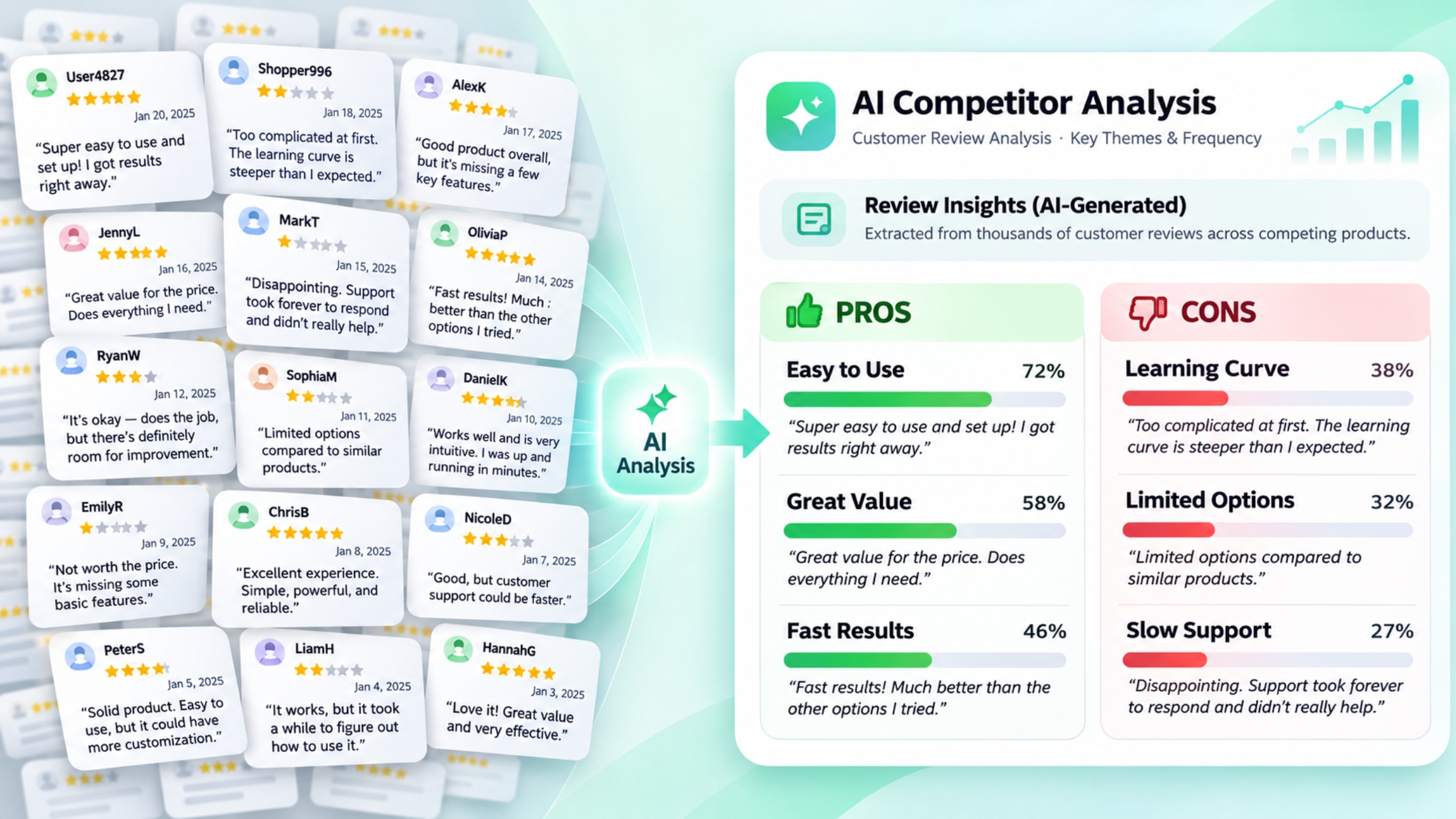
AI changes the economics of that reading. A well-configured AI competitor analysis workflow does not tell you what to sell or what to charge. It takes the unstructured evidence you already have access to — reviews, Q&A, listing copy, offer details — and compresses it into a structured brief of strengths and weaknesses that you can verify, compare, and act on. That is the whole job. Everything else is marketing.
The Three Jobs AI Does Well
- Extraction. Models are genuinely good at finding every mention of fit, size, durability, assembly time, battery life, odor, packaging damage, or support responsiveness inside a large review export — including complaints buried in a three-star review that a human skim would skip right past.
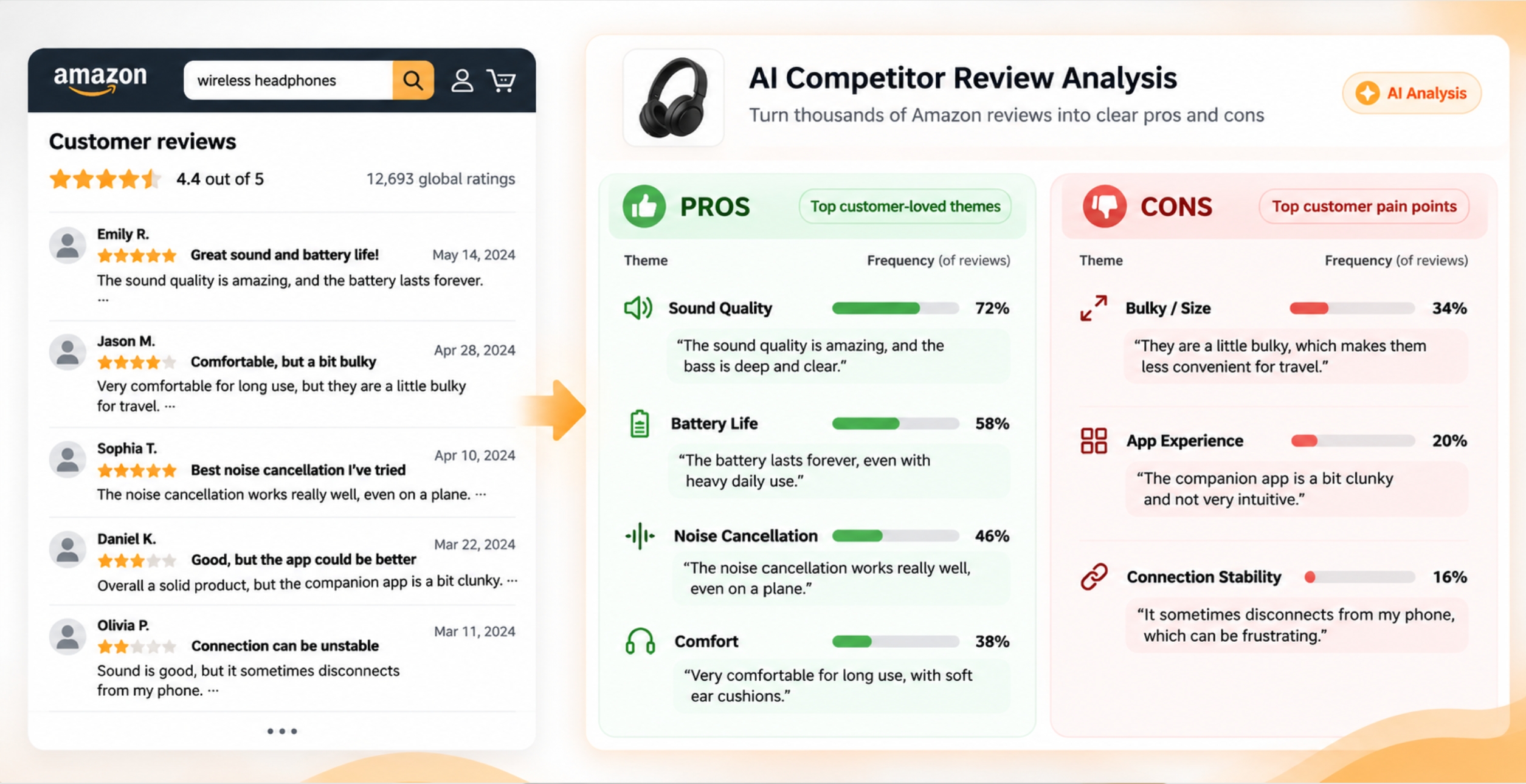
- Summarization. They cluster those mentions into themes, rank them by frequency and emotional intensity, and return a pros list and a cons list with representative quotes attached to each theme.
- Comparison. Run the same schema across three to seven ASINs and the outputs become comparable. Now you can diff competitor A against competitor B and against your own listing, instead of reading five unrelated spreadsheets and trying to hold it all in your head.
What AI Still Cannot Do
- Decide for you. Every pros-and-cons brief still needs a business judgment about margins, cash position, brand positioning, and whether you can actually deliver on a claim.
- Judge review authenticity. Models take reviews at face value. If a competitor has a suspicious cluster of five-star reviews written in the same week, the AI will summarize it as a strength. Review manipulation detection remains a human and platform-policy job.
- Know your economics. An AI does not know your landed cost, your break-even ACoS, or whether a 12% price cut is survivable. It can tell you that price is a recurring complaint; it cannot tell you whether you can afford to fix it.
- Handle version and seasonality drift. Reviews written about a 2023 model may not describe the version in the buy box today. A summary that blends five years of reviews into one theme list is confidently describing a product that no longer exists.
- Guarantee factual accuracy. Generated summaries can invent quotes, merge themes, or attribute one competitor's complaint to another. Every output needs a verification pass before it influences a listing, a price, or an inventory decision.
The practical rule is simple: AI compresses evidence, you supply judgment. Keep that division of labor and the workflow below will save you hours every month. Reverse it, and you will rewrite a listing around a complaint that never existed — which is a very expensive way to learn this lesson.
Why Pros & Cons Summaries Beat Raw Data Dumps
A spreadsheet with two thousand review rows is technically rich and practically useless. Nobody on your team reads it, nobody remembers it two weeks later, and nobody can make a decision from it. The pros-and-cons format works because it matches how Amazon shoppers actually decide: they scan a listing for reasons to buy, then scan reviews for reasons not to.
A good AI-generated pros and cons summary is therefore not a book report. It is a decision artifact — short enough to read in two minutes, structured enough to compare across ASINs, and sourced enough that you can defend every claim in a team meeting.
The Pros of AI-Driven Pros and Cons Summaries
- Speed to first insight. Work that used to take an afternoon of skimming now produces a usable draft in minutes, which means you analyze more competitors and revisit them more often.
- A consistent schema. Every competitor gets the same fields in the same order, so comparison is apples-to-apples instead of five analysts describing five products in five different ways.
- Scale across a competitor set. Going from three ASINs to seven is a copy-paste, not a hiring decision.
- Secondary objections surface. Humans anchor on the loudest complaint. Models surface the mid-frequency issues — packaging damage, unclear instructions, missing accessories — that quietly cost conversion.
- Reusable customer language. Verbatim quotes feed bullet points, A+ modules, image callouts, and ad angles, all in the customer's own words.
- Language coverage. US listings attract reviews in English and Spanish, and models handle both without you hiring a translator.
The Cons You Have to Plan Around
- Hallucination risk. A model asked for quotes will sometimes produce a plausible-sounding one that does not exist. This is the single most expensive failure mode in AI summarization for market research.
- Sampling bias. Reviewers are not a representative sample of buyers. Angry customers and delighted customers write; the satisfied middle is silent, and the AI inherits that skew.
- Over-aggregation. A single theme like "quality issues" can hide three unrelated defects that need three different fixes.
- Stale snapshots. A summary built on a data pull from six months ago can describe a listing that has since been rewritten and a product that has since been revised.
- Compliance and platform rules. How you collect review data, and what you do with the text afterward, both carry risk. Scrapers and public chatbots are not automatically compliant.
- False confidence. Clean formatting makes weak evidence look strong. A tidy table with three themes feels more authoritative than a messy truth with nine.
None of these are reasons to skip AI. They are reasons to build verification into the process — which is exactly what Steps 4, 5, and 6 below are designed to do.
The 7-Step Workflow: Using AI to Summarize Competitor Pros & Cons
This is the workflow we recommend to US sellers running competitor analysis on Amazon for a single sub-category. Budget about 90 minutes for the first full pass, then 20 to 30 minutes for each monthly refresh once the prompts and scorecard are saved.
Step 1 Define the decision before you open a tool
Vague briefs produce vague summaries. Write one sentence that names the decision, the deadline, and the output format you expect. Real examples from seller workflows:
- "Decide by Friday whether to launch a 2-pack variant, based on how often competitors get complaints about running out mid-month."
- "Rewrite three bullet points to pre-empt the most common 1-3 star objection in this sub-category."
- "Decide whether our $34 price is defensible against two $26 rivals, based on which features reviewers actually say they pay for."
Step 2 Build a three-tier competitor set of three to seven ASINs
Ten competitors produce a summary nobody reads. Three to seven, organized in tiers, produce a comparison you can act on:
- Tier 1 direct substitutes (2-3 ASINs). Same product format, same price band, same job to be done. These set your pros-and-cons baseline.
- Tier 2 adjacent alternatives (1-2 ASINs). Different format, same job. These reveal what a customer would buy instead of you, which is often a positioning goldmine.
- Tier 3 the category benchmark (1 ASIN). The listing everyone in the niche points to. You are not trying to beat it on every attribute — you are looking for the single axis where it is weak.
Practical rule: if two ASINs sit in price bands more than roughly 2x apart, their pros and cons stop being comparable. A $12 product and a $60 product can share a category and share almost no customer expectations.
Step 3 Collect four input types and date-stamp everything
- Voice of customer. Reviews separated into 1-3 star and 4-5 star groups, Q&A threads, and return reasons if you have them. Separating by star rating is the difference between a complaint list and a real insight.
- Positioning. Title, bullets, A+ modules, brand story, main image, and any comparison charts in the listing.
- Offer. Price, coupon, subscribe-and-save discount, pack size, shipping promise, and warranty terms.
- Visibility. Top organic keywords, BSR trend, and review count velocity. This tells you which competitors are actually winning traffic, not just ranking for their own brand name.
Export or screenshot each input with a date attached. Six weeks later, when you re-run the analysis, that date is the only thing that tells you whether a change in the summary is a real shift in customer sentiment or just noise from a shuffled sample.
Step 4 Prompt for structure, not prose
The single biggest quality upgrade in AI summarization for market research is refusing essays. Ask for a fixed schema and the output becomes checkable. Ask for "insights" and you get adjectives with a confident tone.
- Theme name (maximum eight words)
- Approximate share of the sampled reviews that mention it
- One verbatim quote with its star rating or review ID
- Which customer segment is most likely to raise it: first-time buyers, heavy users, or gift buyers
- The "so what" implication for a competing listing or product
- A short unknowns section describing what the data cannot tell you
Cap it at five themes per side. A 20-theme list is a data dump wearing a costume, and it will put your team right back where it started.
Step 5 Verify the output against source reviews
This step is non-negotiable and it is where most teams quietly skip. Run this checklist for every competitor:
- Spot-check 10 to 20 reviews per competitor, including at least five three-star reviews — they carry the most nuance and the most usable language.
- Search your export for the exact quote the AI returned. If you cannot find it, mark the theme unverified and do not act on it.
- Check recency: were the top themes driven by reviews from the last 12 months, or from a product generation ago?
- Check variant mixing: reviews attached to a different size, color, or bundle can poison a clean summary.
- Record the sample size the AI actually used, not the sample size you assumed it used.
If more than one theme per competitor fails verification, the problem is almost always the prompt or the input, not the model. Tighten both and re-run before you change anything on your listing.
Step 6 Score the benchmark
Turn the verified pros and cons into a scorecard so the comparison survives contact with your team and your next planning meeting. Section 5 below gives you the full template, scoring rules, and how to read the result without fooling yourself.
Step 7 Convert insight into action and schedule a re-check
- Competitor cons become your claim opportunities — but only if your product genuinely solves them. A claim you cannot support is a returns problem with a marketing budget.
- Competitor pros become your parity requirements. If a competitor wins on a hygiene factor like clear instructions, match it or explain the trade-off.
- Objections become copy assets: bullet points, A+ content modules, image callouts, and ad angles.
- Re-run the analysis every 30 to 60 days, after any listing change, and before any major inventory commitment. Competitive pros and cons are a moving target, not a one-time audit.
Mini Case Study: Turning a Vague Complaint Into a Listing Fix
The following is an illustrative example built from a typical seller workflow, not a specific brand. A seller of kitchen scales ran the seven steps against three Tier 1 competitors. The AI summary flagged "hard to switch measurement units" as a top-three complaint for two of the three ASINs and as a mid-frequency theme for the third. The seller verified it by reading 15 three-star reviews across the set and found six explicit mentions plus two Q&A questions asking the same thing.
The actions were small: a callout on the main image, one rewritten bullet, an A+ comparison module showing the unit-switching step, and an added FAQ entry. Forty-five days later the seller re-ran the same prompts. The theme still ranked for two competitors but had dropped out of the top three for their own ASIN. That is a hypothesis worth testing further, not a guaranteed result — outcomes vary by category, traffic mix, and seasonality, so treat any before-and-after as an experiment rather than proof.
Copy-Ready AI Prompts for Competitor Pros & Cons
Prompts are reusable assets. Save them, version them, and keep the schema identical across competitors so the outputs stack into a single comparison. The five below cover the workflow end to end. Replace the bracketed fields with your own data.
Prompt 1 Core pros and cons extraction
"You are a competitive research analyst for a US Amazon seller. Input: [paste the review export for ASIN X, including star ratings and dates] and [paste the listing title and bullets]. Return two sections, PROS and CONS. For each theme (maximum five per section), give: theme name (max eight words), approximate share of sampled reviews, one verbatim quote with its star rating, the customer segment most likely to say it, and the implication for a competing listing. Then list three unknowns — things this data cannot tell us. Rules: never invent quotes. If the evidence is thin, write 'low confidence'. Do not include a theme supported by fewer than three separate reviews."
Prompt 2 Segment differences
"Using the same review set, split reviewers into three segments: first-time buyers, repeat or heavy users, and gift buyers (infer from review language and context). For each segment, list the top two praise themes and the top two complaint themes. Then highlight any theme where segments disagree — those are the positioning opportunities. Do not merge segments to make the output shorter."
Prompt 3 Claim-versus-reality gap check
"Here is competitor X's listing copy: [paste]. Here is their verified review summary: [paste]. Identify (a) claims in the listing that reviewers confirm, (b) claims reviewers contradict or never mention, and (c) strengths reviewers praise that the listing never mentions. Output three lists and attach the supporting quote to every point. If there is no supporting quote, move the item to a fourth list called 'unverified'."
Prompt 4 Objection to bullet point
"Take the top three verified complaints in this category: [paste]. For each one, write a single Amazon bullet point under 200 characters that pre-empts the objection without disparaging any competitor, using only claims our product can support: [paste product facts]. Flag any bullet that would require a claim we cannot substantiate, and suggest a safer alternative."
Prompt 5 Monthly diff and monitoring
"You have two summaries for the same ASIN, dated [date 1] and [date 2]. Compare them and return: themes that grew, themes that faded, completely new themes, and a one-line recommendation on whether our listing needs a change this month. Mark any difference that is likely caused by a small sample rather than a real shift."
Three habits keep these prompts reliable over time: keep the schema identical across competitors, paste raw data rather than your own summary of it, and always ask the model to state confidence. Following those three rules alone eliminates most of the rework.
Turning Summaries Into a Benchmark Scorecard
A pros-and-cons summary is an input. A scorecard is the output your team can argue about productively, because it forces everyone onto the same scale and the same attributes.
Score each attribute from 1 to 5 based on the verified summary, not on impressions. Add your own ASIN as the final column. The scores below are illustrative for a fictional sub-category — replace them with your own verified ratings.
| Attribute | Competitor A (Tier 1) | Competitor B (Tier 1) | Competitor C (Tier 2) | Benchmark (Tier 3) | Your ASIN |
|---|---|---|---|---|---|
| Ease of first use | 3 | 4 | 3 | 5 | ? |
| Build quality / durability | 4 | 2 | 3 | 4 | ? |
| Value for price | 5 | 4 | 4 | 2 | ? |
| Instructions & setup clarity | 2 | 2 | 3 | 4 | ? |
| Condition on arrival / packaging | 3 | 3 | 5 | 4 | ? |
| Customer support responsiveness | 4 | 2 | no data | 5 | ? |
| Listing clarity (bullets, images, A+) | 3 | 4 | 3 | 5 | ? |
How to score without fooling yourself
- Weight by mention frequency. An attribute nobody talks about in reviews should not swing the total, however strongly you feel about it.
- Score the attribute, not the marketing. A confident listing claim is not evidence; a pattern of reviews is.
- Use half points only with a citation. If you cannot point to the review that justifies the 3.5, it is a 3.
- Write "no data" instead of guessing 3. A neutral guess silently becomes a false finding three meetings later.
How to read the finished scorecard
- A competitor scoring 5 in a high-weight attribute where you score 2 is a genuine threat. Fix the product or reframe the positioning honestly.
- A competitor scoring 2 in a high-weight attribute is your messaging opportunity — but only if your product actually delivers.
- Rows where everyone scores 4 or 5 are hygiene factors. Do not build your brand positioning there; you will spend money to reach parity.
- Rows where everyone scores low are category-wide pain points, and they are usually the most valuable input for a product improvement or a new variant.
Choosing an AI Competitor Analysis Tool for the US Market
The US market has no shortage of AI competitor analysis tools. The differences that actually matter are not the number of features on the pricing page — they are whether the data behind the summary is real, current, and traceable back to a source.
What to check before you pay
- Data source and coverage. Does it read actual ASIN-level reviews and Q&A, or only listing metadata that tells you nothing about customer experience?
- Refresh cadence. Weekly is workable for most categories; monthly is too slow for fast-moving niches where a competitor can rewrite a listing overnight.
- Traceability. Can you click from a summary theme back to the reviews that support it? If not, verification becomes manual again.
- Keyword and reverse-ASIN depth. Pros and cons tell you what customers feel; keyword data tells you what they search. A serious competitor comparison needs both.
- Export and audit trail. CSV or spreadsheet export with a snapshot date makes the analysis defensible when someone asks why a decision was made.
- Language handling. US listings attract reviews in English and Spanish; make sure nothing quietly gets dropped from the sample.
- Compliance posture. Prefer tools that operate within marketplace terms over scrapers that put your selling account at risk.
Where SellerSprite fits in this workflow
SellerSprite is built for the data-collection half of the workflow: competitor review analysis, reverse ASIN keyword lookups, keyword search volume research, listing and A+ inspection, and ongoing competitor tracking in one place. That means your team spends its time on Steps 4 through 7 — prompting, verifying, scoring, and acting — instead of copying reviews into a spreadsheet by hand.
If you are still assembling the broader AI stack for your Amazon business, start with AI for Amazon FBA: the complete guide and come back here for the competitive-research layer. If you prefer to understand the manual method this workflow automates, read how to run competitor analysis on Amazon. And if Step 2 is where you get stuck, the reverse ASIN strategy guide walks through the keyword-first way to find the right ASINs. For a feature-by-feature look at tooling, see our Amazon competitor analysis tool breakdown.
The fastest way to evaluate any tool is to test it against an ASIN you already understand. You can create a free SellerSprite account and run one competitor through the review and keyword data before you commit to a process around it.
Note for verification: feature sets, data coverage, and plan limits change frequently across all tools in this category. Confirm current capabilities inside the app before you build a team workflow around them.
Accuracy, Compliance, and the Limits of AI Summaries
AI summarization is a draft-generating technology. The trust has to come from the process built around it, not from the model's confident tone.
Keep a human in the loop
Every summary should be signed off by someone who has read at least part of the underlying evidence. That is not bureaucracy. It is the difference between a listing change based on 40 real complaints and a listing change based on a model's guess — and only one of those shows up as improved conversion rather than refunds.
Protect data and respect the rules
Do not paste customer personal information into a general-purpose chatbot. Use tools that aggregate review text rather than exposing individual reviewer identities. On the policy side, Amazon's customer review policies and the FTC's rule on consumer reviews and testimonials both matter if you plan to quote reviews in your listing, use AI to generate review-like content, or reference competitor ratings in your marketing. Verify the current text of both before you publish anything — these rules are updated periodically and the details count.
Build an audit trail
- Date-stamp every input snapshot, including the review window you filtered to.
- Save the prompt version alongside the output so you know what produced a given summary.
- Record which themes were verified and which were not, and by whom.
- Note the model and tool used, since switching models can change the output style and the error rate.
When a teammate asks six months later why a bullet was rewritten, the audit trail answers in ten seconds instead of reopening an argument.
When not to trust the summary
- Fewer than roughly 30 recent reviews on an ASIN — the sample is too small to call a theme.
- A recent product version change that the review pool has not caught up with yet.
- A category with heavy incentivized or manipulated review activity.
- A sudden spike in one theme that appears in no source review you can find.
- Any summary where the quotes cannot be located verbatim in the export.
Six Mistakes That Ruin AI Competitor Analysis
- Asking for opinions instead of evidence. "What do customers think about this product?" returns adjectives. "Which themes appear in at least three reviews, with quotes?" returns data. Fix: always specify the schema and the minimum evidence threshold.
- Mixing variants and time windows. A summary built from five years of reviews across four sizes describes nothing in particular. Fix: filter the export before you prompt.
- Stopping at the summary. A theme without an owner and a deadline is entertainment. Fix: assign each verified theme to a specific action — copy, image, product, or support.
- Treating one loud complaint as a pattern. A single vivid one-star review can dominate a weak prompt. Fix: require a minimum frequency and check the count yourself.
- Letting AI write the listing directly. Generated copy drifts toward claims you cannot support. Fix: use AI to structure evidence, then have a human write and verify every claim.
- Running the analysis once. Competitor pros and cons shift with new reviews, new versions, and new pricing. Fix: schedule a 30 to 60 day refresh and re-run the same prompts so changes are comparable.
FAQ
How does AI summarize the pros and cons of competitors?
The process has four stages. First, extraction: the model reads a structured input — usually a review export with star ratings and dates, plus the competitor's listing copy — and pulls out every mention of a product attribute, benefit, or problem. Second, clustering: those mentions are grouped into themes such as "easy setup," "leaks after a month," or "instructions unclear." Third, ranking: themes are ordered by how many separate reviews support them and how emotional the language is. Fourth, formatting: the model returns a fixed schema of theme name, frequency, a verbatim quote, the customer segment most likely to raise it, and the implication for a competing listing. The output is only as reliable as the input you paste and the schema you insist on, so always verify a sample of quotes against the source reviews before acting.
What are the best AI tools for competitor analysis in the US market?
There is no single best tool, because the workflow has two halves that are usually served by different products. For data collection and marketplace intelligence, you want a platform that covers ASIN-level review analysis, keyword and reverse-ASIN research, listing and A+ inspection, and ongoing competitor tracking — SellerSprite is built around these jobs. For summarization and prompt-driven analysis, a general-purpose AI assistant with a fixed output schema works well, provided you paste verified data and check the quotes. When you evaluate any tool, prioritize data source and coverage, refresh cadence, traceability from summary back to source review, export and audit trail, multilingual handling, and compliance posture over feature count. Feature sets and plan limits change often, so confirm current capabilities in-app before standardizing a team process.
Can AI competitor analysis replace manual competitive research?
No, and treating it as a replacement is the most common way teams get burned. AI removes most of the reading, sorting, and formatting work — which is genuinely the bulk of the hours. What it cannot remove is judgment: deciding which competitor set is comparable, spotting suspicious review patterns, judging whether a complaint reflects your target customer or an edge case, checking quotes against source data, and deciding which trade-offs your product and margin can support. The practical split is that AI handles the evidence collection and compression, while a human owns sampling decisions, verification, and strategy. Teams that keep that division get faster without sacrificing accuracy; teams that skip the human layer get confident summaries that fail in the market.
How accurate are AI-generated competitor pros and cons summaries?
Accuracy depends far more on your inputs and prompt design than on which model you use. With a clean, date-filtered, ASIN-specific review export and a schema that demands verbatim quotes and confidence flags, summaries are typically reliable enough to guide decisions after a verification pass. The common failure modes are fabricated quotes, theme merging across variants, stale data windows, and over-generalization from a small sample. Guard against all four by spot-checking 10 to 20 reviews per competitor, searching the export for each quoted line, confirming the review dates, and marking any theme you cannot source as unverified. If more than one theme per competitor fails verification, fix the prompt and the input before you change anything on your listing.
Is it allowed to use AI to analyze Amazon reviews?
Analyzing aggregated review text for internal competitive research is standard seller practice, but the details matter. Prefer licensed tools that aggregate reviews rather than scraping them at scale yourself, since scraping can create account and terms-of-service risk. Do not paste reviewer names, addresses, or other personal information into a general-purpose chatbot. If you want to quote review language in your listing or advertising, review Amazon's customer review policies and the FTC's rule on consumer reviews and testimonials first, because both restrict how review content and ratings can be used and both are updated periodically. When in doubt, paraphrase insights into your own claims rather than republishing review text, and confirm the current policy language before publishing.
Next Steps
- Write down the one decision this analysis needs to support, and the date you need it by. If you cannot name it in one sentence, stop and clarify before touching a tool.
- Pick three to seven competitor ASINs across the three tiers, export their reviews with dates and star ratings, and save the snapshot in a dated folder.
- Run Prompt 1 on one competitor, verify every quote against the export, then standardize the schema before you scale to the rest of the set.
- Build the benchmark scorecard, assign an owner and a deadline to each verified theme, and put a 30 to 60 day refresh on the calendar.
- Ready to skip the manual export step? Create a free SellerSprite account and run one competitor through the review and keyword data end to end.
References
- SellerSprite — AI for Amazon FBA: The Complete Guide View
- SellerSprite — How to Run Competitor Analysis on Amazon View
- SellerSprite — Reverse ASIN Strategy Guide View
- SellerSprite — Amazon Competitor Analysis Tool Overview View
- U.S. Federal Trade Commission — Rule on the Use of Consumer Reviews and Testimonials (16 CFR Part 465) View
- National Institute of Standards and Technology — AI Risk Management Framework View
- Amazon Seller Central — Customer Product Reviews policies (verify the current version in Seller Central, as policy pages change periodically) View
By SellerSprite Content Expert
Amazon seller tools and marketplace SEO specialist.
Editorial process: AI-assisted draft prepared for human fact-checking, source verification, and brand review before publication.