TL;DR: Amazon search volume is a proxy for consumer demand, but it is not a direct guarantee of sales. Success requires balancing high volume with relevance and conversion performance.
Key Takeaways
- Search volume indicates popularity, but conversion rate (CVR) determines ranking.
- Always distinguish between generic head terms and high-intent long-tail keywords.
- Data accuracy varies by tool; focus on trends rather than exact decimal numbers.
Table of Contents
- What Amazon Search Volume Is (And What It Isn't)
- Where Amazon Search Volume Comes From
- Search Volume Formats: Score, Range, Trends
- Three Levels of Demand: Head, Mid, and Long-Tail
- How Search Volume Relates to Ranking
- Search Volume vs. Keyword Difficulty
- Using Search Volume for Listing SEO
- Using Search Volume for PPC Strategy
- Common Mistakes to Avoid
- Practical Workflow: From Volume to Execution
- FAQ
- References
Note on marketplaces: This guide is specifically optimized for the US market.
What Amazon Search Volume Is (And What It Isn't)
Definition: demand signal for a query, not a guarantee of sales
Search volume represents the market's interest level. While a high volume indicates many people are looking for a product, it doesn't mean they are buying yours. It is a signal of potential traffic, which must then be converted into sales through a high-quality listing and competitive pricing.
Search volume vs. "buyer intent" (informational vs. transactional on Amazon)
On Amazon, most searches are transactional. However, broad terms like "gift for dad" have lower specific buyer intent compared to "blue light blocking glasses for men." The former is informational/browsing, while the latter is highly specific and closer to a purchase decision.
Myth vs. reality: what volume can and cannot predict
- Myth: High volume equals automatic riches. Fact: High volume usually comes with brutal competition.
- Myth: Low volume is useless. Fact: Low volume keywords often have the highest conversion rates and ROI.
Where Amazon Search Volume Comes From (And Why Numbers Differ by Tool)
Understanding the source of your data is critical for making informed decisions. Not all "search volume" numbers are created equal.
Native sources vs. third-party estimates
Amazon provides native data through Search Query Performance (SQP) and Brand Analytics (Search Frequency Rank), while some third-party tools use advanced algorithms to estimate the raw numbers by combining Amazon's rank data with click-through rate models.
Why the same keyword shows different volume across tools
Sampling, normalization, refresh cycles, query grouping, marketplace differences
Different tools use different data refresh cycles (daily vs. monthly) and normalization techniques. Some tools might group plural and singular forms together, while others treat "shoe" and "shoes" as distinct queries with separate volumes.
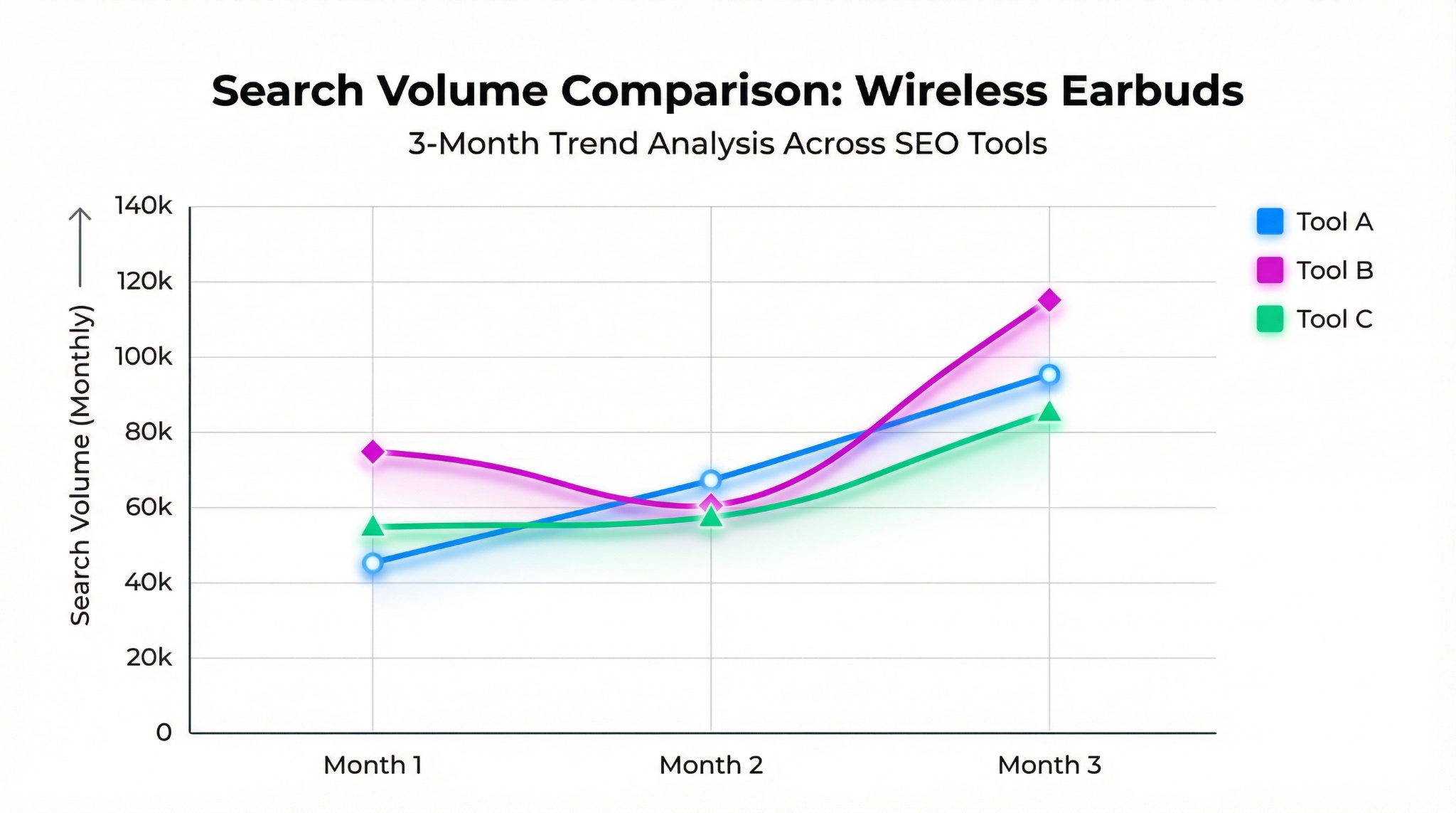
Marketplace and time window effects (US vs. UK; 30 days vs. 12 months)
US search volume is typically much higher than other marketplaces. Additionally, a "30-day" window might capture a holiday spike, whereas a "12-month average" provides a more stable, albeit less reactive, view of true demand.
Search Volume Formats You'll See (Score, Range, Monthly Volume, Trend Line)
"Score" vs. "estimated monthly searches"
Some tools provide a relative "Score" (e.g., 1-100) to show popularity, while others provide a raw number (e.g., 50,000 searches/month). Raw numbers are better for calculating potential sales, while scores are easier for quick comparative analysis.
Trend lines: direction matters more than the exact number
Is the keyword growing or dying? A keyword with 10,000 searches that is growing 20% month-over-month is often a better target than a stagnant keyword with 20,000 searches.
Seasonality: how to spot predictable peaks vs. one-time spikes
A simple seasonality checklist
- Recurring peaks: Does it happen every December (Christmas)?
- Lead time: Does volume start rising 2 months before the peak?
- Amplitude: How drastic is the drop-off after the season ends?
The Three Levels of Demand: Head Terms, Mid-Tail, Long-Tail
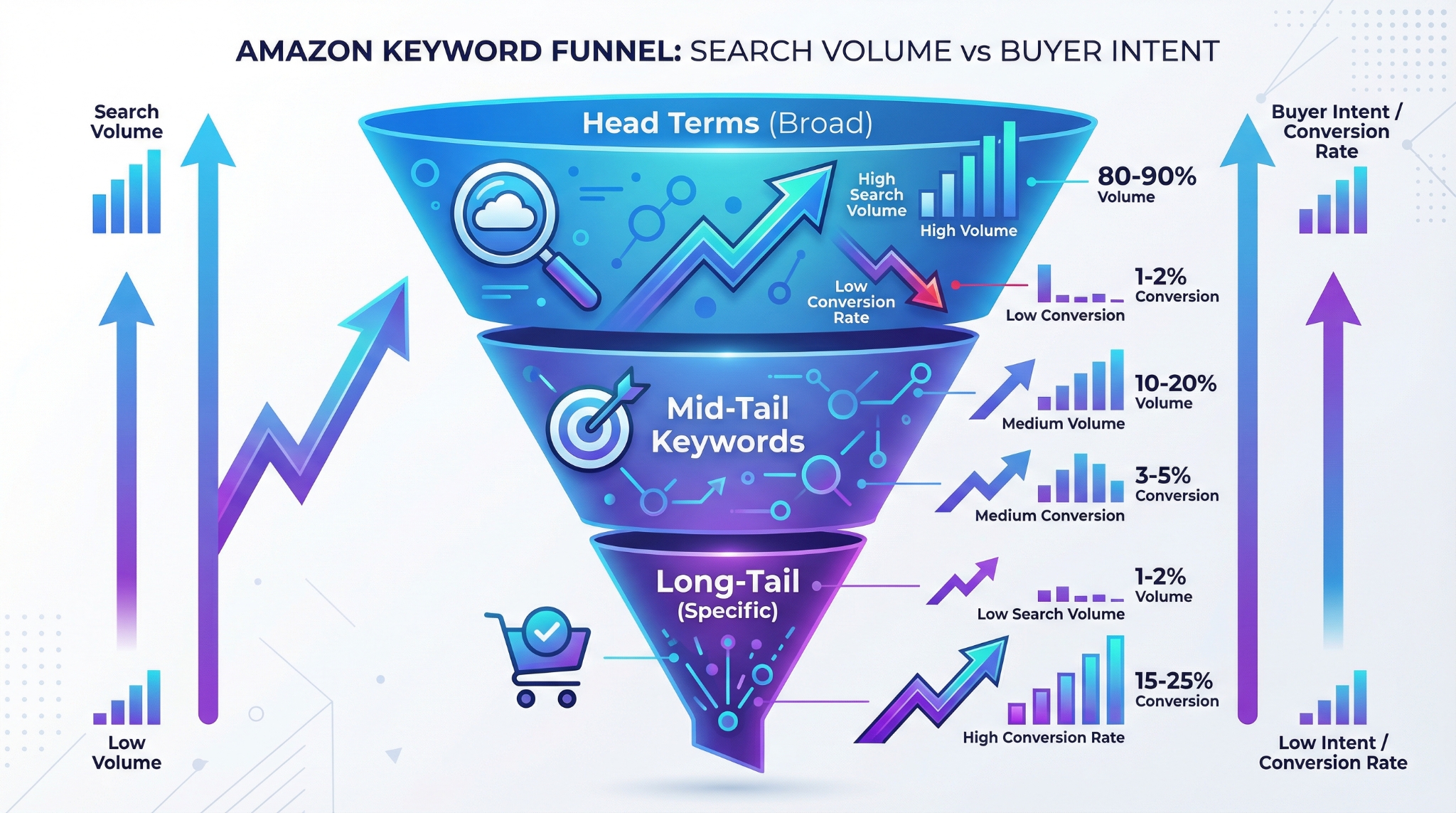
Segmenting keywords by volume helps you allocate your budget and SEO efforts efficiently.
Head terms: huge volume, broad intent, heavy competition
Example: "Supplements." These terms have massive volume but are incredibly expensive to bid on and difficult to rank for organically without a massive budget.
Mid-tail: clearer intent, better conversion potential
Example: "Magnesium supplements." These narrow the field and attract buyers who know what category they want, leading to better conversion rates than head terms.
Long-tail: lower volume, high relevance, often highest profitability
How to "stack" modifiers
Example: "Magnesium glycinate 400mg vegan capsules." By stacking modifiers (type + strength + dietary), you target a specific customer. Use SellerSprite's Keyword Research tool to find these high-conversion nuggets.
How Search Volume Relates to Ranking
Volume doesn't "rank you", performance does
Amazon's A9 algorithm prioritizes products that generate the most revenue for a keyword. If you have 100,000 people searching but none buy your product, your rank will tank regardless of the volume.
Why high-volume keywords are harder: competition + conversion expectations
To rank for a high-volume keyword, you need a high volume of daily sales. This requires massive inventory levels and aggressive PPC spend to maintain the "velocity" required to stay on page one.
The practical takeaway: use volume to choose targets, then win with relevance + conversion
A ranking reality check
Check your Click-Through Rate (CTR) and Conversion Rate (CVR). If these are below the category average, chasing more volume will only waste your ad budget.
Search Volume vs. Keyword Difficulty (Why High Volume Can Be a Trap)
Difficulty drivers: competitor depth, listings quality, review moats
A keyword might have 50,000 searches, but if the top 10 results all have 20,000+ reviews, the "difficulty" is extreme. You must evaluate the "review moat" before entering a high-volume niche.
A simple opportunity framework: Demand × Relevance × Ability-to-win
Scoring model example (1-5 scale)
Rate each keyword: Demand (5), Relevance (5), Ability-to-win (2). Total Score: 12/15. If Ability-to-win is low, consider it a secondary target.
When low-volume keywords beat high-volume keywords (profit-first targeting)
Low-volume terms usually have lower CPCs. If you can dominate ten 500-volume keywords, you often make more profit than failing to crack the top 20 of one 5,000-volume keyword.
How to Use Search Volume for Listing SEO (Keyword Prioritization & Placement)
Build a "Keyword Portfolio" (Core / Support / Experimental)
Organize your list: Core (High volume + high relevance), Support (Long-tail), and Experimental (Emerging trends).
Placement rules: where volume-heavy terms belong
- Title: Place your single most important high-volume term here.
- Bullets: Integrate mid-tail terms that highlight benefits.
- A+ Content: Use semantic terms and variations.
- Backend: Use misspellings and synonyms to capture hidden volume.
Avoid keyword stuffing: prioritize readability and relevance
If your listing looks like a robot wrote it, humans won't buy it. A lower CVR hurts your ranking more than a "missing" keyword helps it.
How to Use Search Volume for PPC (Smarter Bids, Better Discovery)
Volume helps choose the right match type strategy
For high-volume terms, start with Exact match to control spend. For discovery, use Broad match on mid-tail terms to find new long-tail opportunities.
Volume vs. CPC vs. CVR: the profitability triangle
Why high-volume terms often need tighter negatives
Because high-volume terms are broad, they often trigger irrelevant clicks. Rigorous negative keyword management is essential to prevent budget bleed.
Workflow: start with discovery → promote winners → isolate exact scale
Use search volume to identify the "ceiling" of a keyword's potential, then scale your bids as the keyword proves its worth.
Common Mistakes When Interpreting Amazon Search Volume
- Treating volume as guaranteed sales: Volume only measures intent, not your product's appeal.
- Ignoring intent: Branded search volume (e.g., "Nike shoes") is useless if you sell generic sneakers.
- Comparing across marketplaces incorrectly: 5,000 searches in Germany is huge; 5,000 in the US is tiny.
- Ignoring seasonality: Don't launch a "pool float" in October based on July's search volume.
- Offer mismatch: Chasing high volume for a premium product when the search intent is for "cheap" alternatives.
A Practical Workflow: From Search Volume → Keyword List → Execution
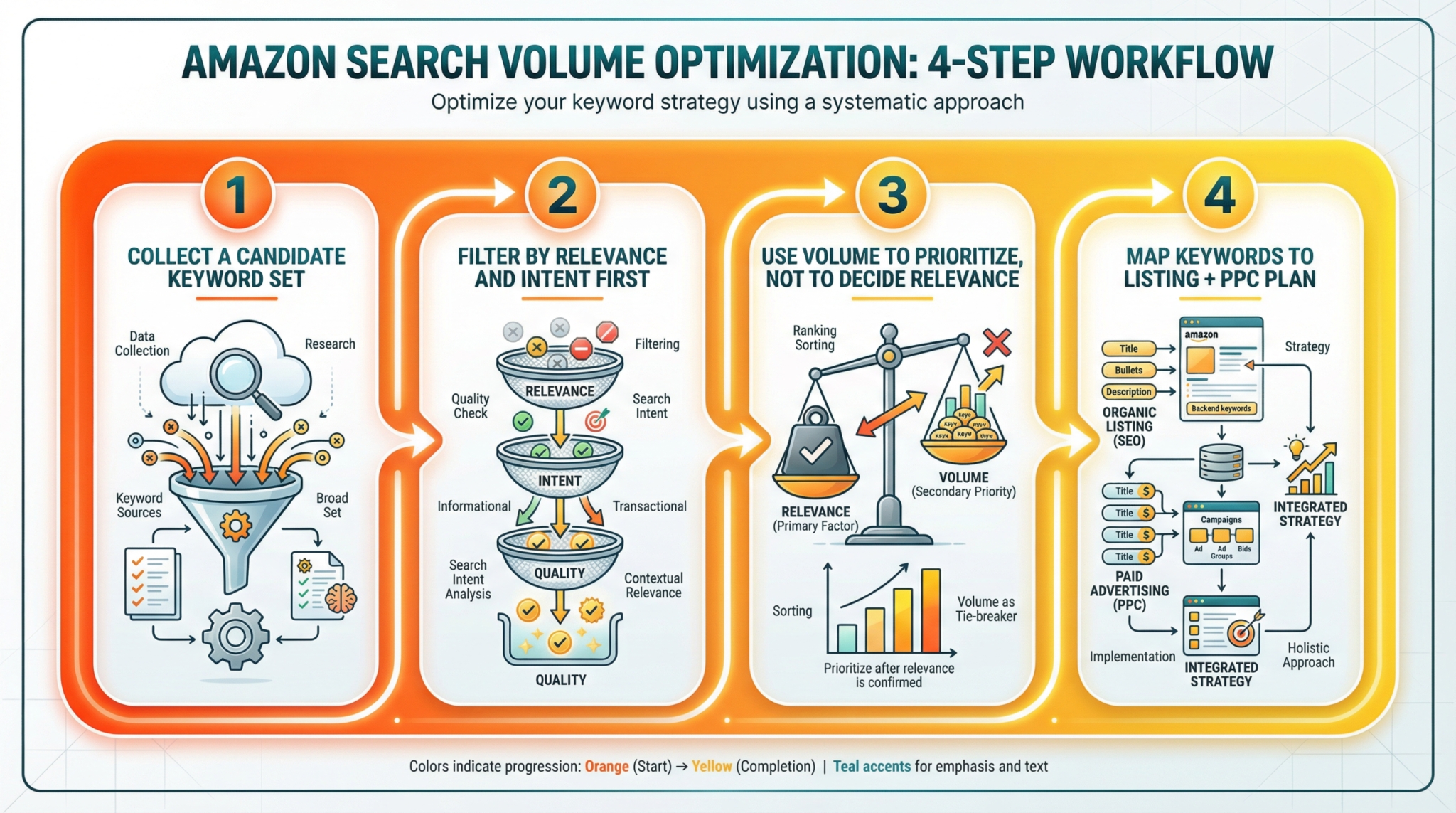
Follow these four steps to turn data into dollars.
Step 1: Collect a candidate keyword set
Use Amazon-native data, competitor listings, and customer reviews to build a list of 50-100 keywords. Refer to the Amazon Keyword Research Guide for deep-dive techniques.
Step 2: Filter by relevance and intent first
Delete any keyword that doesn't accurately describe your product. High volume on an irrelevant term is a liability.
Step 3: Use volume to prioritize, not to decide relevance
Sort your remaining relevant keywords by search volume to decide which ones go in your Title vs. your Backend.
Step 4: Map keywords to listing + PPC plan
- Primary Keyword (Volume > 10k): [Insert Here]
- 5 Support Keywords (Volume 2k-5k): [Insert Here]
- 10 Long-tail Keywords (Volume < 1k): [Insert Here]
FAQ
How can I find the exact search volume for a specific keyword on Amazon?
Amazon does not provide "exact" monthly search volume numbers to the public. However, you can get highly accurate estimates using tools like SellerSprite or by analyzing the Search Query Performance report in Brand Analytics if you are a brand-registered seller.
What is the difference between Amazon Search Frequency Rank and actual search volume?
Search Frequency Rank (SFR) is a relative ranking (e.g., #1 is the most searched keyword). It tells you popularity compared to other terms but doesn't tell you if the volume is 1 million or 100,000. Actual search volume is the estimated count of searches.
Which free tools provide the most accurate Amazon search volume data for Amazon sellers?
While most high-accuracy data is paid, some tools offer limited daily free searches or Chrome extensions. Amazon's own Brand Analytics is the best "free" (included with professional account) source for trend data, though it lacks raw volume counts.
What's a "good" search volume for a keyword on Amazon?
A "good" volume depends on your niche. In a broad category like Electronics, 50,000+ is good. In a niche like "Industrial scientific tools," 1,000 might be excellent. Focus on finding volume that matches your production capacity and profit margins.
Why did my Amazon keyword's search volume drop suddenly?
Sudden drops are usually due to seasonality (e.g., end of Summer), the end of a viral trend (TikTok trends), or a change in how Amazon groups or suggests keywords in the search bar.
Next Steps
- Audit your current listing's top 5 keywords using SellerSprite Reverse ASIN.
- Identify 3 long-tail keywords with low competition to target in your next PPC campaign.
- Sign up for SellerSprite to track real-time search volume trends.
References
By SellerSprite Success Team
The SellerSprite Success Team consists of seasoned Amazon SEO specialists and data analysts dedicated to helping sellers leverage data-driven insights to dominate the Amazon marketplace.