TL;DR: Amazon's US return policy generally allows customers to return most items within 30 days of the estimated delivery date, with category and seasonal exceptions. What happens next depends on whether Amazon or the seller fulfilled the order. For seller-fulfilled returns, Amazon's current process gives sellers four calendar days after receiving a returned item to assess it and process the appropriate refund before an automated refund may be issued. The operational job does not end there: sellers still need to reconcile refund costs, inspect recovered inventory, investigate exceptions, and determine why the customer returned the product.
Key Takeaways
- A return has more than one deadline. The customer's return eligibility, the seller's refund-processing window, and any reimbursement-claim deadline are separate.
- FBA and FBM follow different operational paths. Amazon manages FBA customer returns; seller-fulfilled merchants retain more responsibility for return inspection and refund decisions.
- A refund can happen before the product arrives. Eligible Refund at First Scan transactions and returnless refunds mean payment and physical inventory do not always move together.
- Not every returned unit can be resold. Condition, missing components, handling requirements and inventory disposition determine how much value remains.
- Return reasons are evidence to investigate, not conclusions. The best improvements come from connecting Amazon return records with product inspections, listing content and customer feedback.
Table of Contents
- One Return, Three Different Timelines
- What the Customer Does First
- FBA vs. FBM: Who Actually Handles the Return?
- The Four Calendar Days That Matter for FBM Sellers
- Why Some Refunds Arrive Before the Package
- A Refunded Order Is Not Necessarily Recovered Inventory
- When a Reimbursement Claim Is Appropriate
- What Does One Return Really Cost?
- Read the Return Reason, Then Find the Actual Problem
- The Weekly Return Review That Changes Something
- The Return Is Not Finished at the Refund
- FAQs
- References
Marketplace scope: This guide covers Amazon.com in the United States. It explains the customer-facing return process only where it affects seller operations. Return windows, fees and procedures can differ by category, fulfilment programme, season and marketplace. It is not a substitute for the return instructions displayed on an individual order or the current Amazon Seller Central policy.
One Return, Three Different Timelines
The first mistake in understanding Amazon Return Policy and Procedures is treating every deadline as the same countdown.
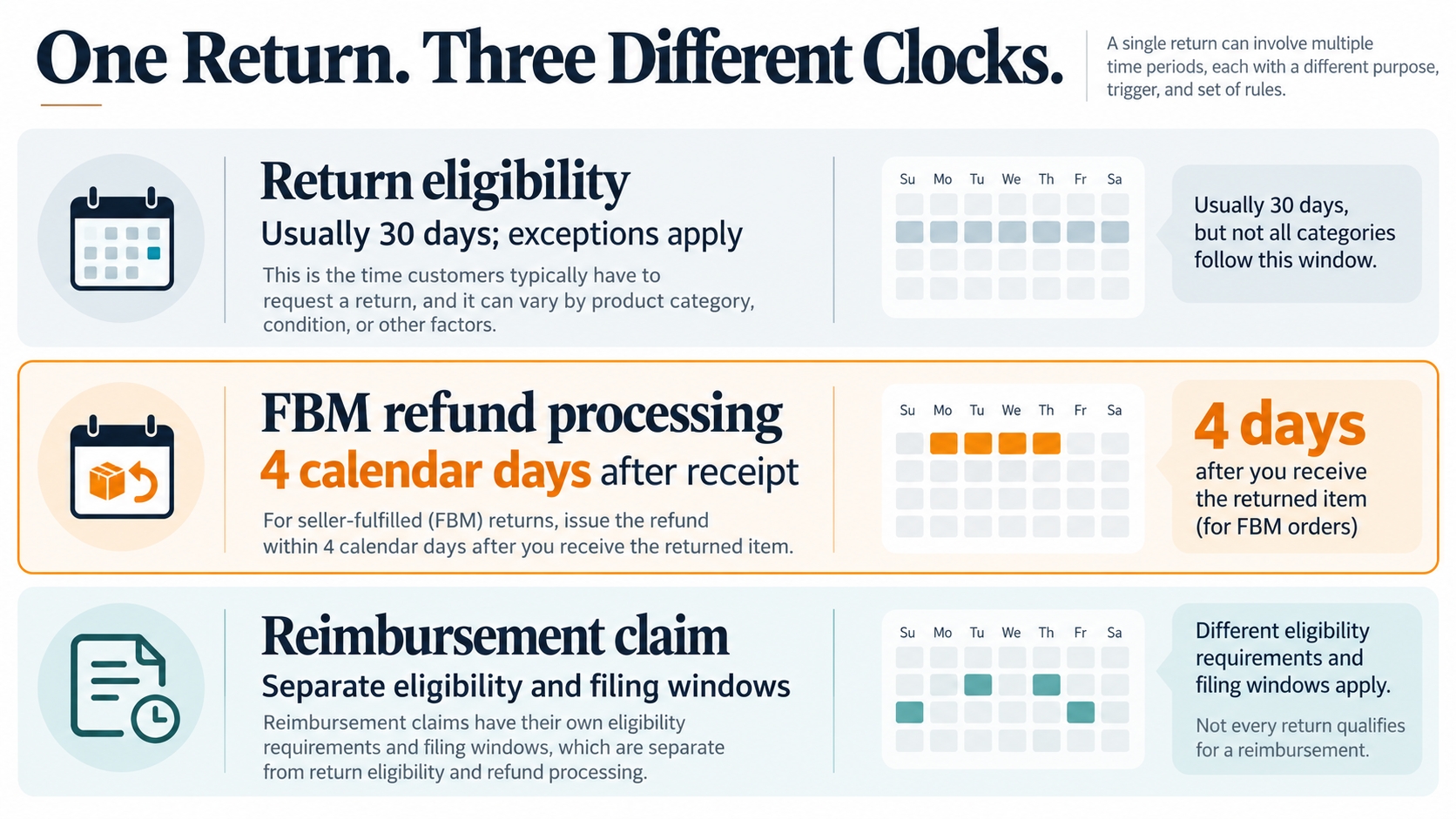
One deadline determines whether a customer can request a return. Another determines how quickly a seller must process a returned item. A third may determine whether Amazon will consider a reimbursement claim.
These events can occur on different dates. A buyer may receive a refund before a returned package arrives, while a seller may discover a damaged return only after the refund has already been issued.
CLOCK 01
Return Eligibility
Most eligible items have a standard return window of about 30 days from the estimated delivery date, subject to specific exceptions.
CLOCK 02
Refund Processing
For seller-fulfilled returns, the current post-receipt assessment and refund-processing window is four calendar days.
CLOCK 03
Reimbursement Eligibility
SAFE-T and FBA reimbursement processes have separate eligibility conditions and filing windows.
The Standard 30-Day Window Is Not Universal
Amazon generally permits most items to be returned within 30 days of the estimated delivery date. However, the applicable window can be shorter or longer depending on the category, item or seasonal policy. Some products are not eligible for ordinary physical returns and may have different refund or support arrangements.
Sellers should check the rules for their own catalogue rather than describing all Amazon products as having an unconditional 30-day return guarantee. A customer return request that falls within Amazon's policy generally cannot be rejected simply because the seller would prefer not to receive the item.
2026 POLICY UPDATE: EXTENDED HOLIDAY RETURNS
Amazon has announced that items purchased on Amazon.com between November 1 and December 31, 2026 may be returned until January 31, 2027, with an earlier January 15, 2027 deadline for Apple-branded products.
The extended window applies to both FBA and FBM orders. Amazon states that it is applied automatically, while existing return and refund conditions remain in effect.
Sellers can review Amazon's official 2026 holiday return announcement when forecasting seasonal returns and inventory recovery.
What the Customer Does First
Before examining the seller's responsibilities, it helps to understand what a return looks like to the customer. The customer-facing process is relatively simple, but the available options depend on the order.
- Find the order. The customer opens Your Orders and selects the applicable Return or Replace Items option when available.
- Choose a reason. Amazon asks why the product is being returned. Depending on the order, the buyer may provide comments or additional details.
- Select an available resolution. The customer may be offered a refund, replacement, return label, QR-code drop-off or another eligible resolution.
- Follow the return instructions. If a physical return is required, the buyer sends or drops off the item using the method provided.
Not every order will display every option. A buyer may have an automatically authorised return, a request that needs manual review, or a resolution that does not require shipping the product back.
Why the Return Reason Matters to Sellers
A customer choosing "not as described" is giving the seller an important signal. It may suggest inaccurate images, the wrong variation, incomplete specifications or a product that genuinely differs from the listing.
However, the selected reason is not a completed investigation. The seller still needs to compare the order record, product details, any available buyer comments and the condition of the returned item.
A single return reason may be vague. A pattern of the same issue across a particular variation or production batch is more useful, especially when supported by inspection records.
FBA vs. FBM: Who Actually Handles the Return?
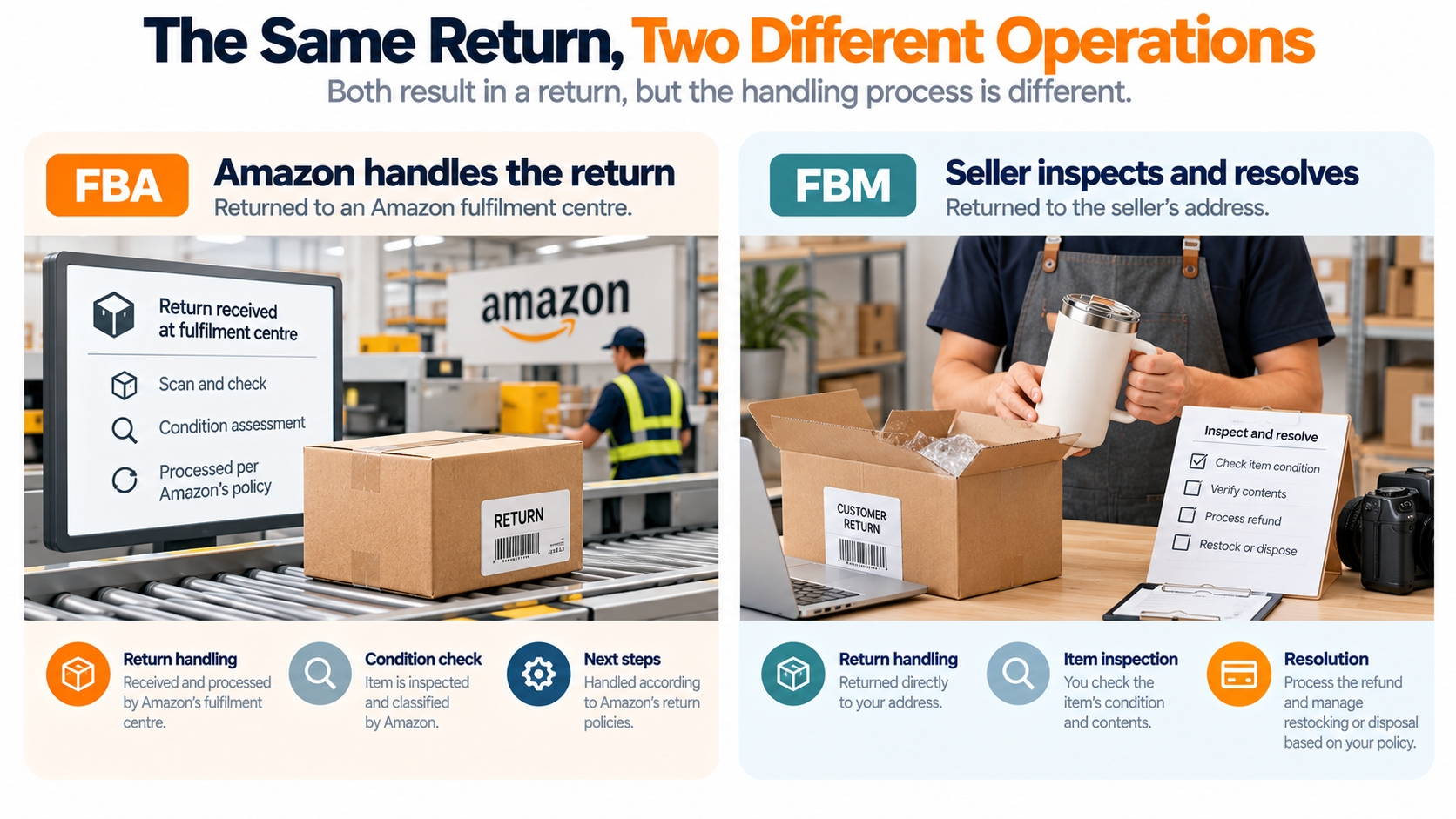
The customer may see a similar returns experience regardless of fulfilment method. Behind the scenes, FBA and Fulfilled by Merchant (FBM) place different responsibilities on the seller.
FBA sellers delegate much of the return handling and related customer service to Amazon. Seller-fulfilled merchants remain responsible for important return-management decisions, including handling exceptional requests and assessing merchandise received back.
| Step | Fulfilment by Amazon | Seller-Fulfilled Orders |
|---|---|---|
| Return authorisation | Generally handled through Amazon's customer-return process. | Most eligible US returns are automatically authorised; certain exceptions require seller review. |
| Return logistics | Amazon manages the applicable return process and fulfilment-network handling. | The seller receives returned merchandise through the relevant label and return-address arrangement. |
| Refund handling | Amazon generally manages customer refunds under the applicable FBA policies. | The seller may process the refund, or Amazon may issue one automatically under qualifying circumstances. |
| Inventory condition | Amazon evaluates returned inventory and records whether it is sellable or unsellable. | The seller or its receiving partner inspects the actual returned unit. |
| Possible reimbursement | Evaluated under applicable FBA reimbursement and inventory policies. | Eligible Amazon-issued refunds may qualify for SAFE-T review under specific conditions. |
Neither fulfilment model eliminates the seller's need to study returns. An FBA seller may have less direct involvement in receiving the parcel, but still needs to examine financial adjustments, unsellable stock and recurring customer complaints.
The Four Calendar Days That Matter for FBM Sellers
One of the most important US return-procedure changes in 2026 concerns what happens after a seller receives a returned item.
Effective January 26, 2026, Amazon extended the FBM refund-processing window from two business days to four calendar days. If a seller does not process the applicable refund within that window, Amazon may issue an automated refund.
This matters because calendar days are not the same as business days. A team that inspects returned products only on selected weekdays can lose its opportunity to assess damage, record evidence and make an appropriate refund decision.
What to Do When the Return Arrives
- Match the parcel to the order. Verify the order ID, return details, tracking and expected item before changing its refund status.
- Record the received condition. Inspect the product, packaging and accessories. Where relevant, document missing or materially different contents with clear photographs.
- Check the applicable refund treatment. Determine whether a full refund, permitted partial refund or another authorised resolution applies under Amazon policy.
- Process the action in Seller Central. Use the relevant return and refund workflow rather than relying only on an internal spreadsheet or support message.
- Close the inventory loop. Decide whether the unit can be returned to sellable stock, requires further evaluation or must be held as unsellable.
In Seller Central, use Orders and the applicable Manage Seller-Fulfilled Returns page to find the request and its available actions. Amazon's seller-fulfilled return management instructions describe the current workflow for authorised requests, exceptional cases and refunds.
Partial Refunds Need an Eligible Reason and Evidence
Sellers cannot automatically deduct a restocking fee whenever a customer returns an item. Amazon's guidelines prohibit such fees for an item returned within the applicable policy window in its original condition.
Depending on the facts, an item returned in a used, damaged or materially different condition may qualify for a partial refund through a permitted restocking-fee deduction. The applicable amount depends on the reason and condition, and the seller must use the correct policy and supporting evidence.
Amazon's Guided Refund Workflow allows sellers to grade returned items and document applicable deductions. When the returned item differs from the original shipment, the workflow may require photographs and condition details. Do not use a generic deduction percentage or treat normal inspection costs as automatic justification for withholding money.
Operational distinction: A documented condition problem can support a policy-permitted refund adjustment. It does not mean every unsellable return qualifies for reimbursement, and it does not justify deducting fees when the customer received an incorrect or defective item through seller error.
Why Some Refunds Arrive Before the Package
A refund transaction does not always confirm that a product has been physically returned. Amazon has several mechanisms that can separate the payment event from the arrival of the merchandise.
Refund at First Scan
For eligible seller-fulfilled returns using Amazon's prepaid return-label programme, Refund at First Scan (RFS) can issue a refund when the customer drops off the package and it receives the qualifying carrier scan.
The product may still be in transit when that refund occurs. The seller should therefore distinguish the financial event from physical receipt and condition assessment, keeping tracking records for any later discrepancy.
Returnless Refunds
A returnless refund allows a customer to receive a refund without sending the product back. Depending on the programme and circumstances, this may result from the seller's returnless-refund settings or an Amazon-issued resolution.
For low-value merchandise, reverse shipping and handling can sometimes cost more than the recoverable inventory. However, the decision should use the relevant Amazon settings and programme rules, not a universal dollar threshold invented by the seller.
Why This Distinction Matters for Reporting
Refunds, return requests and physically received units are different populations. If a seller treats them as identical, a return-rate dashboard may appear inconsistent even when the underlying records are correct.
Keep the return's financial status and inventory status separately. That prevents a refunded order from being mistaken for recovered merchandise, and helps the team identify cases where a package has not arrived or the product is no longer sellable.
A Refunded Order Is Not Necessarily Recovered Inventory
The refund may resolve the customer's financial claim, but the seller still has to determine what happened to the unit. Inventory recovery is a second decision, and it can materially change the final cost of the return.
What Happens to FBA Returns?
Amazon normally evaluates returned FBA inventory to determine whether it is sellable or unsellable. Eligible items evaluated as sellable can be placed back into available inventory. Products assessed as unsellable follow the applicable unfulfillable-inventory process.
Sellers can review return information and inventory disposition through the relevant FBA Customer Returns records. Amazon's FBA Dashboard also provides access to customer-return trends and reasons, helping sellers identify products that may need further attention.
A return marked unsellable is not automatically an Amazon-liability claim. The cause, programme rules and inventory event determine whether reimbursement is available.
What Happens to Seller-Fulfilled Returns?
For FBM orders, the seller or its warehouse partner inspects the received item. The purpose is to determine whether the item still qualifies for sale under its intended condition, needs an authorised recovery process, or should be removed from sellable inventory.
Keep returned units separate from new inventory until their condition has been established. A product with missing components, damaged packaging or uncertain functionality should not be silently returned to stock under the original condition.
Three Possible Inventory Outcomes
SELLABLE
The item meets the applicable selling-condition requirements and can re-enter available inventory.
HOLD FOR REVIEW
The unit needs additional checks, documentation or an eligible value-recovery decision.
UNSELLABLE
The item cannot be offered in its current condition and follows the relevant removal or disposal process.
Amazon offers eligible FBA value-recovery services, including Grade and Resell options, but their requirements and fees must be assessed separately. Enrolment in a recovery programme does not make every returned item automatically recoverable.
When a Reimbursement Claim Is Appropriate
A refund or damaged return does not automatically establish that Amazon owes the seller reimbursement. Claims depend on the fulfilment programme, the source of the refund, the available evidence and the applicable policy.
SAFE-T for Eligible Seller-Fulfilled Cases
SAFE-T, short for Seller Assurance for E-Commerce Transactions, allows sellers to request compensation for certain eligible Amazon-issued refunds and replacement-related cases.
Examples may include a materially different item returned by the buyer, certain damaged or unsellable returns that were not the seller's fault, or an eligible refund for merchandise that was not actually returned. Amazon determines coverage and reimbursement under its policy.
The four-day refund deadline matters here too. Amazon states that an automated refund triggered because the seller failed to process the received return within that period is generally not eligible for SAFE-T reimbursement. Specific exceptions exist, including situations where the return was not actually received or certain return-reason disputes.
FBA Reimbursements Follow a Different Policy
FBA inventory reimbursement rules address eligible lost or damaged inventory and certain customer-return events. Amazon distinguishes incidents before an order from those occurring after an order, and the reimbursement calculation differs.
For an eligible post-order FBA customer-return claim, the reimbursement valuation is generally based on the customer refund or replacement amount, less applicable fees. This differs from eligible pre-order lost or damaged inventory, where product sourcing cost is central to the valuation.
Check the exact event and filing window in Seller Central before submitting a claim. Do not copy a deadline from one reimbursement category into another, and do not submit speculative claims before the relevant eligibility period.
A practical claims rule: Preserve the original order details, refund record, carrier events, condition photographs and relevant correspondence. The evidence should demonstrate what actually happened, not simply that the seller disagrees with the financial result.
What Does One Return Really Cost?
A return can produce several separate financial events: customer revenue is reversed, Amazon fees may be adjusted, handling costs remain, and the item may or may not retain resale value.
This is why calculating return losses as "the product price plus every original expense" can be misleading. The original sale and its refund must be reconciled together, and any recovered inventory value should be recorded separately from money already received.
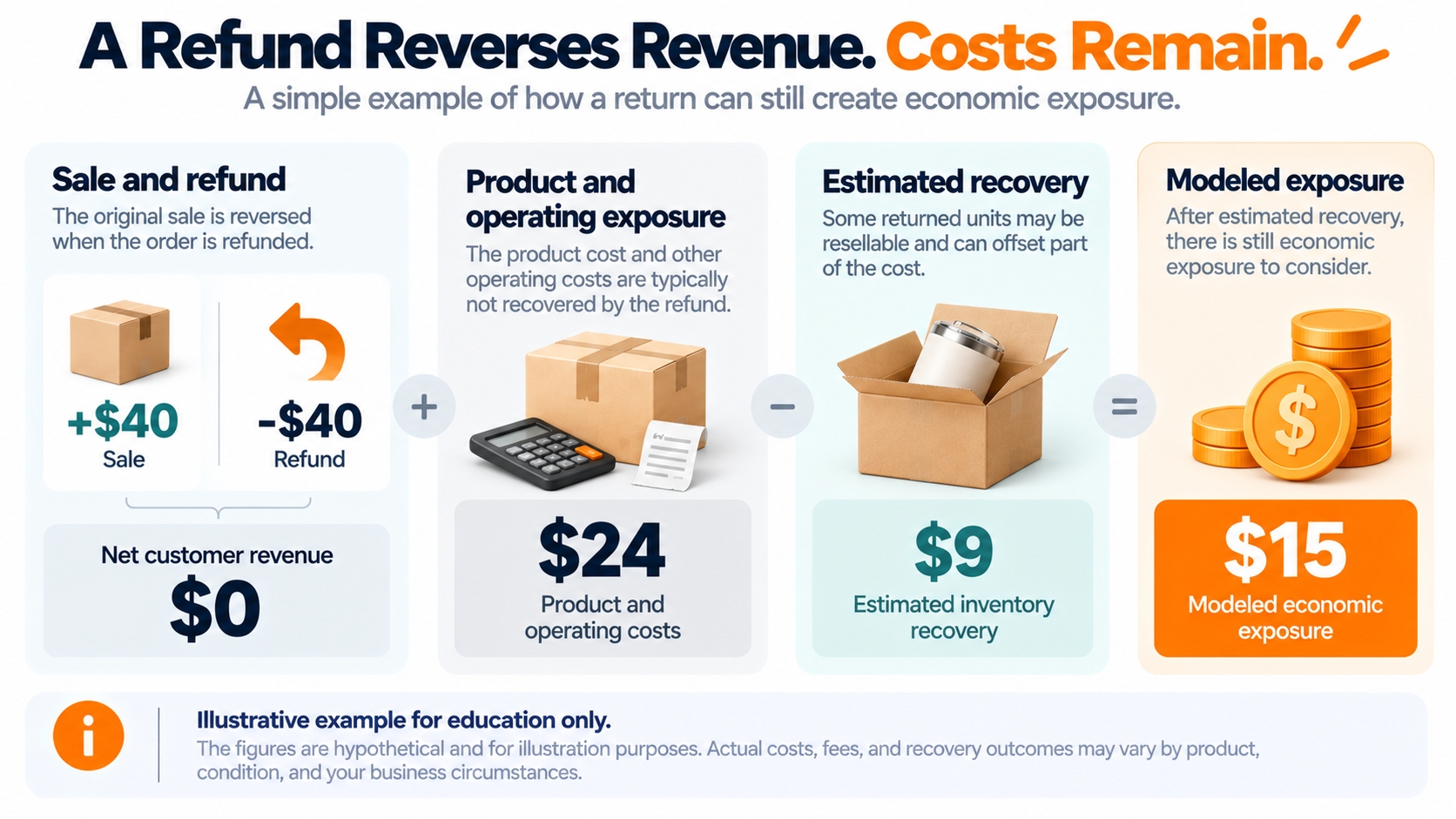
Example: A $40 Order That Was Fully Refunded
Consider a hypothetical $40 product sale that is subsequently refunded in full. The $40 sale and $40 refund offset one another, leaving zero net customer revenue from that transaction. The seller still bears expenses that were not recovered.
| Transaction component | Amount |
|---|---|
| Original customer payment | +$40.00 |
| Customer refund | -$40.00 |
| Net customer revenue | $0.00 |
| Landed product cost | $12.00 |
| Non-recovered selling and fulfilment costs, net of applicable credits | $5.00 |
| Advertising allocation | $4.00 |
| Return handling and inspection | $3.00 |
| Total economic exposure before product recovery | $24.00 |
| Hypothetical net recoverable inventory value | -$9.00 |
| Modeled exposure after expected recovery | $15.00 |
Without any recoverable product value, the modeled exposure is $24. If the returned unit retains $9 in net recoverable value, that exposure falls to $15. The latter is an estimate of inventory recovery, not $9 already received in cash or a guaranteed future resale.
The example excludes fixed overhead, income taxes and any additional fees not included in its stated assumptions. It also assumes selling and fulfilment costs are already net of applicable credits. Do not deduct refunded fees twice or add the $40 customer refund as an independent loss on top of the reversed revenue.
Some High-Return Products Face Additional Processing Fees
Amazon's 2026 US FBA returns-processing fee schedule applies to qualifying products whose return rates exceed the relevant thresholds. Its described schedule covers products other than apparel and shoes, which have separate fee treatment.
Amazon's fee calculation looks at units shipped in a particular month and units physically returned during that month and the following two calendar months. The fee applies to eligible returned units above the relevant threshold, rather than automatically to every refund.
This reinforces the need to distinguish refund counts from physical-return counts and to account for the timing of Amazon's measurements when reviewing a product's financial performance.
Read the Return Reason, Then Find the Actual Problem
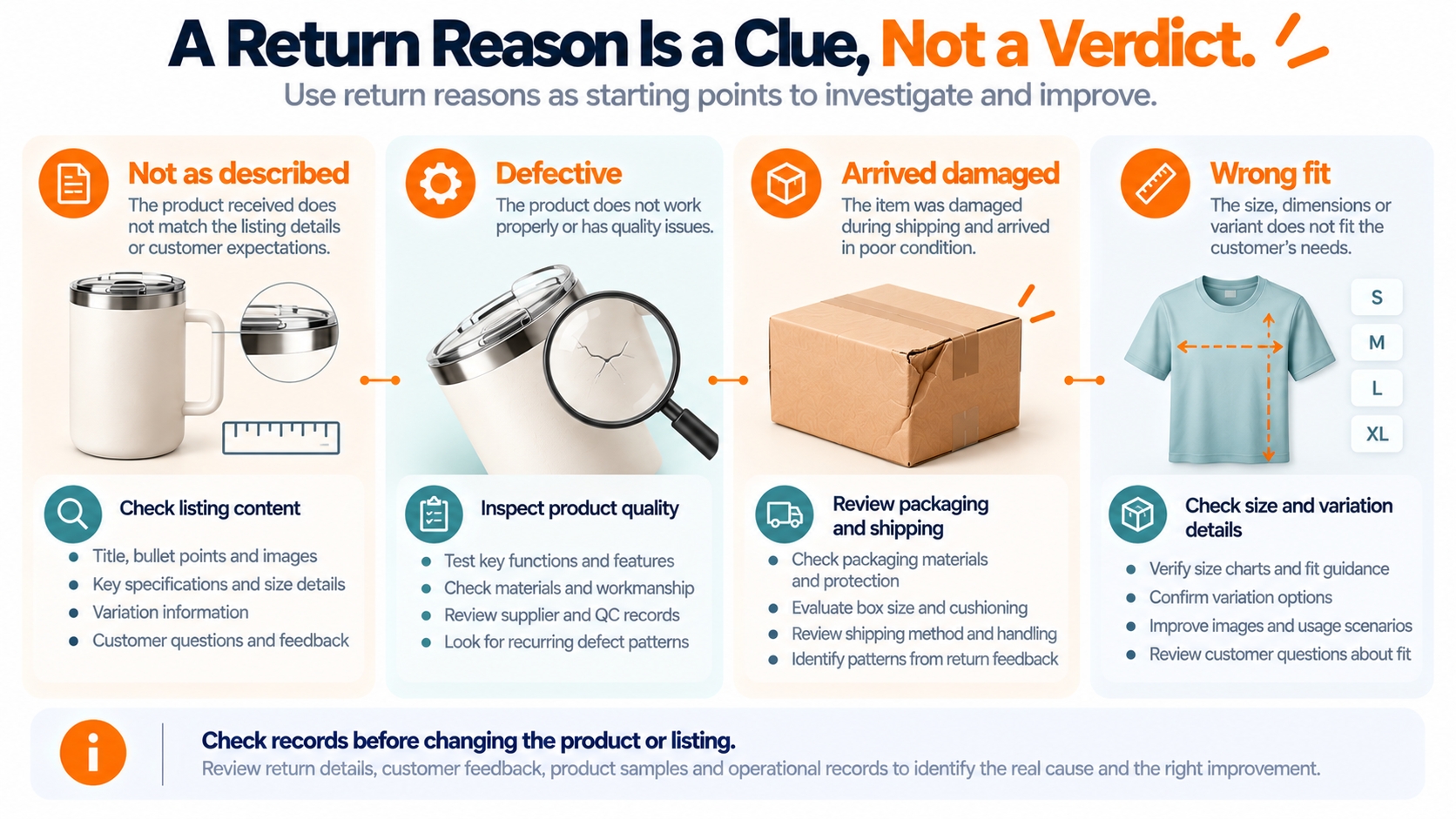
A completed refund answers a financial question. The return reason raises a different question: what went wrong between the customer's expectation and the product they received?
Amazon return data is useful because it comes from actual transactions. But the reason selected by a customer may be incomplete, ambiguous or unrelated to a manufacturing defect.
Combine return codes with buyer comments, the listing version, product variation, fulfilment method and available inspection evidence before assigning a cause.
Translate Return Reasons Into Investigation Questions
| Return theme | Evidence to examine | Potential corrective action |
|---|---|---|
| Not as described | Product photos, dimensions, variation selection, supplied accessories and the listing version. | Correct inaccurate listing details or address a product-configuration mismatch. |
| Defective or stopped working | Batch data, functional testing, supplier records and available defect evidence. | Investigate quality control or isolate an affected production batch. |
| Arrived damaged | Packaging, shipment conditions, damage photographs and handling records. | Review packaging protection and the relevant fulfilment process. |
| Wrong size or fit | Size guides, measurements, compatible models and affected variations. | Improve fit information or investigate actual manufacturing variation. |
| No longer needed | Order timing, customer comments and the wider pattern of return reasons. | Monitor the pattern without automatically classifying the product as defective. |
Give Return Metrics a Clear Denominator
A useful internal return-request rate might measure the number of orders with a return request divided by delivered orders from a defined cohort. A physical-return rate instead measures units actually returned against the relevant shipped-unit population.
Those rates answer different questions. If they use different time windows or mix orders with units, they should not be compared as though they were identical measures. Late returns can also change a cohort's results after the original sales month.
Segment by ASIN, child variation, fulfilment method and time period where the data allows. Do not calculate a product defect rate by dividing negative review mentions by estimated sales. Reviews represent a selected set of customers, not every transaction.
Use Customer Reviews as Supporting Evidence
Customer reviews can reveal product expectations that a return code does not explain. Several customers describing a lid that is difficult to close, for example, may justify examining product design, instructions or material consistency.
SellerSprite's AI Review Analysis can help organise available review content into recurring complaints, praised features, use cases and unmet expectations. Use those themes to identify questions worth investigating, then verify them against original reviews and your own product and return records.
For a deeper breakdown of product-level return metrics and common causes, see SellerSprite's Amazon return-rate analysis guide. The important distinction is that return data identifies completed customer outcomes, while review analysis helps interpret experiences and expectations.
The Weekly Return Review That Changes Something
Return reporting often fails because the team produces a summary but never connects it to a product or operational change. A short recurring review can be more useful than a large dashboard if it forces the right decisions.
Use three distinct questions, each with an owner and a recorded next action.
01 / ACTIVE CASES
Which Returns Still Need a Decision?
Review open authorisations, parcels received but not fully assessed, refunds approaching deadlines, and cases that may require an eligible claim. Address time-sensitive obligations before reviewing aggregate trends.
02 / REPEATED LOSSES
Which ASINs Are Producing Avoidable Costs?
Identify products with recurring physical returns, condition losses or unusual cost patterns. Compare similar time periods and investigate whether a particular variation, supplier batch or fulfilment route is involved.
03 / VERIFIED CHANGES
What Did We Change, and Did It Help?
Track listing corrections, packaging changes, supplier actions and updated instructions. Compare subsequent outcomes with the earlier period while accounting for advertising, sales mix and seasonality.
For example, several returns reporting an incorrect pack quantity may justify reviewing the product's main image, title, variation mapping and packing specification. The team should then confirm the problem was actually corrected, not simply that the next week's return count was lower.
Some returns cannot be prevented through listing changes. Customers may change their minds, no longer need an item or experience circumstances outside the product's control. The objective is to reduce avoidable problems while handling legitimate returns correctly.
The Return Is Not Finished at the Refund
An Amazon return creates two obligations for the seller. The immediate one is to follow the correct policy and resolve the transaction. The longer-term one is to understand what the returned product, customer feedback and financial adjustments reveal about the business.
Keep the deadlines separate. Distinguish a completed refund from an actual returned unit. Use the appropriate FBA or FBM procedure, preserve evidence for eligible claims, and account for recoverable inventory before calling a return a complete loss.
The real operating improvement comes when the same avoidable return does not keep appearing. That requires a connection between customer-service records, product quality, listing accuracy and inventory decisions, not simply a faster refund.
FAQs
What is Amazon's standard return policy?
Most eligible products can generally be returned within 30 days of the estimated delivery date. Category-specific and seasonal exceptions apply, so the applicable order instructions and Amazon's current return policy should be checked before assuming every product has the same window.
What is Amazon's holiday return deadline for 2026 purchases?
For eligible Amazon.com purchases made between November 1 and December 31, 2026, the announced extended return deadline is January 31, 2027. Apple-branded products have an earlier January 15, 2027 deadline. The policy applies to both FBA and FBM orders.
How long do Amazon FBM sellers have to refund a returned item?
Under the US process effective January 26, 2026, FBM sellers have four calendar days after receiving a returned item to assess it and process the appropriate refund before Amazon may issue an automated refund.
Can Amazon refund a customer before receiving the returned product?
Yes. Eligible Refund at First Scan transactions can trigger a refund when the carrier first scans the returned parcel. Some returns may also qualify for a returnless refund, where the customer is not required to send the item back.
Can Amazon sellers refuse a return request?
Most in-policy US seller-fulfilled returns are automatically authorised by Amazon. Some out-of-policy requests and exempt categories require manual review, where the seller must act according to Amazon's applicable rules. Sellers cannot simply replace Amazon's return policy with their own restrictions.
Can a seller charge a restocking fee?
Only in circumstances permitted by Amazon's restocking-fee guidelines. An item returned within policy in its original condition generally cannot be charged a restocking fee. Used, damaged or materially different returns may qualify for an applicable deduction when properly documented.
Does Amazon reimburse sellers for every damaged return?
No. Reimbursement depends on the fulfilment programme, responsibility for the event, policy eligibility and available evidence. SAFE-T applies to certain seller-fulfilled cases, while FBA inventory events follow separate reimbursement policies.
Are returned FBA products automatically resold?
No. Amazon evaluates returned FBA inventory. Eligible items assessed as sellable may return to available stock, while unsellable units follow the appropriate inventory process. Additional recovery options may be available for eligible enrolled items.
Does every return hurt a seller's Order Defect Rate?
No. A return by itself is not the same as an Order Defect Rate event. ODR is based on defined measures such as negative seller feedback, A-to-z Guarantee claims and chargebacks. However, poor return handling can still lead to customer-service problems and other operational consequences.
What is the most useful way to analyse Amazon return rates?
Separate return requests, refunds and physically received units. Compare the same ASIN or variation across consistent time periods, investigate recurring reasons and use actual seller records to verify the cause. A single percentage without a defined denominator is not enough to guide a product decision.
References
- Amazon Seller Central: Manage Seller-Fulfilled Returns View
- Amazon: Extended Return Window for November and December 2026 Purchases View
- Amazon: Seller-Fulfilled Refund Process Update Effective January 26, 2026 View
- Amazon Seller Central: Issue a Partial Refund View
- Amazon Seller Central: Guidelines for Charging Restocking Fees View
- Amazon Seller Central: Refund Options View
- Amazon Seller Central: Reimbursement for Seller-Fulfilled Orders (SAFE-T) View
- Amazon Seller Central: FBA Customer Returns Settings View
- Amazon Seller Central: FBA Inventory Reimbursement Policy View
- Amazon Seller Central: 2026 Returns Processing Fee Changes View
- Amazon: FBA Dashboard and Customer Return Insights View
- Amazon: How to Manage Customer Returns for Seller-Fulfilled Orders View
By SellerSprite Content Team
The SellerSprite Content Team combines Amazon marketplace research, ecommerce data analysis and seller-operations expertise. Its research interests include post-purchase customer behaviour, product quality signals, inventory performance and the relationship between marketplace policies and commercial outcomes. The team examines how returns, customer feedback and fulfilment practices influence product performance, helping sellers evaluate operational issues using structured evidence rather than isolated metrics.
Last reviewed: October 21, 2026