TL;DR: Mastering long-tail keywords on Amazon is the most effective way to lower your ACoS by targeting specific buyer intent and reducing cost-per-click competition.
Key Takeaways
- Long-tail keywords offer higher conversion rates (CVR) and lower cost-per-click (CPC) than head terms.
- A successful strategy involves a 3-layer PPC structure: Discovery, Control, and Scale.
- Using tools like SellerSprite's Keyword Mining is essential for finding low-competition, high-intent phrases.
Table of Contents
- Why Long-Tail Keywords Are the "Low ACoS Advantage"
- What Counts as a Long-Tail Keyword on Amazon
- How Long-Tail Keywords Impact PPC Performance
- Step 1: Build a Long-Tail "Keyword Universe"
- Step 2: Validate Long-Tails for Profit Potential
- Step 3: The PPC Workflow: Harvest Long-Tails
- Step 4: Build a Long-Tail Manual Campaign Structure
- Step 5: Apply Long-Tails to Listing SEO
- Step 6: Scaling Without Breaking ACoS
- Common Mistakes That Make Long-Tails Fail
- FAQ
- References
Note on marketplaces: This guide is specifically optimized for the US market.
Why Long-Tail Keywords Are the "Low ACoS Advantage"
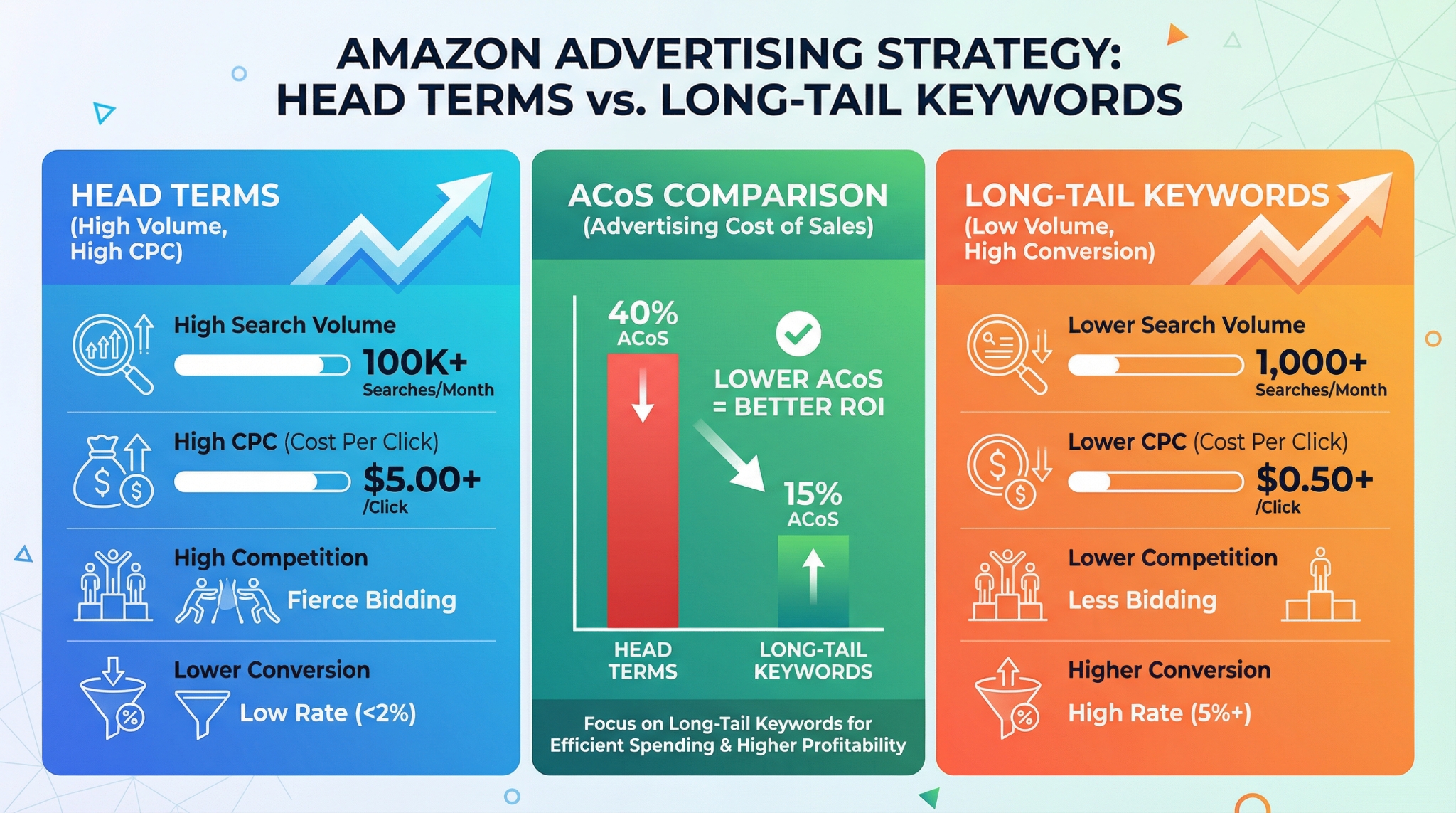
In the competitive landscape of Amazon US, high-volume "head terms" often lead to bidding wars that inflate Advertising Cost of Sales (ACoS). Long-tail keywords, typically consisting of three or more words, offer a strategic escape. These phrases target specific niches, reducing competition and cost.
The economics: lower CPC + higher CVR = lower ACoS
The math is simple: because fewer sellers bid on "organic bamboo cutting board with handle" compared to just "cutting board," the CPC is lower. Furthermore, a shopper using specific terms is closer to a purchase decision, which spikes your conversion rate (CVR).
Why head terms usually burn budget
Head terms have broad intent. A user searching for "shoes" might want sneakers, heels, or boots. Bidding on these broad terms results in many clicks from users who aren't looking for your specific product, leading to wasted spend and high ACoS.
What "good" long-tail looks like
A high-performing long-tail keyword must be specific, perfectly fit your product, and imply purchase readiness. For example, "heavy duty stapler for 100 pages" is far superior to "stapler" for a specialized seller.
Long-tail wins when:
- The search term contains specific attributes (size, material).
- The intent is clearly transactional (e.g., "replacement parts for...").
- Competition for the exact phrase is low (fewer than 10 strong competitors).
What Counts as a Long-Tail Keyword on Amazon
Understanding the anatomy of a long-tail keyword is crucial for Amazon keyword research. It’s not just about length; it's about the depth of intent.
Head vs. mid-tail vs. long-tail
Head terms (1-2 words) offer high volume but low intent. Mid-tail (2-3 words) balances volume and intent. Long-tail (4+ words) offers the highest specificity. Sellers often misuse these by ignoring the conversion potential of lower-volume phrases.
The 6 modifier families that create long-tail intent
Attribute (material, size, pack)
Example: "3-pack stainless steel mixing bowls with lids."
Use case ("for hiking", "for toddlers")
Example: "lightweight sleeping bag for summer backpacking."
Compatibility ("compatible with…")
Example: "coffee filters compatible with Keurig K-Duo."
Problem/solution ("for dry skin", "pain relief…")
Example: "anti-itch cream for sensitive eczema skin."
Comparison (“alternative”, “vs”, “replacement”)
Example: "glass lid replacement for 10 inch skillet."
Compliance-safe claims
Ensure your long-tails avoid prohibited medical claims while still addressing user needs.
How Long-Tail Keywords Impact PPC Performance (ACoS, CPC, CVR)
Long-tail keywords are the engine behind a lean PPC budget. They allow you to win the "low hanging fruit" of Amazon advertising.
The ACoS formula and long-tail inputs
ACoS = (Ad Spend / Sales). By lowering the CPC (Spend) and increasing the CVR (Sales per click), long-tail keywords mathematically drive down your ACoS more effectively than any bid adjustment alone.
Long-tail improves "traffic quality"
When you target "extra firm memory foam pillow for side sleepers," every click you pay for is from a user whose needs match your product exactly. This minimizes the "bounce rate" from your listing.
When long-tail doesn't work
Even the best keyword won't convert if your listing has poor images, a high price point compared to competitors, or a lack of reviews. The keyword brings the horse to water; the listing makes it drink.
Step 1: Build a Long-Tail "Keyword Universe" (Fast, Repeatable Sources)
To succeed, you need a vast list of potential phrases. This process, known as Amazon keyword mining, should be systematic.
Amazon autocomplete mining
Use the search bar to see what real buyers are typing. Try templates like "{core} for..." or "{core} with...". For automated results, SellerSprite's Keyword Mining can generate thousands of these combinations in seconds.
Competitor extraction (Reverse-ASIN logic)
Analyze top competitors to see which long-tail terms they are ranking for. Focus on their attribute-heavy phrases rather than just their brand name.
Customer language mining (Reviews + Q&A)
Read reviews to find how customers describe their problems. Phrasing like "works for my arthritis" or "perfect for small apartments" are gold mines for long-tail targeting.
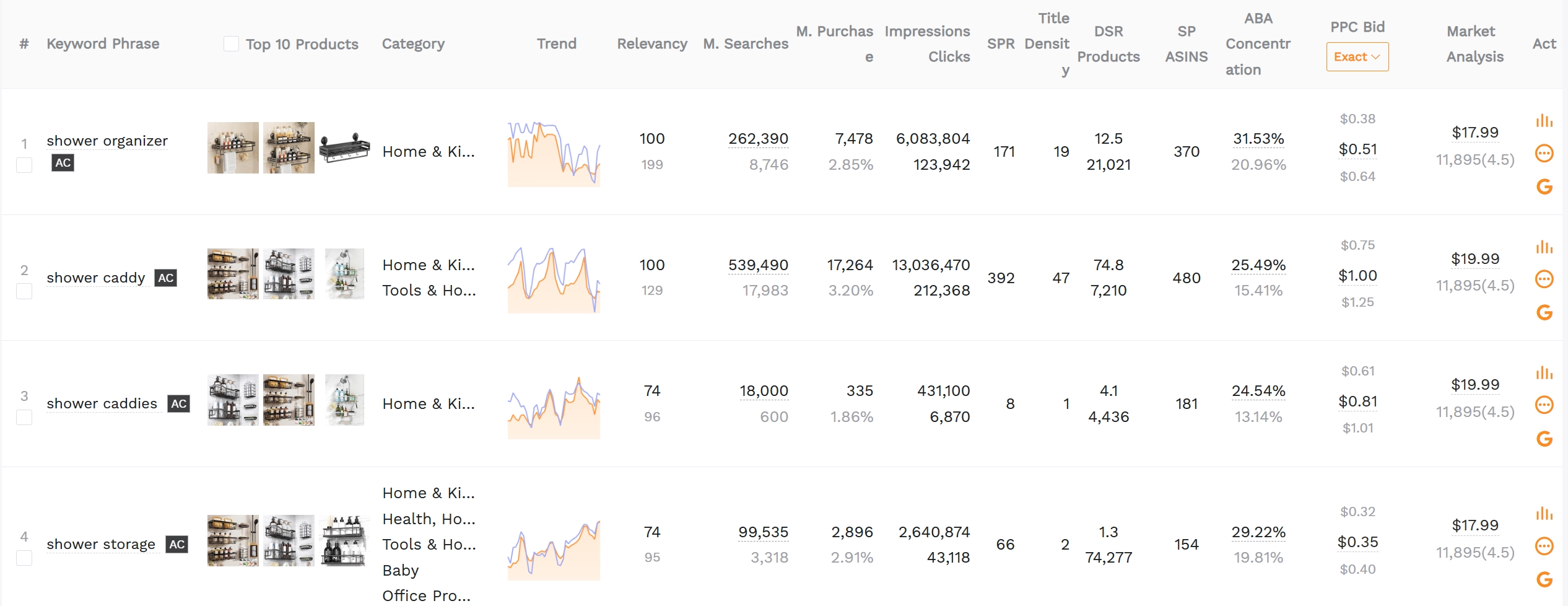
Step 2: Validate Long-Tails for Profit Potential (Not Just Relevance)
Not every long-tail is worth bidding on. You must filter your "universe" for profitability.
The Relevance, Intent, and Profitability (RIP) Test
Relevance: Does the query describe your exact product?
Intent: Does it imply a purchase?
Profitability: Is the margin high enough to cover the CPC? Use a simple scoring model: Relevance (1-5) × Intent (1-5) = Priority.
| Keyword | Relevance | Intent | Total Score |
|---|---|---|---|
| Blue yoga mat 1/4 inch | 5 | 4 | 20 |
| How to clean yoga mat | 2 | 1 | 2 |
Step 3: The PPC Workflow: Harvest Long-Tails From Auto Campaigns
Your automatic campaigns are your best research tool. They identify the long-tail terms Amazon’s algorithm already associates with your product.
The "Harvest → Promote → Negate" SOP
- Harvest: Download the Search Term Report weekly. Look for terms with 2+ orders and ACoS below your target.
- Promote: Move these winning terms to a Manual Exact Match campaign to control the bid.
- Negate: If a term has many clicks but zero sales, add it as a Negative Exact in the Auto campaign to save budget.
Step 4: Build a Long-Tail Manual Campaign Structure
To maintain a low ACoS, your campaign structure must be organized. Avoid mixing high-volume and long-tail terms in the same ad group.
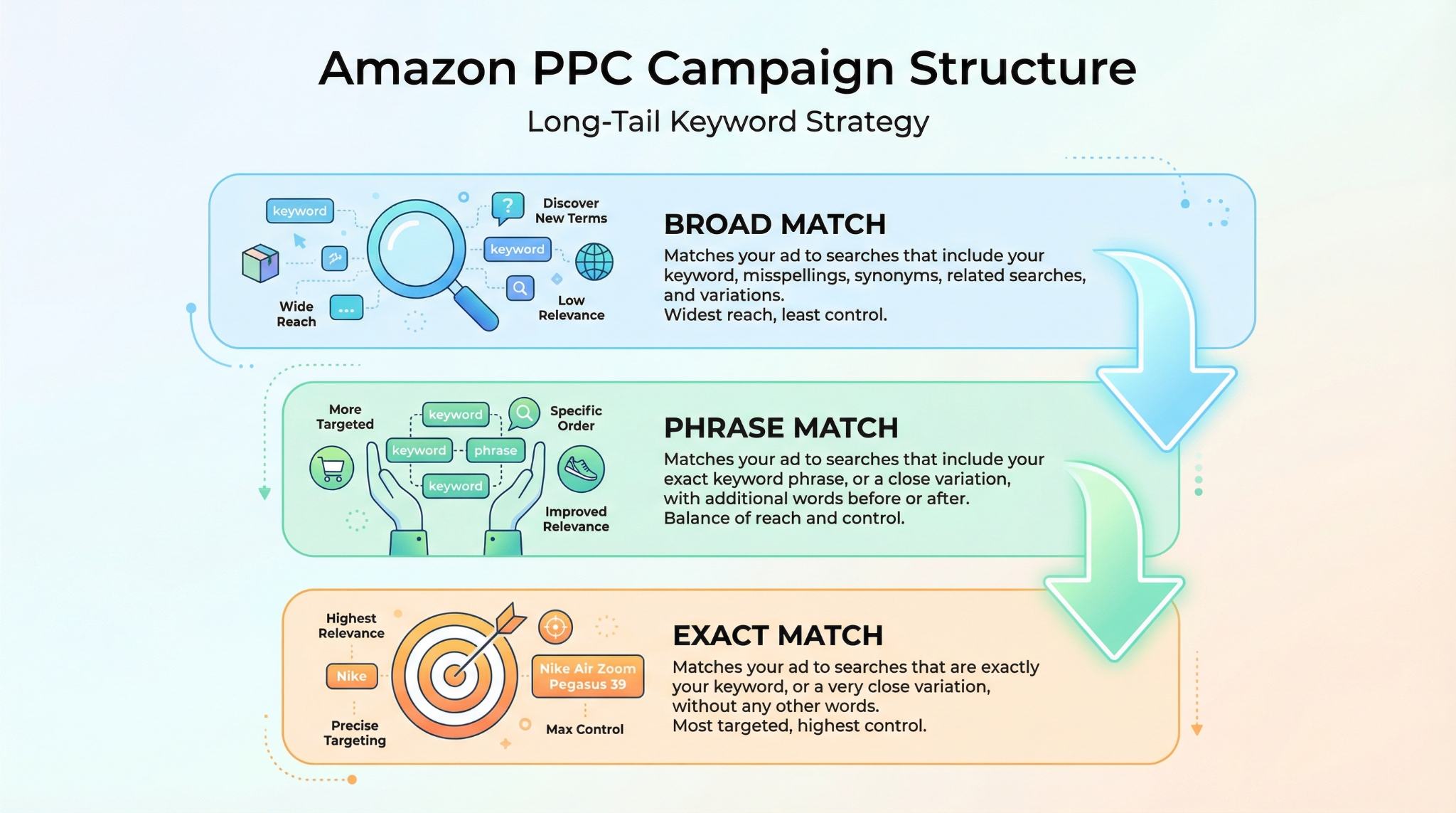
The 3-Layer Structure
- Discovery (Auto/Broad): Finding new long-tail terms.
- Control (Phrase): Testing the stability of discovered terms.
- Scale (Exact): Aggressively bidding on proven long-tail winners.
Step 5: Apply Long-Tails to Listing SEO
PPC and SEO must work together. If you target a long-tail keyword in PPC, that keyword should appear in your listing to improve relevancy scores and CVR.
Where to place long-tails
Place your most important long-tail phrases in the Bullet Points and Backend Search Terms. Only include them in the Title if they flow naturally and don't look like keyword stuffing.
Step 6: Scaling Without Breaking ACoS
Once you dominate long-tail niches, you can move toward "mid-tail" keywords. These have higher volume but slightly higher competition.
Use the profits from your low-ACoS long-tail campaigns to fund the expansion into broader terms. This "bridge" strategy ensures you grow sustainably without burning your margins.
Common Mistakes That Make Long-Tails Fail
Avoid "Set and Forget" mentalities. Long-tail trends shift, and new competitors emerge. Regularly update your negative keyword lists and refine your manual campaigns based on fresh long-tail strategies to stay ahead.
FAQ
How do I find low-competition long-tail keywords for my Amazon product?
Use a combination of Amazon's autocomplete feature, SellerSprite's Keyword Mining, and Reverse ASIN lookups on mid-tier competitors to identify phrases with specific modifiers like size, material, or use-case.
Why are long-tail keywords more effective for Amazon PPC campaigns?
They are more effective because they target shoppers with specific intent, leading to a much higher conversion rate and lower cost-per-click due to reduced competition compared to head terms.
What is the difference between short-tail and long-tail keywords on Amazon?
Short-tail keywords (e.g., "pillows") are broad and high-volume, while long-tail keywords (e.g., "king size cooling gel memory foam pillow") are specific and typically lead to more immediate purchase decisions.
How many long-tail keywords should I target per Amazon product?
Start with 20-50 highly relevant long-tail terms. As you harvest more from your auto campaigns, this list can grow into the hundreds, organized across different ad groups.
Should long-tail Amazon keywords be Exact or Phrase first?
Use Phrase match for testing to discover variations, but move proven winners to Exact match immediately to ensure you aren't paying for irrelevant clicks and to have maximum control over your bid.
Next Steps
- Audit your current PPC campaigns and identify high-ACoS head terms to negate.
- Run a SellerSprite Keyword Mining session to find 20 new long-tail opportunities.
- Sign up for SellerSprite to access advanced mining tools.
References
By SellerSprite Success Team
The SellerSprite Success Team consists of e-commerce experts dedicated to helping Amazon sellers scale using data-driven insights and advanced keyword analysis tools.