TL;DR: FBA usually requires an earlier commitment to inventory, while dropshipping can postpone purchasing a unit until a customer orders it. That does not make dropshipping cheaper per sale or eliminate the need for working capital. Compare the same product using three measures: cash committed before payment arrives, contribution per order, and the cost of unsold or unsuccessful orders. The right choice depends on supplier terms, packaged dimensions, delivery performance, and how reliably the product sells.
Key Takeaways
- Compare complete costs, not one fee against one supplier price. FBA fulfillment is only part of the FBA bill. A dropship supplier's product price may exclude handling, delivery, and returns.
- Lower unit costs need enough sales to matter. A bulk-buying advantage can disappear when leftover inventory must be stored longer or cleared below cost.
- No warehouse does not mean no cash requirement. A supplier may require payment before Amazon makes the customer proceeds available.
- Supplier compliance is a purchasing requirement. A quote is unusable if the supplier cannot fulfill orders under Amazon's dropshipping rules.
Table of Contents
- Amazon FBA and Dropshipping Costs Start at Different Moments
- What the FBA Fulfillment Fee Leaves Out
- What the Supplier's Dropshipping Quote Leaves Out
- A $30 Product, Priced Both Ways
- The Unsold Units Can Reverse the Winner
- How Much Cash Do You Need Before Amazon Pays You?
- Test the Demand Behind the Cost Estimate
- Choose the Commitment You Can Support
- FAQs
- References
Scope: Amazon.com in the United States. The dropshipping comparison assumes a compliant supplier fulfilling your Amazon orders, not sales through a separate online store. Published fees were reviewed on October 22, 2026. Worked examples exclude sales tax collected from customers and distinguish contribution from profit after fixed overhead and income tax.
Amazon FBA and Dropshipping Costs Start at Different Moments
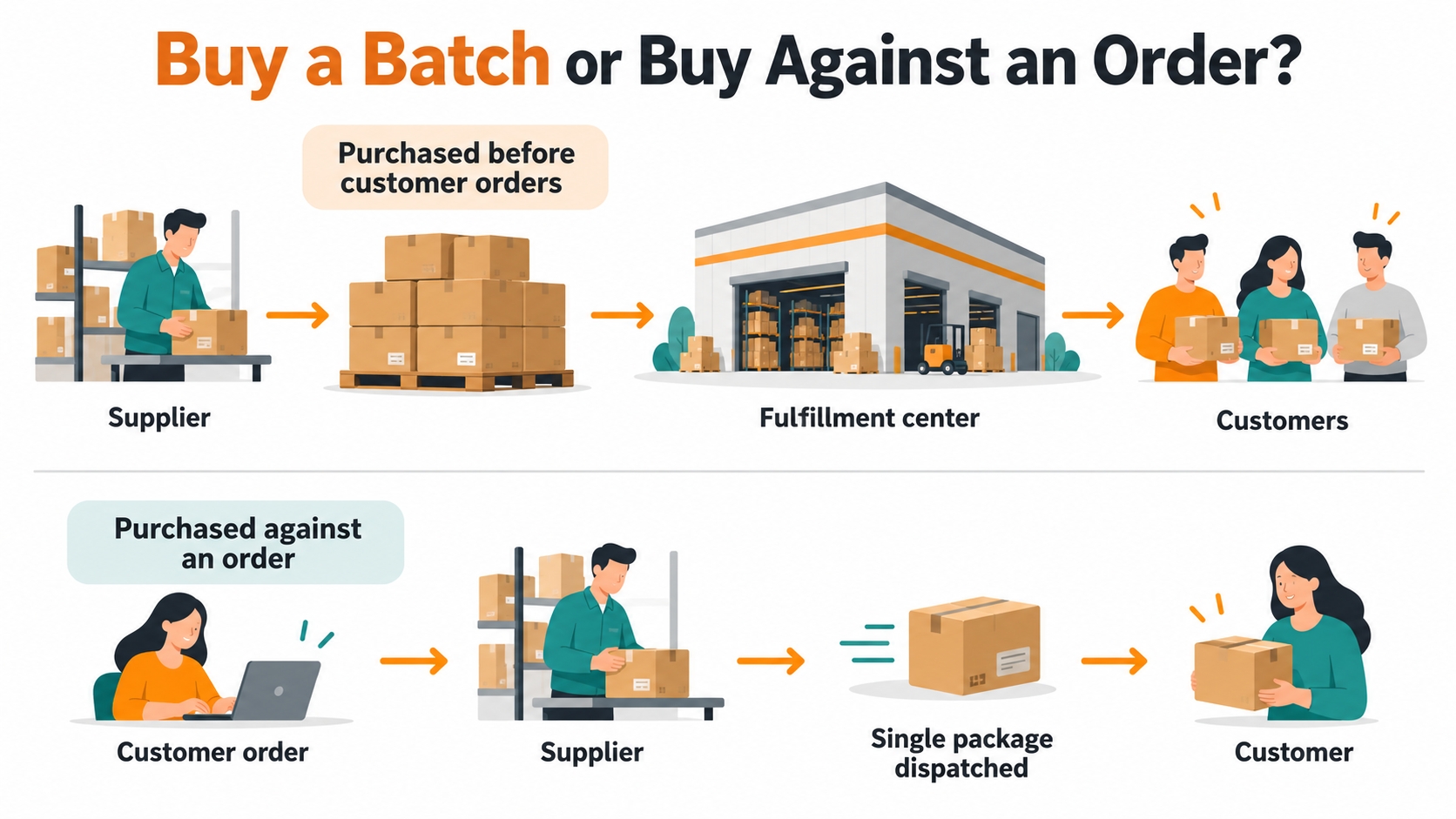
Two suppliers offer the same product. One gives you a lower unit price if you buy a batch. The other charges more but will ship individual customer orders. The cheaper quote is not necessarily the cheaper business.
With Fulfillment by Amazon (FBA), you send eligible inventory into Amazon's network. Amazon stores it and handles order fulfillment, associated customer service, and returns. You still have to source the stock, prepare it, and decide how much to commit.
With dropshipping, a supplier fulfills customer orders on your behalf. In the arrangement examined here, you purchase each unit after receiving an order instead of buying a speculative batch. Supplier agreements can differ, so check for deposits, minimum purchases, or prepaid balances.
FBA: COMMIT TO THE BATCH
You may gain a purchasing advantage, but you also carry the consequences if demand slows before the stock sells.
DROPSHIPPING: FUND THE ORDER
You can limit unsold-stock exposure, but must price the supplier's per-order charges and finance the interval before customer proceeds reach you.
FBA is a fulfillment service, not a sourcing model. Dropshipping is one way to fulfill merchant orders; FBM also includes shipping inventory you already own. A supplier sending your bulk purchase to an Amazon fulfillment center is not the same arrangement as that supplier shipping each order to the customer.
The Amazon selling fees neither option removes
Amazon's US Individual plan charges $0.99 per item sold; Professional costs $39.99 per month. Referral fees are additional and depend on the product's fee category, applicable price bands, and minimums. Neither FBA nor dropshipping makes an Amazon sale exempt from these charges.
What the FBA Fulfillment Fee Leaves Out
A fulfillment estimate tells you about one service. It does not tell you the complete cost of sourcing, stocking, selling, and recovering value from a product.
Check product eligibility before requesting freight quotes. Some products can be sold on Amazon but are unsuitable for FBA, and requirements can differ for dangerous goods, expiration-dated products, and temperature-sensitive inventory.
Getting the unit ready and into the network
Begin with product cost, inspection, packaging, preparation, freight, and any applicable duties or clearance charges. Divide shared shipment costs using a documented allocation method. Weight, volume, or unit count may be appropriate depending on what created the charge.
Cost convention: Here, landed inventory cost means the product plus the costs of getting it prepared and delivered to the chosen stocking location. Inbound placement, storage, fulfillment, selling fees, and advertising are shown separately. Other accounting conventions exist; the essential point is to count each charge once.
Amazon discontinued US FBA prep and item-labeling services for shipments created from January 1, 2026. Price the required work with your supplier, prep provider, or internal team rather than assuming Amazon will perform it after arrival.
Inbound placement is separate from carrier freight. Compare the placement charge and total transport cost across the shipment options actually offered. A route with a lower placement fee can still cost more overall if it requires additional shipments.
Paying for space, time, and fulfillment
FBA storage depends on the inventory space occupied and the applicable period. Base storage, eligible storage-utilization surcharges, and aged-inventory charges should not disappear into a single optimistic fulfillment estimate. Slow sales increase the time during which stock needs space.
Carrying too little inventory can create a different cost. Eligible products may incur Amazon's low-inventory-level fee, calculated using its historical days-of-supply rules. Your own forward-looking stock-coverage estimate is not the same metric.
October 2026 fee check: Amazon's published schedule applies a 3.5% fuel and logistics-related surcharge to US FBA fulfillment fees from April 17, 2026. Holiday peak fulfillment fees apply from October 15, 2026 through January 14, 2027.
The surcharge is not 3.5% of the product's selling price. Check whether it is already included in your estimate, and use the fee period applicable when the order ships.
Run the exact packaged product through Amazon's Revenue Calculator. Confirm dimensions, weight, category, price, and fulfillment assumptions. Save the estimate date and replace forecasts with actual charges once orders begin.
What the Supplier's Dropshipping Quote Leaves Out
A supplier offering a product for $12 may not be offering a delivered customer order for $12. Ask what happens between accepting the order and resolving any problem after delivery.
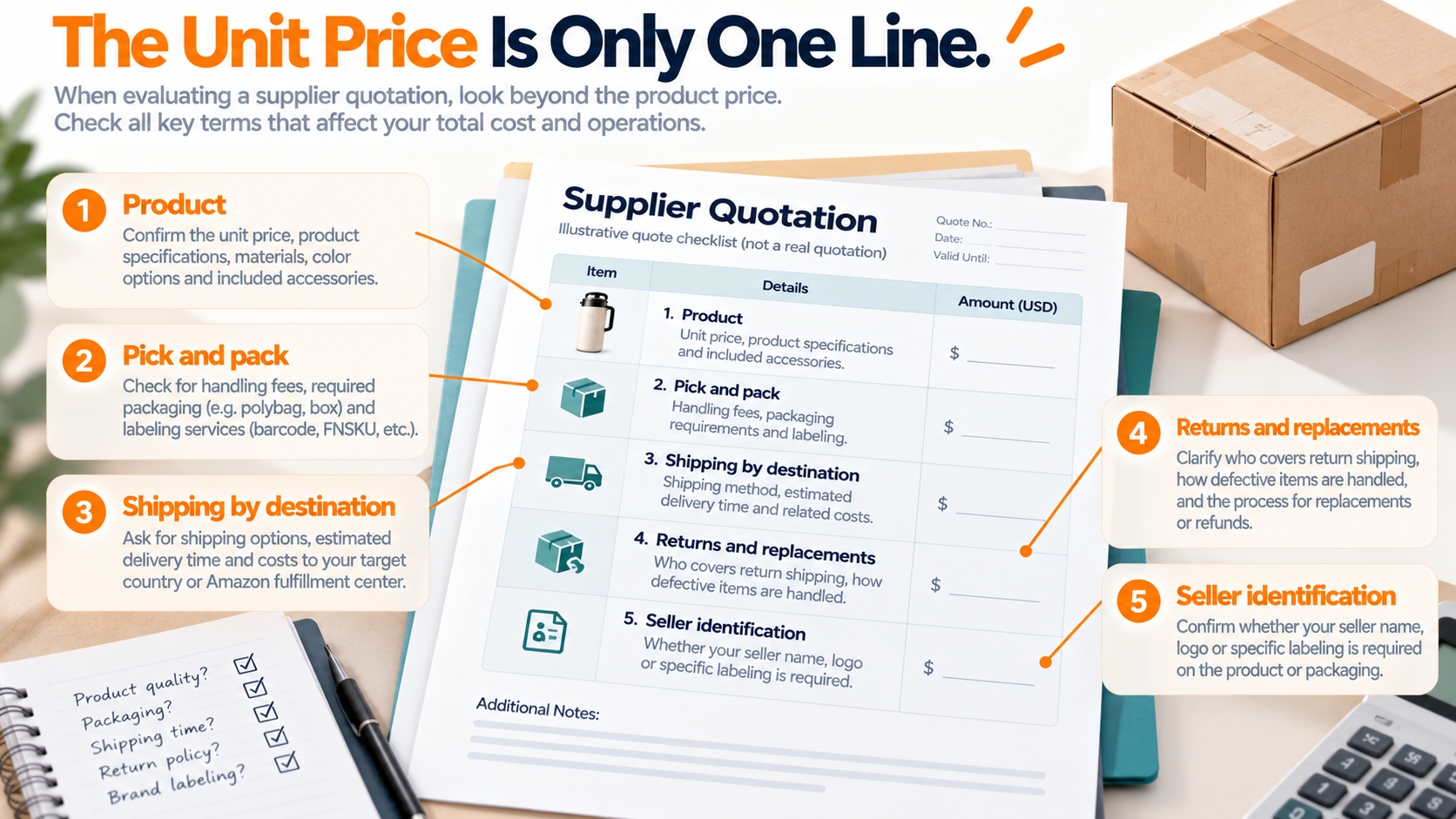
Request a written quote covering the product, pick-and-pack work, shipping by destination, packaging requirements, and any account or integration charges. Ask separately about address corrections, replacements, failed delivery, return postage, and supplier restocking deductions.
The supplier's service must fit Amazon's rules
Under Amazon's dropshipping policy, you must be clearly identified as the seller of record. Your supplier agreement must support the required seller identification on order materials, and you remain responsible for accepting and processing customer returns.
Having another retailer ship directly to your customer with that retailer identified as the seller is not a compliant shortcut. Before listing, examine a test shipment's packing slip, invoice, packaging, tracking, and return instructions.
Price the exceptions, not just the successful deliveries
Suppose the supplier accepts returns only after authorizing a case, but the customer is already entitled to a resolution under Amazon's rules. The gap in timing or reimbursement belongs in your cash and cost assumptions. A supplier contract does not replace your obligations to the Amazon customer.
Check how stock and price updates reach you. A profitable listing is fragile if the supplier frequently changes prices, runs out before accepting orders, or cannot deliver within the promise shown to buyers. Assign a cost to handling exceptions, even when the work is done by the founder.
The quote to request: “What will this exact product cost to deliver to my expected customer destinations, under my seller identity, and what will I owe if it arrives late, damaged, or comes back?”
A $30 Product, Priced Both Ways
Compare the same product, condition, pack quantity, and customer price before deciding which method leaves more. Different delivery promises may affect sales, but keep that uncertainty separate from the arithmetic.
Hypothetical assumptions: The FBA supplier charges $8 per unit, plus $2 allocated to inbound freight, duties, and preparation. The dropship supplier charges $12 per unit and $6 for pick, pack, and customer delivery. Both sell for $30, with an assumed 15% referral fee.
| Input or result | FBA | Dropshipping |
|---|---|---|
| Customer selling price | $30.00 | $30.00 |
| Product ready for fulfillment | $10.00, including $2 inbound costs | $12.00 supplier unit price |
| Inbound placement allowance | $0.50 | Not applicable |
| Customer-order fulfillment | $4.50 | $6.00 |
| Storage over the modeled holding period | $1.00 | Included in supplier pricing |
| Referral fee: assumed 15% | $4.50 | $4.50 |
| Advertising allocated per unit sold | $2.00 | $2.00 |
| Expected net post-sale adjustment | $1.00 | $1.00 |
| Total modeled cost and adjustments | $23.50 | $25.50 |
| Contribution per unit sold | $6.50 | $4.50 |
All figures are assumptions, not current quotes or typical margins. The FBA fulfillment allowance stands for the applicable all-in charge, including relevant fulfillment surcharges. No low-inventory fee is assumed in this example. Supplier storage is embedded in its price, not economically free.
The post-sale adjustment covers expected refunded revenue and incremental return costs, net of applicable fee credits and inventory recoveries. Do not subtract the same refund or product cost again elsewhere. The comparison assumes a Professional plan and leaves its subscription, other fixed overhead, and income tax outside unit contribution.
What the $2 advantage does, and does not, tell you
FBA leaves $2 more per retail unit sold under these assumptions. It does not follow that buying a large batch is the better decision. The table has not yet charged the FBA business for stock that never sells at the planned price.
It also assumes equal advertising cost and the same achievable selling price. Test those assumptions. A supplier-delivered offer with a weaker delivery promise may not attract the same orders. Amazon considers price, delivery, order experience, and availability when evaluating Featured Offers.
The Unsold Units Can Reverse the Winner
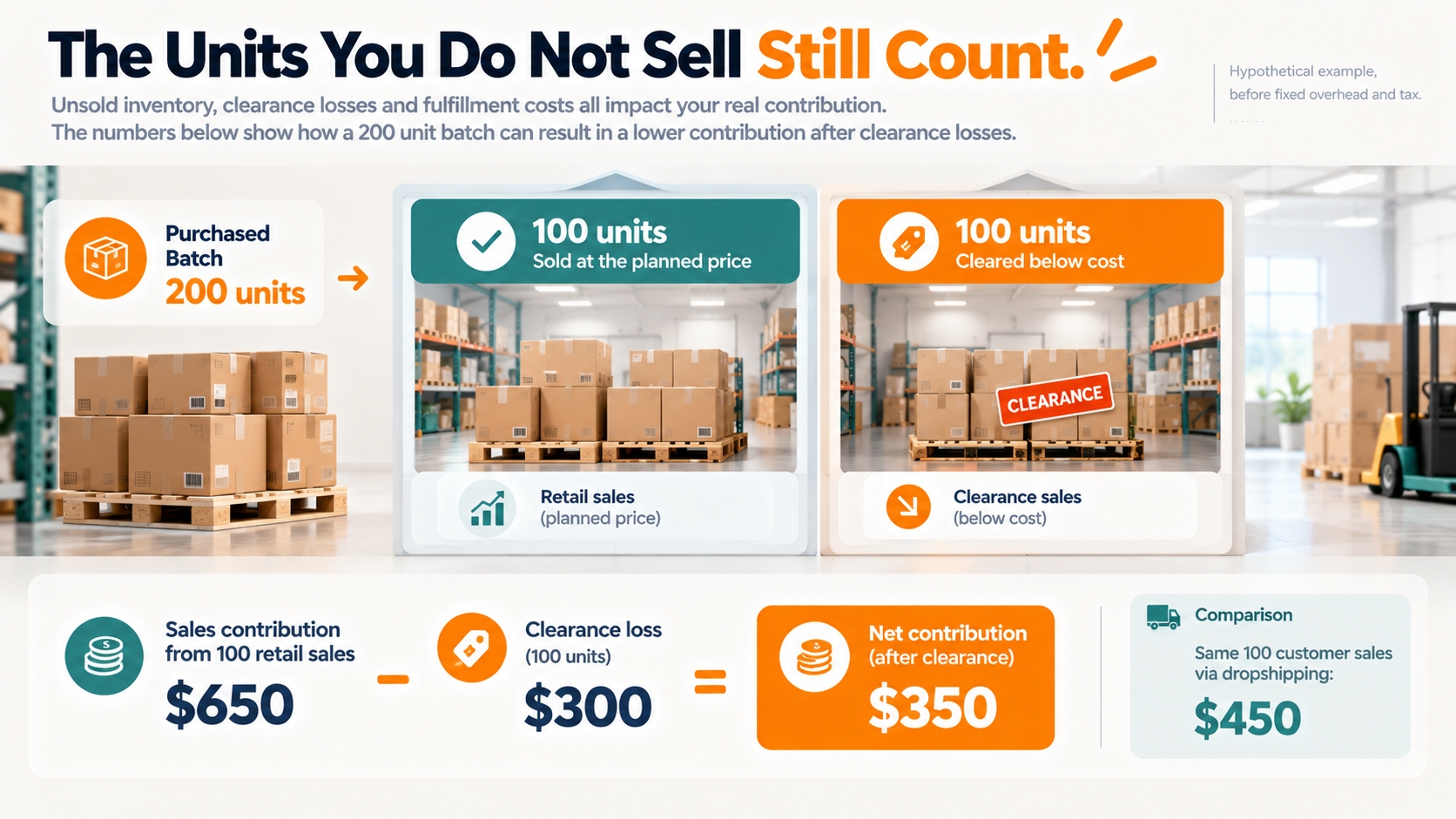
Keep the example's prices and costs, but now require the FBA seller to buy 200 units. Only 100 sell to customers during the test; the remaining 100 are cleared at the end.
Each FBA unit carries $10.50 in acquisition, inbound preparation, and placement costs. Assume the leftover units recover $7.50 each, net of their additional storage, removal, and clearance expenses. That creates a $3 loss per leftover unit.
Same 100 customer sales, different batch outcomes
FBA: 100 sales × $6.50 contribution = $650.
Less 100 leftover units × $3 clearance loss = $300.
Modeled batch contribution: $350.
Dropshipping: 100 sales × $4.50 contribution, with no purchased leftovers in this arrangement.
Modeled contribution: $450.
FBA earned more on every customer sale, but dropshipping finished $100 ahead after the remaining inventory was cleared. Both results remain before fixed overhead and income tax.
Find the sales quantity that makes the commitment worthwhile
For this particular 200-unit purchase, each retail sale earns an extra $2 through FBA, while each leftover unit loses $3. The two arrangements reach equal contribution when 120 units sell at the planned price:
120 sold × $2 advantage = 80 leftovers × $3 loss = $240
That 60% batch sell-through is a result of these assumptions, not an Amazon target or a general industry benchmark. Change the clearance recovery, holding period, purchase size, or selling price, and the crossover changes.
If you keep the leftovers instead, do not write off their entire cost automatically. They remain inventory, but they also remain cash you cannot use elsewhere. Model their likely selling time and recoverable value rather than valuing every unsold unit at the full retail price.
How Much Cash Do You Need Before Amazon Pays You?
There is no useful universal startup budget without a product, supplier agreement, and sales plan. Build a cash calendar from the dates money must leave the business, not just a list of expenses.
Amazon payouts can reflect fees, refunds, reserves, and deferred transactions, and bank receipt can follow the transfer date. A recorded sale is therefore not the same as cash available to pay a supplier.
FBA startup cash: the first batch is only part of the budget
The example's 200-unit FBA batch commits $2,100 to product, inbound preparation, and placement. Payment dates vary, but the commitment exists before you know whether all 200 units will sell.
Add samples, required product checks, account costs, content production, advertising, and a contingency for delays. Then include the next supplier payment. Replenishment may become due before the first batch has fully converted back to cash.
Dropshipping startup cash: fund the gap between orders and payouts
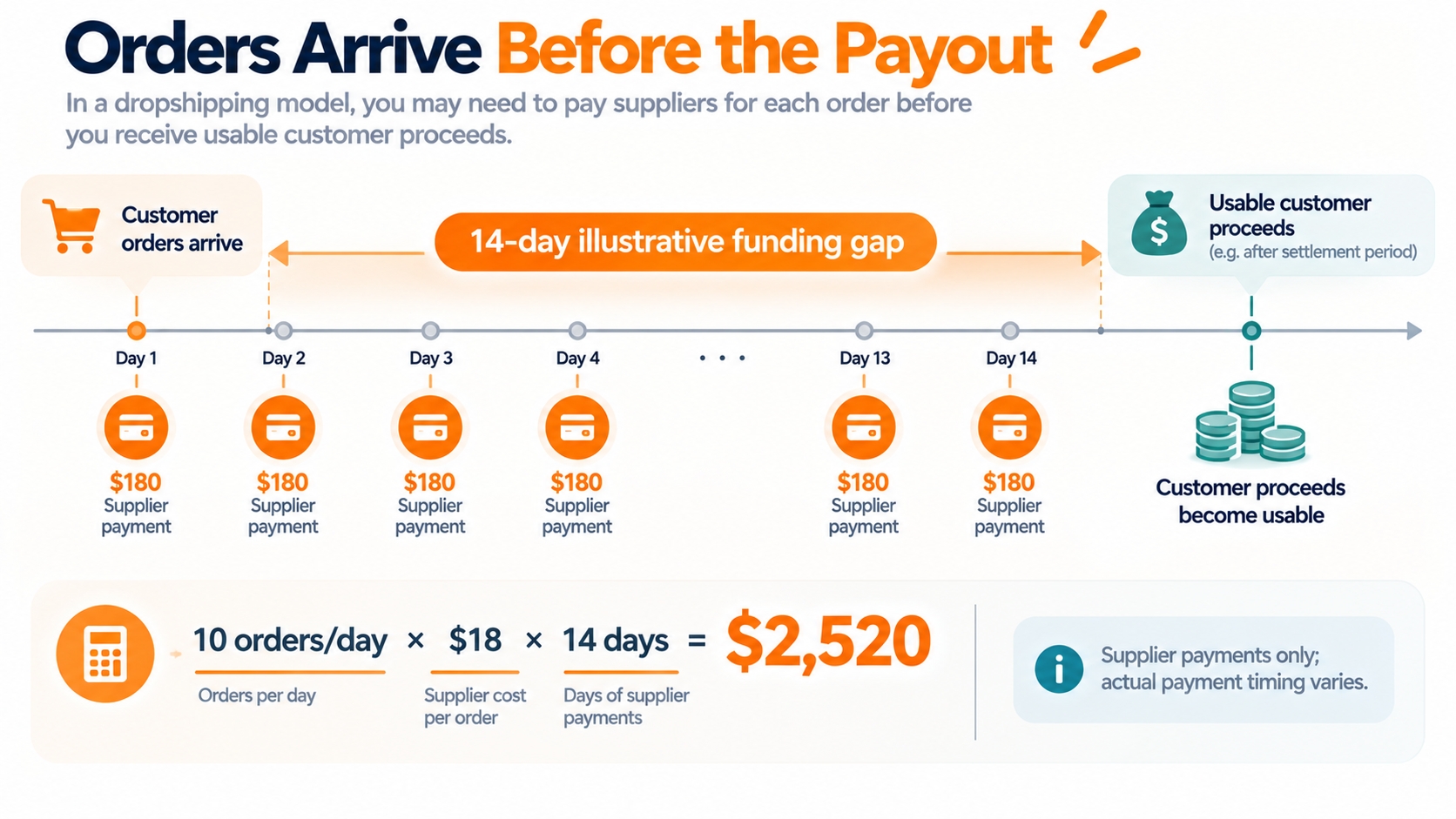
Assume the dropship supplier requires immediate payment of $18 per order: $12 for the product and $6 for delivery. At 10 orders per day, a hypothetical 14-day interval before usable customer proceeds arrive creates the following supplier-funding requirement:
10 orders/day × $18 supplier payment × 14 days = $2,520
The 14 days is a modeling assumption, not a promised Amazon payment schedule. The $2,520 covers supplier payments only; advertising, refunds, fixed costs, and any longer reserve period need additional room. Supplier credit terms could reduce this gap.
Do not compare that figure directly with the FBA batch commitment and declare one model cheaper to launch. One funds a particular inventory quantity; the other funds a particular flow of orders. Compare both over the same calendar and expected sales volume.
Keep fixed overhead outside the unit comparison, but inside the decision
Monthly subscriptions, software, staff, and financing costs still have to be paid. Deduct them once when moving from total contribution to business profit. A low-volume launch can show positive contribution on each sale and still fail to cover its monthly overhead.
Test the Demand Behind the Cost Estimate
The most sensitive number may not be a fee. It may be how many units you can sell before paying for more stock or accepting a lower price.
Research comparable ASINs by configuration, condition, pack count, and delivery offer. A strong BSR indicates relative product sales performance; it does not allocate orders to your future offer. Do not divide an ASIN sales estimate by its seller count and treat the answer as your forecast.
Use market history to challenge the purchase quantity
SellerSprite Product Research lets you compare product metrics and examine historical sales trends, BSR, prices, and reviews. Use those observations to test whether today's attractive price or sales pace has persisted, and whether demand appears seasonal.
Build a lower-demand case as well as an upside case. Marketplace estimates help set assumptions; supplier quotations, Amazon's applicable fees, and your own actual orders determine the economics. A research-tool margin estimate is not a complete quote for your shipment.
Plan for the next order, not only the first sale
For FBA, count lead time through production, preparation, transport, receiving, and sale-ready stock. Set the reorder review early enough to cover that interval, then test whether supplier payment dates fit the cash calendar. Delivery to a warehouse is not the same milestone as inventory ready to fulfill orders.
For dropshipping, examine supplier stock-feed accuracy, dispatch cutoffs, tracking availability, and peak-period capacity. Avoid replacing an unavailable product with a different item just to preserve the order. The promised product and service must remain deliverable.
The next purchase needs four numbers
Expected units sold: By a defined date, under a stated price and delivery offer.
Contribution per unit: After the full fulfillment and post-sale cost assumptions.
Peak cash requirement: The largest gap between scheduled payments and usable receipts.
Downside exposure: The cost of slower sales, lower prices, failed deliveries, or leftover stock.
Choose the Commitment You Can Support
FBA is worth considering when repeatable demand, product size, and the purchasing arrangement make the stock commitment worthwhile. Dropshipping is worth considering when the supplier can meet Amazon's requirements and customer expectations at a delivered cost that leaves adequate contribution.
Neither choice should be made for an entire catalog just because it worked for one SKU. A fast-moving product and a slow, bulky item can deserve different fulfillment arrangements.
Where holding your own stock outside Amazon is another option, SellerSprite's FBA vs. FBM cost and control comparison expands the decision beyond supplier dropshipping.
Before increasing inventory or advertising, compare your original quote with a small set of completed orders. Review actual fees, delivered costs, refunds, receipt dates, and remaining stock. Requote whenever packaging, supplier terms, shipping routes, or the applicable fee period changes.
The final test: Can you fund the order, fulfill it correctly, and still accept the result if sales are slower than planned? That answer matters more than which method has the smaller advertised starting cost.
FAQs
Is Amazon FBA cheaper than dropshipping?
Neither is always cheaper. FBA can produce better contribution per sold unit while exposing more cash to unsold inventory. Dropshipping can reduce speculative stock purchases while adding higher supplier and per-order delivery costs. Compare the same product over the same sales period.
What belongs in an Amazon FBA and dropshipping costs comparison?
Include sourcing, preparation, inbound transport, relevant Amazon fees, customer delivery, storage, advertising, expected post-sale adjustments, and fixed overhead. Then calculate the inventory or supplier-payment cash requirement separately. A positive unit margin does not establish that the business can finance the model.
Does Amazon charge a separate dropshipping subscription?
Dropshipping does not replace Amazon's standard selling-plan and referral fees. Supplier platforms or integrations may charge separately. For a compliant order fulfilled outside FBA, model the supplier's delivery charges rather than adding an FBA fulfillment fee.
Is dropshipping allowed on Amazon?
It must comply with Amazon's dropshipping policy. You must be identified as the seller of record, control the required seller identification in shipment materials, and remain responsible for customer returns. A supplier's offer to ship products does not establish compliance.
Can I start dropshipping without working capital?
Not safely unless your payment arrangements cover the gap. A supplier may require payment before Amazon proceeds are usable, while advertising and refunds create additional obligations. Use your actual supplier terms and Payments Dashboard instead of assuming that a customer order immediately funds itself.
What FBA cost changes should US sellers check in 2026?
Check the applicable fulfillment schedule, including the 3.5% fuel and logistics surcharge and the October 15, 2026 to January 14, 2027 peak period. Also budget for preparation and item labeling outside Amazon following the discontinuation of US FBA prep services.
Does FBA guarantee better conversion or the Featured Offer?
Do not budget for a guaranteed uplift. Amazon considers the competitiveness of the offer, including price, delivery, customer experience, and stock availability. Compare actual outcomes for your product rather than assigning a universal conversion bonus to FBA.
When should I move a dropshipped product into FBA?
Consider it after confirming repeat demand, FBA eligibility, acceptable packaged dimensions, a reliable bulk supplier, and enough cash for inventory and replenishment. Recalculate the batch outcome under slower sales. The number of orders alone does not establish that a bulk commitment is worthwhile.
References
- Amazon: Fulfillment by Amazon View
- Amazon: What Is Dropshipping? View
- Amazon: Selling Plans and Referral Fees View
- Amazon Seller Central: FBA Product Restrictions View
- Amazon Seller Central: FBA Prep Service Discontinuation View
- Amazon Seller Central: FBA Inbound Placement Service Fee View
- Amazon Seller Central: Monthly Inventory Storage Fees View
- Amazon Seller Central: Low-Inventory-Level Fee View
- Amazon Seller Central: 2026 US FBA Fulfillment Fee Changes View
- Amazon Seller Central: Drop Shipping Policy View
- Amazon: Revenue Calculator and Cost Estimates View
- Amazon: How Seller Payments Work View
- Amazon: Featured Offer Selection View
- SellerSprite: Product Research Quick Tips View
- SellerSprite: Amazon FBA vs. FBM, Costs and Control View
By SellerSprite Content Team
The SellerSprite Content Team works across Amazon marketplace research, e-commerce data analysis, and seller education. Our research focuses on how product demand, competitive pricing, fulfillment costs, and supplier terms influence purchasing and inventory decisions. We study both the earnings potential of individual products and the stock commitments needed to support them, with particular attention to seasonal demand and the limits of marketplace estimates.
Last reviewed: October 22, 2026