TL;DR: Effective Amazon competitor tracking helps sellers monitor pricing changes, product launches, and sales trends to stay ahead in the US marketplace. Using the right tools, you can turn competitor data into actionable insights for growth.
Key Takeaways
- Amazon competitor tracking enables real-time monitoring of pricing, inventory, and product performance across top sellers.
- Advanced tools like SellerSprite provide automated alerts, historical data, and benchmarking features tailored for the US market.
- Effective competitor analysis supports smarter pricing strategies, PPC optimization, and product differentiation.
Table of Contents
Note on marketplaces: This guide is specifically optimized for the US market.
Why Amazon Competitor Tracking Matters
In the hyper-competitive US Amazon marketplace, staying ahead means knowing more than just your own metrics. Top-performing brands and growth-focused sellers use Amazon competitor tracking to anticipate market shifts, respond to pricing changes, and refine their product offerings. Whether you're a new seller trying to break into a crowded niche or an established brand optimizing your portfolio, understanding your competition is no longer optional but essential.
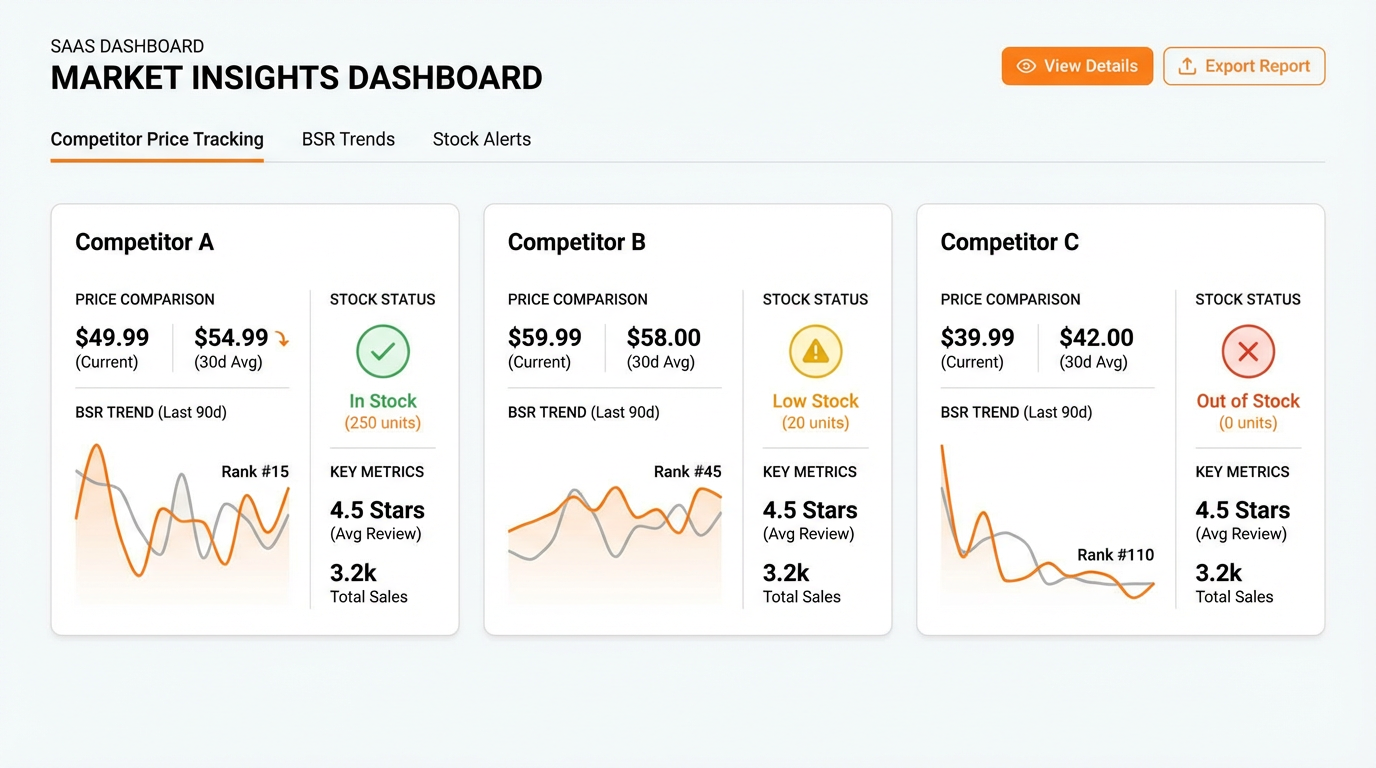
Competitor tracking goes beyond checking prices manually. It involves systematic monitoring of key performance indicators such as Best Seller Rank (BSR), review velocity, inventory levels, and advertising behavior. These signals help you identify opportunities, like launching a promotion when a top competitor runs out of stock, or avoid pitfalls, such as entering a price war without sufficient margin buffer.
For marketing and operations teams, this intelligence fuels better decisions across pricing, inventory planning, and ad spend. By integrating competitor insights into your daily workflow, you shift from reactive to proactive selling.
Step-by-Step Guide to Tracking Amazon Competitors
Tracking competitors on Amazon doesn't have to be time-consuming. With the right approach, you can build a repeatable process that delivers consistent insights. Here's how to do it:
Step 1: Identify Your True Competitors
Start by identifying who your real competitors are, not just sellers in your category, but those ranking for the same keywords and targeting the same customers. Use tools like SellerSprite's Search Query Performance Dashboard to see which ASINs appear alongside yours in search results. Look at sponsored placements and organic rankings to pinpoint key rivals.
Step 2: Monitor Pricing and Promotions
Price is one of the most dynamic and impactful variables on Amazon. Set up automated price tracking to detect changes in real time. Watch not only list prices but also coupon discounts, bundle offers, and lightning deals. A sudden drop might signal a clearance event, or an aggressive market grab.
Pro tip: Track price elasticity by observing how rank shifts after a competitor adjusts their price. This helps inform your own Amazon PPC strategy, especially when deciding whether to compete on price or differentiate through branding.
Step 3: Analyze Sales Performance via BSR and Reviews
Best Seller Rank (BSR) is a proxy for sales volume. While not perfectly linear, consistent movement in BSR, especially after a price change or ad campaign, can reveal performance trends. Pair BSR data with review velocity (number of new reviews per week) to estimate sales velocity.
For example, if a competitor gains 50 five-star reviews in a week and their BSR improves by 30%, they're likely running a strong promotion or leveraging Vine. This signals increased momentum you may need to counter.
Step 4: Track Inventory and Availability
Stockouts are golden opportunities. When a top competitor goes out of stock, their traffic and conversion potential don't disappear but transfer. Use inventory tracking tools to get alerts when key players run low. This allows you to increase ad bids, highlight availability in your listing, or even temporarily adjust pricing to capture demand.
Step 5: Benchmark Your Product Against Competitors
Compare your product's features, images, A+ content, and pricing side-by-side with top competitors. Identify gaps in your listing that could be costing you conversions. For instance, if competitors include comparison charts and you don't, that's a quick win.
This benchmarking process should be ongoing, not a one-time task. Markets evolve, and so should your product presentation.
Tools That Make a Difference in Competitor Analysis
Manual tracking is inefficient and error-prone. The best Amazon seller competition tools automate data collection, provide historical trends, and deliver alerts when key thresholds are crossed.
SellerSprite: All-in-One Amazon Competitor Tracking
SellerSprite offers a comprehensive suite for Amazon marketplace competitor research, including:
- Real-time price tracking with alert rules (e.g., notify me if Competitor X drops below $19.99)
- Historical BSR and pricing charts to spot trends
- Inventory status monitoring with out-of-stock alerts
- Review velocity tracking and sentiment analysis
- Competitor ad intelligence (which keywords they're bidding on)
These features are especially valuable for growth-focused sellers and marketing managers who need to make fast, data-driven decisions. Unlike basic scrapers, SellerSprite normalizes data across time and categories, giving you accurate benchmarks.
Other Notable Tools
While SellerSprite leads in integration and ease of use, other tools like Helium 10, Jungle Scout, and Keepa also offer competitor tracking. However, many lack advanced alerting, ad intelligence, or US-specific optimization. For example, some tools struggle with volatile categories where keyword rankings fluctuate daily.
For new sellers, starting with a free trial of SellerSprite can provide immediate value without upfront cost. Sign up today to begin tracking your top competitors in minutes.
Strategic Uses of Competitor Insights
Competitor tracking isn't just about observation but about action. Here's how top sellers use the data:
Optimize Your Pricing Strategy
Dynamic pricing tools can automatically adjust your prices based on competitor moves. But even without automation, knowing when competitors raise or lower prices helps you time your promotions for maximum impact. For example, avoid launching a discount when a rival is already running a deeper one.
Refine Your PPC Campaigns
Use competitor ad intelligence to discover high-performing keywords. If a top seller is consistently bidding on a keyword, it's likely converting. Incorporate these into your exact match campaigns or use them in auto-campaign targeting.
Also, analyze negative keyword patterns. If competitors are avoiding certain search terms, there may be low intent or high returns, helping you reduce wasted ad spend.
Improve Product Listings and Differentiation
By analyzing competitor content, you can identify underserved customer needs. Maybe they're missing a key feature in their bullet points, or their images don't show use cases. Use this gap to strengthen your own listing and position your product as the better choice.
Plan Product Launches and Inventory
Before launching a new product, study competitors' launch patterns. How many reviews did they get in the first month? Did they use coupons or giveaways? This historical context helps you set realistic goals and allocate budget effectively.
FAQ
How can I track my competitors' prices on Amazon effectively?
Use a dedicated Amazon pricing strategy tool like SellerSprite to monitor competitor prices in real time. Set up custom alerts for price drops or increases, and review historical pricing charts to identify patterns. This allows you to respond quickly, whether by adjusting your own price, increasing ad spend, or highlighting value differences in your listing.
What are the best tools for Amazon competitor tracking in the US market?
SellerSprite is one of the best tools for Amazon competitor tracking in the US due to its real-time data, automated alerts, and deep integration with Amazon's ecosystem. It outperforms many alternatives by offering ad intelligence, review velocity tracking, and inventory monitoring, all tailored for the US marketplace. Other tools like Helium 10 and Jungle Scout offer basic tracking but often lack advanced analytics and alerting features.
How do I analyze my Amazon competitors' sales and product performance?
Analyze competitors' sales performance by tracking their Best Seller Rank (BSR) trends, review velocity, and inventory changes over time. Use tools like SellerSprite to visualize this data and correlate it with pricing or promotional activity. Additionally, examine their product content: images, A+ pages, and keywords, to assess quality and identify areas where you can differentiate.
Next Steps
- Start a free trial with SellerSprite to begin tracking your top competitors today.
- Visit our Amazon Seller Analytics Guide for a full overview of data-driven selling strategies.
References
- Amazon Seller Central Documentation View
- SellerSprite Search Query Performance Dashboard View
- Amazon Advertising Best Practices View
By SellerSprite Team
The SellerSprite Team comprises Amazon marketplace experts, data analysts, and e-commerce strategists with over a decade of combined experience. We specialize in helping new and growing sellers leverage analytics, PPC optimization, and competitor intelligence to scale profitably on Amazon. Our insights are based on real-world testing, platform updates, and direct feedback from thousands of sellers across the US marketplace.