TL;DR: A private-label seller opens an Amazon product page and discovers another merchant offering the same ASIN. The new offer is cheaper. A few days later, the product's main image appears different from the brand's approved version.
Is this listing hijacking? A counterfeit? A legitimate reseller? Or an unrelated catalog update?
The answer matters because Amazon Brand Registry does not give every brand owner the right to remove other sellers or reverse every listing change. It provides tools for protecting intellectual property, improving catalog accuracy, and managing brand-related privileges. Those tools are most effective when the seller understands exactly which right or policy is involved.
For private-label businesses, protection begins earlier than the first suspicious offer. It starts with a defensible brand name, appropriate trademark rights, genuine product identification, and clear records of what the manufacturer was authorized to produce.
Key Takeaways
- Private labeling and Brand Registry are different things. A private-label product is sold under your brand even if another company manufactures it. Brand Registry is Amazon's program for eligible brand owners.
- Brand enrollment requires more than a logo file. Amazon generally requires an eligible pending or registered trademark and genuine product or packaging imagery showing a permanently affixed brand name.
- Brand Registry improves protection but does not grant exclusive selling rights. A legitimate reseller of authentic goods is not automatically infringing simply because the brand did not authorize that seller.
- Not every suspicious change belongs in an IP complaint. Counterfeits, copied photographs, incorrect listing content, and distribution disputes require different evidence and responses.
- Permissions are part of brand security. Rights Owner, Administrator, Registered Agent, Brand Representative, and Reseller are distinct roles with different responsibilities.
- Monitoring is an early-warning process, not proof of infringement. A price, rating, or BSR change can help prioritize investigation, but the complaint itself must rest on the relevant facts and rights.
Table of Contents
- Amazon Brand Registry and Private Labels: Three Different Kinds of Ownership
- Build a Brand You Can Defend Before Ordering Inventory
- What Amazon Actually Requires for Brand Registry Enrollment
- Separate Brand Protection Permissions from Selling Permissions
- What Brand Registry Changes, and What It Does Not
- Monitor the ASIN Before Calling Something a Hijack
- Which Amazon Reporting Channel Fits the Problem?
- Build an Evidence File That Explains the Violation
- Transparency and Project Zero Solve Different Problems
- A New Offer Appears on a Private-Label ASIN: What Happens Next?
- Measure Protection Without Mistaking Correlation for Recovery
- A Defensible Brand Is More Than a Registered Name
- FAQs
- References
Scope: This article focuses on private-label brands operating in the US Amazon marketplace. Trademark rights, distribution arrangements, and infringement claims can involve jurisdiction-specific legal questions. The explanations below distinguish Amazon's published procedures from general business recommendations. They are not individualized legal advice. Verify eligibility, permitted claims, and available reporting options for the actual account and trademark.
Amazon Brand Registry and Private Labels: Three Different Kinds of Ownership
A seller can own a brand without owning a factory. That is the premise behind private labeling. A manufacturer produces the item, while the business markets it under its own brand identity and assumes responsibility for the product it offers.
Amazon describes private-label goods as products manufactured by one business and sold under another business's name. The model can offer more control over positioning, packaging, and specifications than ordinary resale, but the extent of that control depends on supplier agreements and applicable rights.
Private-label ownership is a commercial arrangement
Suppose a seller works with a manufacturer to produce kitchen storage containers carrying the seller's chosen brand. The seller may control the packaging design, product bundle, selected materials, and marketing, depending on the contract.
This arrangement does not automatically grant exclusive rights to every product shape, manufacturing technique, or feature. A similar container may be sold under another brand without infringing the first seller's trademark, depending on its design and the applicable intellectual property rights.
A trademark protects a source-identifying brand element
A trademark identifies the commercial source of goods or services. It may protect a qualifying brand name, logo, or other mark. Trademark rights are not the same as ownership of every product that bears the mark or every similar-looking product sold in the category.
Copyright may protect original photographs or creative artwork. Patents may protect qualifying inventions or designs. Each category has different legal requirements and infringement standards.
Brand Registry connects eligible rights to Amazon's tools
Amazon Brand Registry is a free program that helps eligible brand owners protect intellectual property, manage product-detail accuracy, and access brand-building features. It does not itself issue a trademark or patent.
PRIVATE LABEL
Who sells the product?
A business markets products made by a manufacturer under its own brand and commercial arrangements.
TRADEMARK
What identity is protected?
A qualifying mark identifies the source of goods or services and may support legal enforcement.
AMAZON BRAND REGISTRY
Which tools become available?
Eligible owners gain access to Amazon's brand protection resources and related selling benefits.
The three can work together, but none is interchangeable with the others. A private-label contract does not equal a trademark registration, and Brand Registry enrollment does not make a generic product design the seller's exclusive property.
Build a Brand You Can Defend Before Ordering Inventory
Private-label sellers often start by evaluating the product: demand, manufacturing cost, competition, and margins. Brand clearance deserves a place before the production commitment, especially when custom molds, packaging, and a large minimum order are involved.
Discovering a conflicting trademark after printing thousands of branded cartons can create a problem that a Brand Registry application cannot solve.
Search for conflicts, not only exact matches
A brand name may be unavailable or legally risky even when the exact spelling is not already registered. Similar pronunciation, appearance, meaning, and related goods can affect whether consumers might confuse two brands.
The USPTO's guidance on federal trademark searching explains how to investigate potentially conflicting marks. A thorough clearance review may also need to consider state registrations, unregistered marks, and other relevant markets.
A database search is a useful starting point, not a legal guarantee that the mark is available. For a major brand investment, qualified trademark advice can help address risks that a simple name search may miss.
Decide what the supplier is allowed to use
A manufacturer may make products for multiple customers. The contract should clarify which party owns the artwork, packaging files, molds where relevant, and any specially developed product specifications.
It should also address the supplier's permission to use the brand name, how branded overruns or defective units are handled, and whether the supplier may produce the same customized design for other customers. Those commercial terms are not created automatically by Amazon Brand Registry.
Plan branding into the actual product or packaging
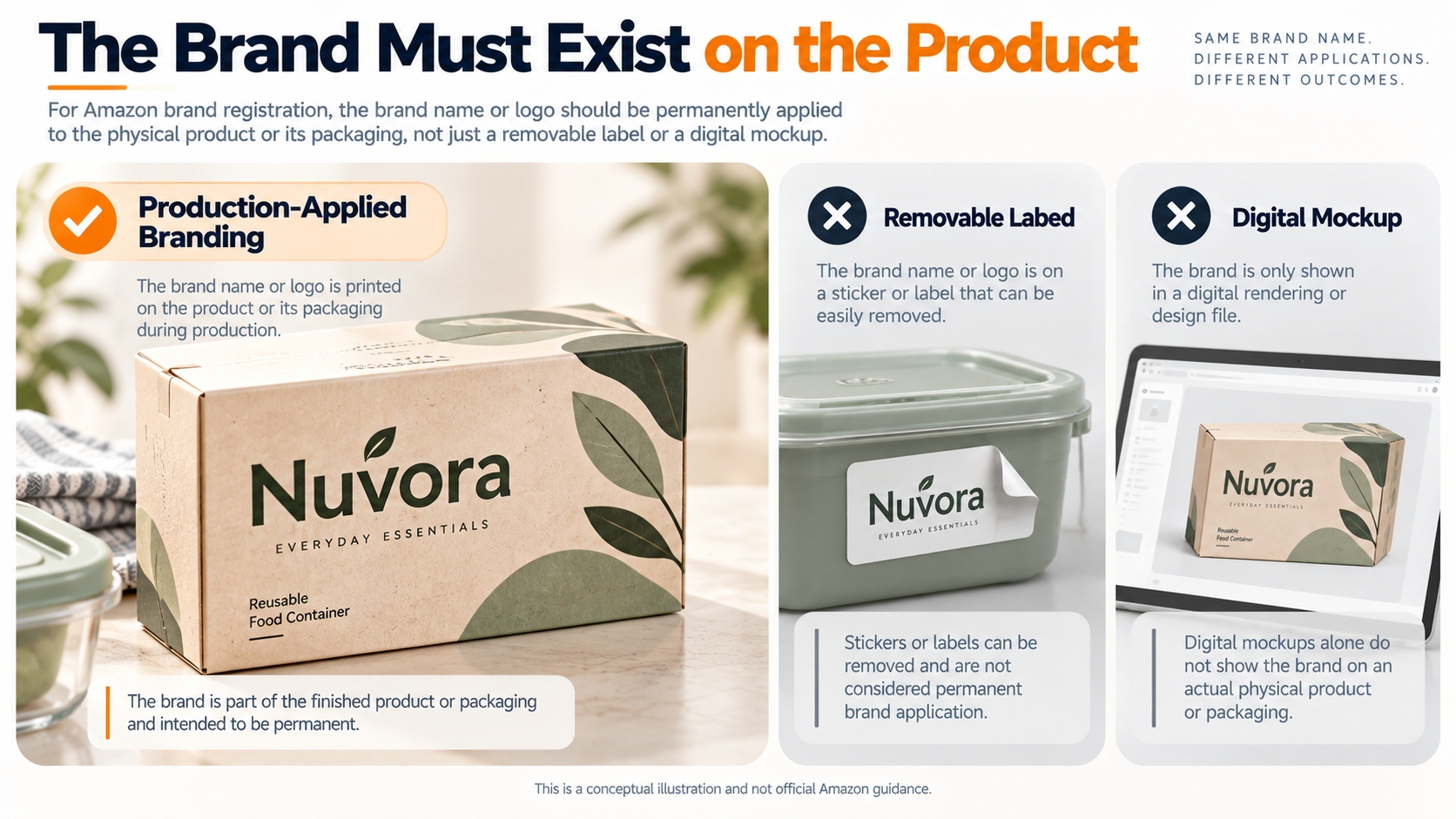
Brand Registry enrollment requires genuine evidence that the brand name is permanently affixed to products or packaging. Amazon's guidance describes production methods such as printing, sewing, engraving, and laser etching.
Do not assume that a removable sticker, hanging tag, digital packaging mockup, or image edited to add a logo will satisfy the application. Arrange authentic production samples and photographs before submission.
Before paying the supplier deposit: Confirm the intended brand name, trademark ownership plan, product specifications, packaging artwork, permanent brand application method, and the records you will retain if the product's authenticity is later questioned.
What Amazon Actually Requires for Brand Registry Enrollment
Brand Registry is not automatically activated when a seller opens a Professional selling account or creates a private-label listing. The brand must qualify, and the trademark owner must complete the appropriate enrollment process.
Amazon's public eligibility guidance requires a qualifying pending or registered trademark and consistent, permanently affixed branding. The accepted trademark office and pending-application conditions depend on the relevant jurisdiction.
The trademark must match the brand identity
Amazon accepts qualifying text-based marks, as well as image-based marks that contain words, letters, or numbers. The brand name entered into the application must match the relevant trademark information.
Differences in spacing or the words used can create application problems. For a design mark, Amazon may require the logo image to match the trademark record rather than a newly redesigned version.
Prepare the actual enrollment materials
The typical information set includes:
- Brand name as recorded for the qualifying trademark.
- Trademark office and registration or application number.
- Required logo information for the appropriate mark type.
- Product categories associated with the brand.
- Authentic photographs showing the brand permanently affixed to the actual product or its packaging.
- Additional manufacturing, distribution, website, or identity information when requested.
The application must be submitted by the trademark owner. A hired agency or service provider can assist, but Amazon's guidance says the rights owner should enroll the brand and then assign appropriate permissions to others.
A pending trademark may qualify, but not every application does
Amazon accepts certain pending trademark applications from supported intellectual property offices. Amazon IP Accelerator can connect businesses with legal service providers and may help qualifying applicants access Brand Registry benefits while a trademark application remains pending.
Acceptance of a pending trademark is not the same as a completed trademark registration. Legal rights and the availability of enforcement programs may differ according to the status of the mark and the marketplace involved.
What happens after submission?
Amazon reviews the brand and trademark information and may verify ownership through the contact or correspondent associated with the trademark record. The applicant may need to complete additional identity verification or provide requested documentation.
Amazon's enrollment guidance advises that the trademark contact complete its confirmation within the stated verification period. Do not assume an application has been approved merely because the submission was accepted by the portal.
What Does Brand Registry Cost?
Amazon Brand Registry enrollment: Free for eligible brands.
Trademark application and legal assistance: Separate costs may apply through the relevant trademark office or professional provider.
Private-label production: Branding, packaging, samples, tooling, and inventory remain separate commercial expenses.
Optional brand services: Certain tools or associated services may have their own eligibility rules or charges.
Brand Registry can also protect brands that do not sell directly on Amazon. However, many selling benefits require an eligible selling account and the appropriate relationship with the enrolled brand.
Separate Brand Protection Permissions from Selling Permissions
A private-label business may have a trademark owner, an Amazon operations team, an external agency, and a distributor. Not all of them should receive the same authority over the brand.
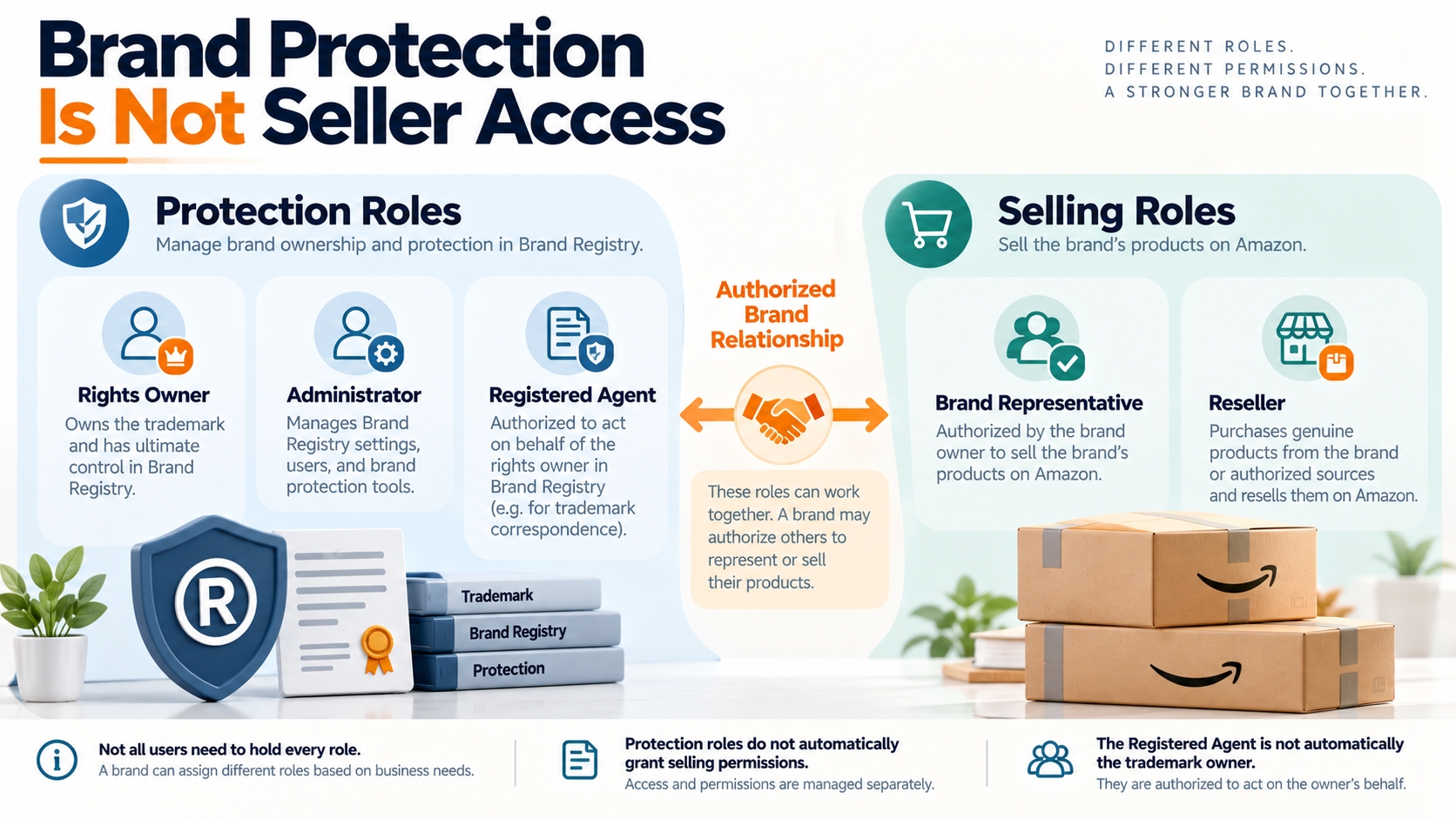
Amazon distinguishes Brand Registry protection roles from selling roles. The first group concerns intellectual property and brand administration. The second concerns the relationship between selling accounts and an enrolled brand.
| Role | Primary responsibility | Important distinction |
|---|---|---|
| Rights Owner | Represents the brand's trademark ownership relationship and associated protection benefits. | Rights ownership is not the same as ordinary seller access. |
| Administrator | Manages affiliated accounts and assigns or changes relevant roles. | Administrative access can affect control over the brand's users. |
| Registered Agent | Acts for a trademark owner on authorized intellectual property matters. | The role does not make the agent the trademark owner. |
| Brand Representative | Internal brand selling account with access to applicable brand-selling benefits. | May access sensitive brand data and should be assigned carefully. |
| Reseller | Affiliated selling account with defined eligibility for brand selling benefits. | Not equivalent to being the legal owner of the mark. |
The same business may hold both protection and selling roles, but the permissions do not automatically substitute for each other. Amazon recommends care when assigning Administrator access because it can be used to manage other users.
Give agencies only the access they need
A design agency helping prepare A+ Content does not necessarily need trademark-administration privileges. A brand protection representative investigating IP violations may need a different authorization from a catalog manager editing product information.
Review which organization owns the Amazon and trademark accounts, who can change user permissions, and what happens when a contractor leaves. Prefer individual, authorized access and remove unnecessary privileges promptly.
What Brand Registry Changes, and What It Does Not
Brand Registry can make it easier for an eligible owner to protect its identity and manage the way products appear in the Amazon store. It also opens access to brand-related services when the business meets the relevant account and program requirements.
Its benefits are substantial, but they have boundaries. Confusing those boundaries is one of the reasons brands file weak complaints or expect automatic control over issues Amazon treats differently.
Stronger protection against misuse of intellectual property
Amazon uses the information provided through Brand Registry to support automated protections, reporting tools, and investigation of suspected intellectual property violations.
Rights owners can also access relevant support processes for brand and catalog matters. That does not mean every submitted claim will be accepted or every marketplace problem will be treated as infringement.
More influence over product presentation
Appropriate brand selling roles can unlock benefits such as A+ Content, Brand Stores, and other eligible brand tools. Brand Registry also helps Amazon associate product information with verified brand relationships.
However, product detail pages remain subject to Amazon's catalog rules, validation, and contribution systems. Brand Registry does not guarantee that every edit submitted by a brand will appear immediately or override all other data.
Brand-building and research benefits
Depending on eligibility, enrolled brands can use Amazon Brand Analytics to study customer search and shopping behavior, A+ Content to explain products more fully, and Brand Stores to present their product range.
These resources support discovery, product communication, and business decisions. They do not automatically establish higher search rankings, better conversion, or exclusive rights to all sales of an ASIN.
The biggest misunderstanding: Brand Registry does not block genuine resellers
Amazon allows eligible sellers to offer authentic products in its store, subject to applicable account, category, and product restrictions. An enrolled brand does not automatically gain exclusive selling rights over every genuine unit bearing its mark.
Amazon staff have publicly explained that Brand Registry is not a tool for enforcing minimum advertised price arrangements or removing genuine-product resellers solely because they are outside a brand's preferred distribution network.
Do not confuse two situations: A seller offering authentic goods obtained through legitimate channels is not automatically selling counterfeits. A seller offering goods that falsely use the brand's trademark or differ materially from the genuine product may raise a different issue that warrants investigation and evidence.
Distribution agreements and trademark infringement involve different legal questions. If a seller is violating a commercial agreement but selling authentic products, the remedy may lie in the contractual relationship rather than an Amazon counterfeit report.
Monitor the ASIN Before Calling Something a Hijack
The word "hijacking" is often used loosely in seller discussions. It may refer to an unfamiliar offer, an unwanted listing edit, suspected counterfeit inventory, or an attempt to use someone else's branding.
Those events should not be treated as equivalent. An effective monitoring routine records the observable change before assigning it a cause.
What is worth monitoring?
| Observable signal | What it may indicate | What it does not prove |
|---|---|---|
| New competing offer | Another seller is offering the ASIN and may affect the Featured Offer. | That the seller's goods are counterfeit or unauthorized under Amazon policy. |
| Title or image changes | Catalog information differs from the brand's reference version. | Who made the change or whether it was an intentional attack. |
| Price movement | Competitive pricing, a different featured offer, or a promotion may have changed. | An IP violation, a counterfeit, or a breach of a particular contract. |
| Rating or review shifts | Customer experience or review population has changed. | That a particular merchant supplied defective or counterfeit goods. |
| BSR or estimated sales movement | Marketplace demand or competitive conditions may be changing. | The cause, seller-level sales loss, or exact damage from an alleged violation. |
Use SellerSprite for marketplace trend context
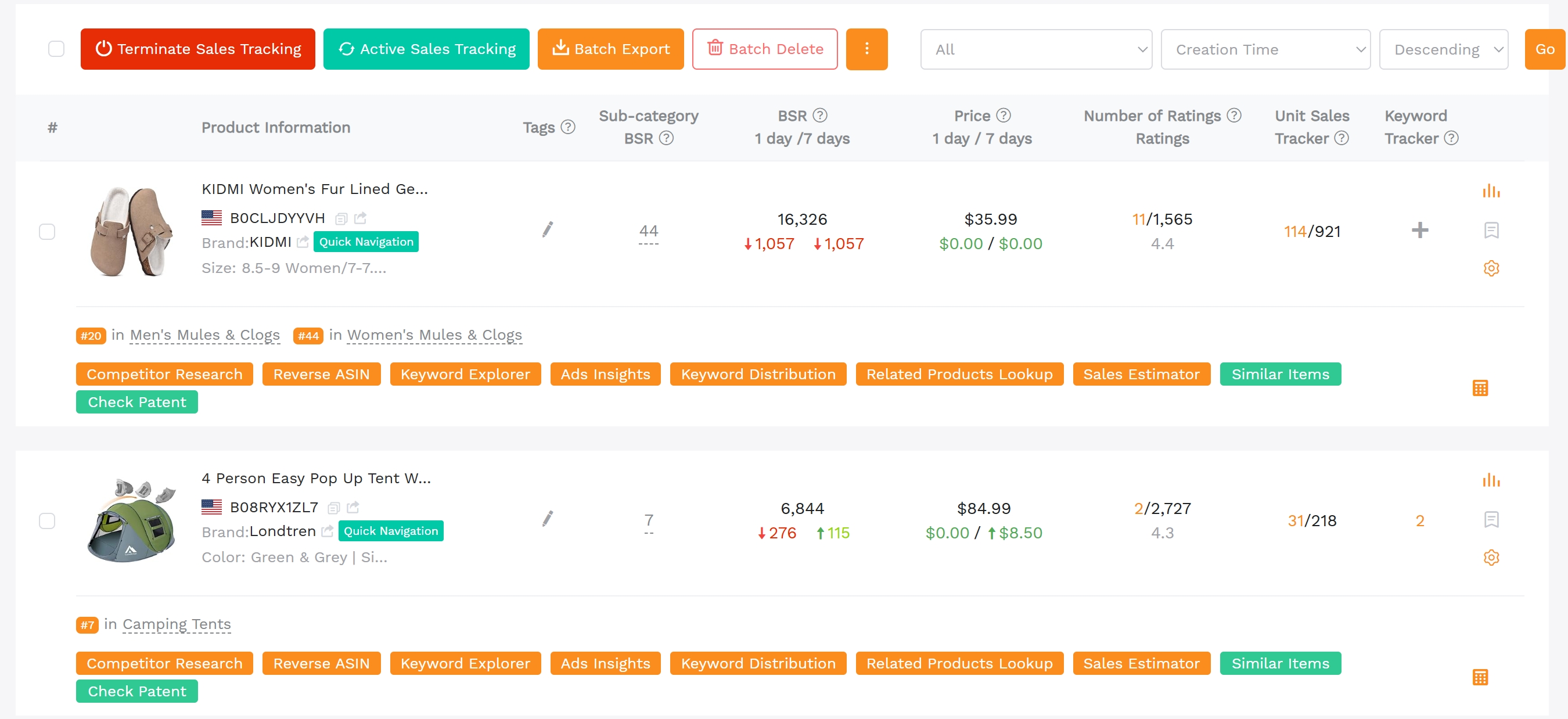
SellerSprite Product & Keyword Tracker can help sellers monitor ASIN-level price, BSR, ratings, estimated sales indicators, and selected keyword rankings over time. Those observations can make it easier to identify unexpected market movement and decide which products deserve closer inspection.
The SellerSprite Product & Keyword Tracker guide describes tracking product performance and historical changes across monitored ASINs.
Use these data as early-warning and context signals. The tracker does not establish the source of an unfamiliar seller's inventory, identify the party responsible for every catalog change, or determine whether a trademark has been infringed.
Preserve a separate record of content accuracy
Keep dated copies of approved product titles, images, bullet points, dimensions, variation information, and packaging specifications. Compare these directly with the live product detail page when an issue is suspected.
A product tracker and a catalog reference library serve different purposes. One helps reveal market trends. The other helps establish exactly how the product information should appear.
Which Amazon Reporting Channel Fits the Problem?
Before reporting a suspected violation, identify the problem precisely. The fact that a brand owner dislikes a listing or seller does not establish that a specific law or Amazon policy has been violated.
This distinction became especially important after Amazon updated its Brand Registry reporting workflow in 2026.
Report a Violation now has a unified guided workflow
Amazon's July 2026 Report a Violation update describes one guided experience within Brand Registry for intellectual property infringement, store policy violations, and certain regulatory compliance concerns.
Its forms guide users through the information relevant to their report, while Submission History allows them to monitor the status and outcome. Amazon states that affiliated Brand Registry users may submit store policy violation reports without the Rights Owner role. Intellectual property claims still require the applicable ownership or authorized-agent authority.
Match the problem to the relevant route
| Situation | Evidence to examine | Appropriate starting point |
|---|---|---|
| Suspected counterfeit | Genuine-product reference, trademark rights, transaction evidence, physical differences, and test-buy findings where appropriate. | Applicable IP infringement report through authorized Brand Registry access. |
| Copied brand photography | Original files, ownership or license records, and the allegedly copied content. | Copyright infringement route, when the claimant has the relevant rights. |
| Inaccurate product details | ASIN, current detail page, approved specifications, and documentation demonstrating the error. | Appropriate catalog correction or Brand Registry support and policy route. |
| Patent concern | Patent details and analysis of the allegedly infringing product or feature. | Patent-specific reporting or evaluation process, with qualified advice where needed. |
| Genuine reseller or MAP dispute | Product authenticity, distribution contracts, and any separate policy or legal concern. | Commercial or legal review; not automatically an IP complaint. |
Amazon's public infringement guidance distinguishes trademark, copyright, and patent issues. Claims should identify the relevant intellectual property and the conduct believed to infringe it.
If the brand is not enrolled
Brand Registry is not the only way to report suspected infringement. Amazon describes separate infringement-reporting options for rights owners outside Brand Registry, subject to the relevant account and evidence requirements.
Use the current Amazon process that applies to the rights holder and report type. Do not submit an allegation under an unrelated category simply because it appears to offer a faster result.
Build an Evidence File That Explains the Violation
A complaint is easier to understand when it clearly separates the brand owner's rights from the facts observed on Amazon. A stack of screenshots is less useful if none explains what the rights owner believes was infringed.
Build the evidence file around a specific allegation and preserve enough context for an independent reviewer to understand it.
Establish the reference version
Keep the trademark record, relevant brand identifiers, genuine product and packaging photographs, approved specifications, original creative files, and any other records needed to demonstrate the rights involved.
Where a manufacturer has produced multiple versions, preserve the differences. A test purchase should be compared with the correct production specification, not an outdated sample from an unrelated batch.
Preserve the observed Amazon activity
Record the ASIN, marketplace, URL, relevant seller or offer information where available, date and time, and the precise page content at issue.
If the concern is about a physical product, a lawful test purchase may provide additional evidence. Preserve the relevant order details, received item, packaging, photographs, and comparison with genuine merchandise. Follow applicable Amazon procedures and do not invent order histories or alter evidence.
Write a factual explanation, not an accusation-filled narrative
Explain what happened, which protected right or policy appears relevant, what evidence supports the conclusion, and which item or content should be reviewed. Avoid relying on statements such as "this seller is stealing our sales" or "the price is too low to be genuine".
When the evidence is incomplete, say what remains unverified. Unsupported counterfeit allegations can harm legitimate merchants and weaken the reliability of the brand owner's reporting process.
A Useful Case File Contains
- The affected ASIN and marketplace.
- The specific product, offer, text, image, or other content at issue.
- Evidence of the brand's relevant rights or genuine product specifications.
- Dated screenshots or transaction documentation, as applicable.
- A concise explanation of the alleged violation.
- Submission identifiers and outcome notes for authorized follow-up.
Store evidence securely and limit access to people who need it. Customer order information, personal data, and internal supplier records should not be copied into public reports or shared more widely than the case requires.
Transparency and Project Zero Solve Different Problems
When a private-label brand faces recurring authenticity concerns, reporting individual incidents may not be enough. Amazon provides additional programs aimed at detecting or preventing counterfeits, but they should not be treated as interchangeable.
Transparency focuses on authenticating individual units
Amazon Transparency is a product serialization program. Eligible brands can use unique codes to support verification of enrolled units and help prevent counterfeit products from reaching buyers.
Once a product is enrolled and protected, valid codes are required under the program's applicable conditions. This introduces operational responsibilities for code generation, packaging or labeling, manufacturing, and distribution.
Transparency enrollment is free, while generated serialization codes have associated costs. The brand should assess the expected protection benefit and the cost of implementing codes across the relevant inventory.
Project Zero provides eligible brands with additional counterfeit-removal capabilities
Project Zero combines Amazon's automated protections with a self-service counterfeit removal capability for brands that meet its eligibility requirements. It is designed for counterfeit issues, not ordinary resale disputes.
Amazon requires training and monitors the accuracy of removal decisions. It also recommends test purchases when appropriate to verify suspected counterfeit activity before self-service action.
Project Zero's self-service removal tool is free for eligible participants. Serialization through Transparency is a separate decision with its own code costs.
TRANSPARENCY
Is this unit authentic?
Uses serialization to help authenticate enrolled products and prevent counterfeit units from reaching customers.
PROJECT ZERO
Can a verified counterfeit listing be removed?
Provides qualifying brands with additional self-service counterfeit removal tools and related protections.
Brand Registry enrollment is a foundation for these programs, not proof of automatic eligibility for every optional feature. The brand should decide whether each program addresses an actual risk in its supply chain and marketplace activity.
A New Offer Appears on a Private-Label ASIN: What Happens Next?
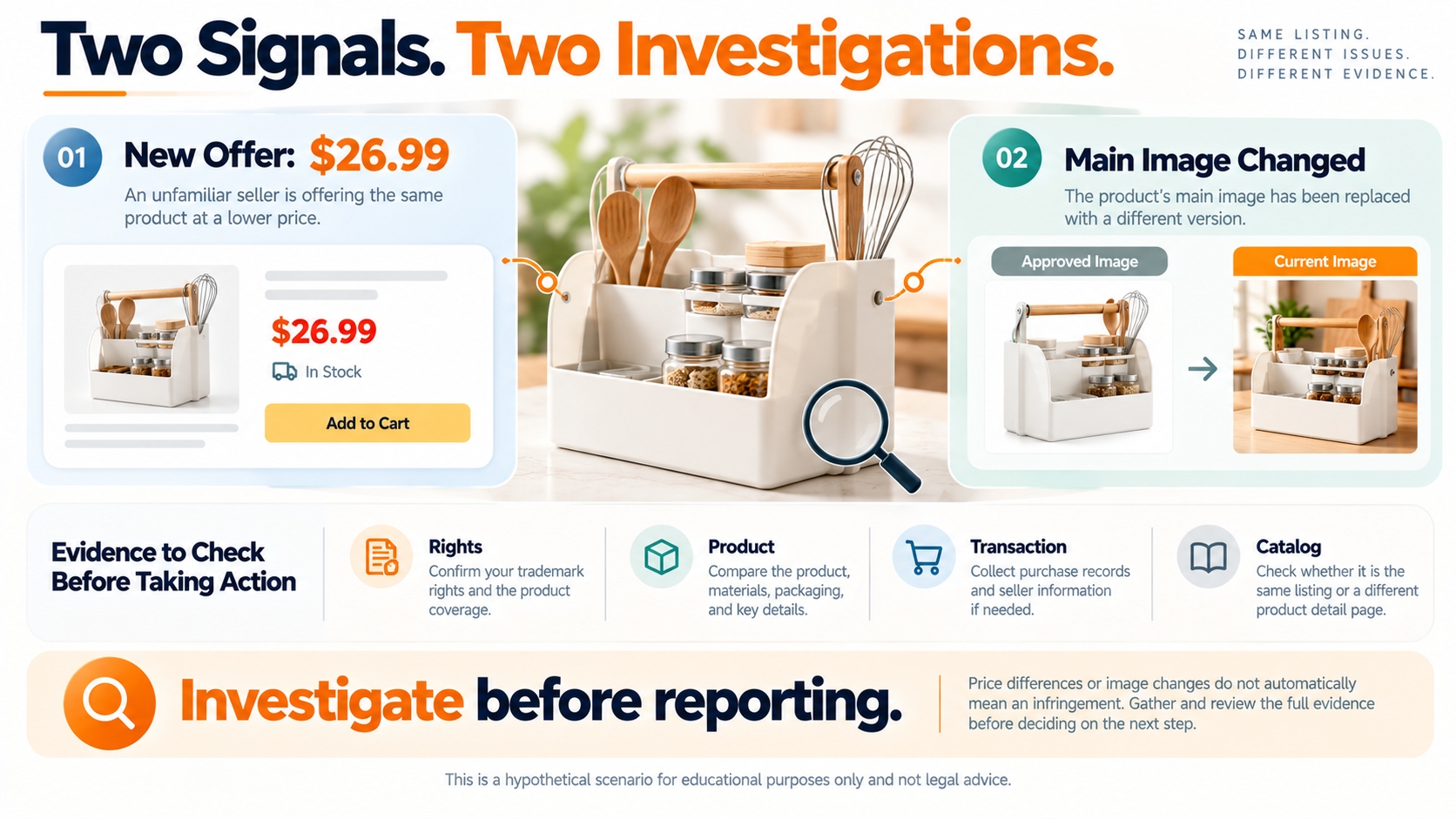
Consider a hypothetical private-label brand selling a kitchen organizer. Its established selling price is $29.99. A new merchant begins offering the ASIN at $26.99. Around the same time, the main image changes to a version that does not match the brand's approved photography.
It is tempting to treat the two changes as evidence of one coordinated hijacking incident. That conclusion would be premature. The seller should examine them as separate observations until evidence connects them.
Keep business impact separate from proof of violation
Suppose sales decline after the new offer appears. The seller can report its actual sales and Featured Offer metrics for the relevant period. But the decline alone does not establish that the new merchant sold counterfeit goods or caused the listing image to change.
Advertising changes, seasonality, inventory availability, and pricing can influence results. Estimate potential business impact only with a clearly described method and distinguish it from legal evidence of infringement.
Measure Protection Without Mistaking Correlation for Recovery
A brand protection case is not finished merely because a report was submitted. The seller needs to understand what Amazon decided, whether the underlying issue changed, and whether additional product or process corrections are required.
The measurement should distinguish confirmed enforcement outcomes from marketplace performance changes that may have unrelated causes.
Track case outcomes first
Record the number of cases opened, the violation type, submitted evidence, Amazon's response, any request for additional information, and the final status.
Where the information is available, monitor the time between identifying an issue, submitting a complete report, and reaching a resolution. A case that is closed without action should be reviewed for missing evidence, incorrect classification, or a misunderstanding of the applicable rule.
Monitor marketplace conditions after the decision
If an inaccurate listing image is corrected, confirm that the new content is visible and matches the actual product. If a counterfeit listing is removed following an accepted report, verify the relevant status through Amazon's available tools.
Product prices, ratings, BSR, and sales trends can provide context around the period. However, an improvement after a case closes is not proof that the enforcement action alone caused the change.
Audit the prevention process, not only the incidents
A recurring issue may indicate a missing supplier control, inconsistent product identification, inadequate catalog documentation, or excessive user permissions.
Review whether the next incident can be prevented through better packaging records, serialization, account-access controls, or a clearer reporting procedure. Do not assume that filing more complaints is always the best protection strategy.
| Measure | Useful business question | Interpretation limit |
|---|---|---|
| Report outcome | Did Amazon accept the report and take the requested action? | Submission alone is not resolution. |
| Time to resolution | How quickly was the documented issue investigated and closed? | Different case types may require different review periods. |
| Listing accuracy | Does the live ASIN now match the verified product information? | A corrected page does not identify the original contributor. |
| Price and BSR trends | What market conditions changed around the incident? | These trends do not independently establish the cause. |
| Repeat incidents | Does the same verified problem recur after the corrective action? | Reporting volume can reflect monitoring intensity as well as risk. |
Maintain a routine that prevents preventable errors
For high-priority ASINs, establish a repeatable review of major catalog changes, offers, relevant customer complaints, and abnormal market movement. Increase attention when the brand launches a new product, changes suppliers, or discovers a substantiated authenticity problem.
Keep the trademark and product records current, review account permissions when employees or agencies change, and verify that the brand's chosen protections still fit its product and distribution model.
A Defensible Brand Is More Than a Registered Name
Amazon Brand Registry gives eligible private-label businesses important protection and brand-management capabilities. But the strongest defense is not simply having a brand listed in Amazon's system.
It is having a brand identity the business is entitled to use, genuine products that can be distinguished from imitations, trustworthy manufacturing and ownership records, and a team that knows how to investigate a problem before making a complaint.
A lower-priced offer may be legitimate. A changed image may be a catalog error. A counterfeit requires evidence. Brand Registry helps address these situations, but the right action depends on understanding which situation actually occurred.
For private-label sellers, the practical objective is to make the brand more difficult to misrepresent, easier to authenticate, and more accurately presented to customers over time.
FAQs
What is the difference between Amazon Brand Registry and private labeling?
Private labeling is a business model in which products manufactured by one company are sold under another company's brand. Amazon Brand Registry is a separate program that helps eligible brand owners protect intellectual property, manage brand information, and access qualifying brand tools. Private-label products are not automatically enrolled.
Do I need a trademark for Amazon Brand Registry?
Yes. Amazon generally requires a qualifying pending or registered trademark from a supported intellectual property office. The mark must meet the applicable format and jurisdiction requirements, and the brand must provide genuine product or packaging evidence displaying its name.
Can I enroll in Brand Registry with a pending trademark?
Certain pending trademark applications qualify, depending on Amazon's supported trademark offices and current eligibility rules. Amazon IP Accelerator can connect applicants with legal providers and may provide a path to faster access to qualifying benefits. A pending application is not equivalent to a completed registration.
Is Amazon Brand Registry free?
Brand Registry enrollment is free for eligible brands. Trademark filings, legal services, product branding, packaging production, and certain optional brand-protection services may have separate costs. Enrolling in Brand Registry does not eliminate ordinary Amazon selling fees.
Can I register a private-label brand without selling on Amazon?
Yes. Amazon states that qualifying trademark owners can enroll brands even if they do not sell directly in the Amazon store. Certain brand-protection resources may be available, while selling benefits such as A+ Content and Brand Stores require additional account eligibility.
Does Brand Registry stop other sellers from listing my products?
No. Brand Registry does not automatically grant exclusive selling rights. Other eligible merchants may offer genuine products, subject to applicable Amazon rules. A reseller outside the brand's preferred distribution network is not automatically selling counterfeit merchandise.
Can I report an unfamiliar seller as a counterfeit?
Not solely because the seller is unfamiliar or offers a lower price. A counterfeit claim requires a relevant basis, such as evidence that products are falsely represented as genuine branded goods. Investigate the item, preserve appropriate evidence, and use the correct reporting category rather than treating unauthorized distribution as proof of counterfeiting.
Can Brand Registry help correct incorrect listing images or titles?
Brand Registry provides brand-related support and tools that can help with product-detail accuracy. However, it does not guarantee that every edit submitted by a brand owner will override all catalog information. Preserve accurate product evidence and use the appropriate correction or support workflow.
What is the difference between Brand Representative and Rights Owner?
Rights Owner is a Brand Registry protection role associated with the trademark owner's rights. Brand Representative is a selling role for an internal brand-affiliated selling account. They provide different privileges and may be held by the same business through appropriately assigned accounts.
What is Amazon Report a Violation?
Report a Violation is a Brand Registry tool for submitting relevant intellectual property, store policy, and certain regulatory compliance reports. Amazon's 2026 update introduced a unified guided experience and Submission History. Access and reporting authority depend on the report type and account relationship.
What is the difference between Amazon Transparency and Project Zero?
Transparency uses serialization to support the authenticity of enrolled individual units. Project Zero provides qualifying brands with additional counterfeit removal capabilities. They address related but different problems, have separate eligibility requirements, and should not be treated as interchangeable.
Does a US trademark protect my private-label brand in every Amazon marketplace?
No. Trademark rights and enforcement depend on the relevant jurisdiction. Amazon supports a global Brand Registry account, but brands expanding into other marketplaces should consider local trademark protection, Amazon's supported trademark offices, and the specific country's requirements.
Can SellerSprite detect counterfeit products or listing hijacking?
SellerSprite Product & Keyword Tracker can monitor ASIN-level marketplace signals such as price, BSR, ratings, and selected keyword rankings. Those data can help identify changes that warrant investigation. They do not independently authenticate products, prove intellectual property infringement, or determine which party caused a catalog change.
References
- Amazon: Private Label Products, Guide to Store Brands and Own-Label Products View
- Amazon: What Is Amazon Brand Registry and How Does It Work? View
- Amazon: Requirements and Tips for Enrolling in Brand Registry View
- USPTO: Federal Trademark Searching View
- Amazon: What Are Brand Registry Roles? View
- Amazon: How to Sell Branded Products on Amazon View
- Amazon: How to Report an Intellectual Property Violation View
- Amazon: Report Brand Violations Faster with One Guided Experience, July 31, 2026 View
- Amazon: Transparency, Product Authentication and Serialization View
- Amazon: Project Zero, Counterfeit Removal and Eligibility View
- Amazon: A+ Content, Eligibility and Brand Presentation View
- SellerSprite: Product & Keyword Tracker Guide View
By SellerSprite Content Team
The SellerSprite Content Team researches Amazon marketplace operations with particular attention to how product data, seller activity, and catalog information affect business decisions. For private-label and brand-protection topics, our editorial work examines the boundary between observable marketplace changes and substantiated intellectual property concerns. We draw on Amazon's published brand programs, public trademark guidance, and product-tracking research to help sellers distinguish routine competition from issues that merit documented investigation and authorized reporting.
Last reviewed: October 30, 2026