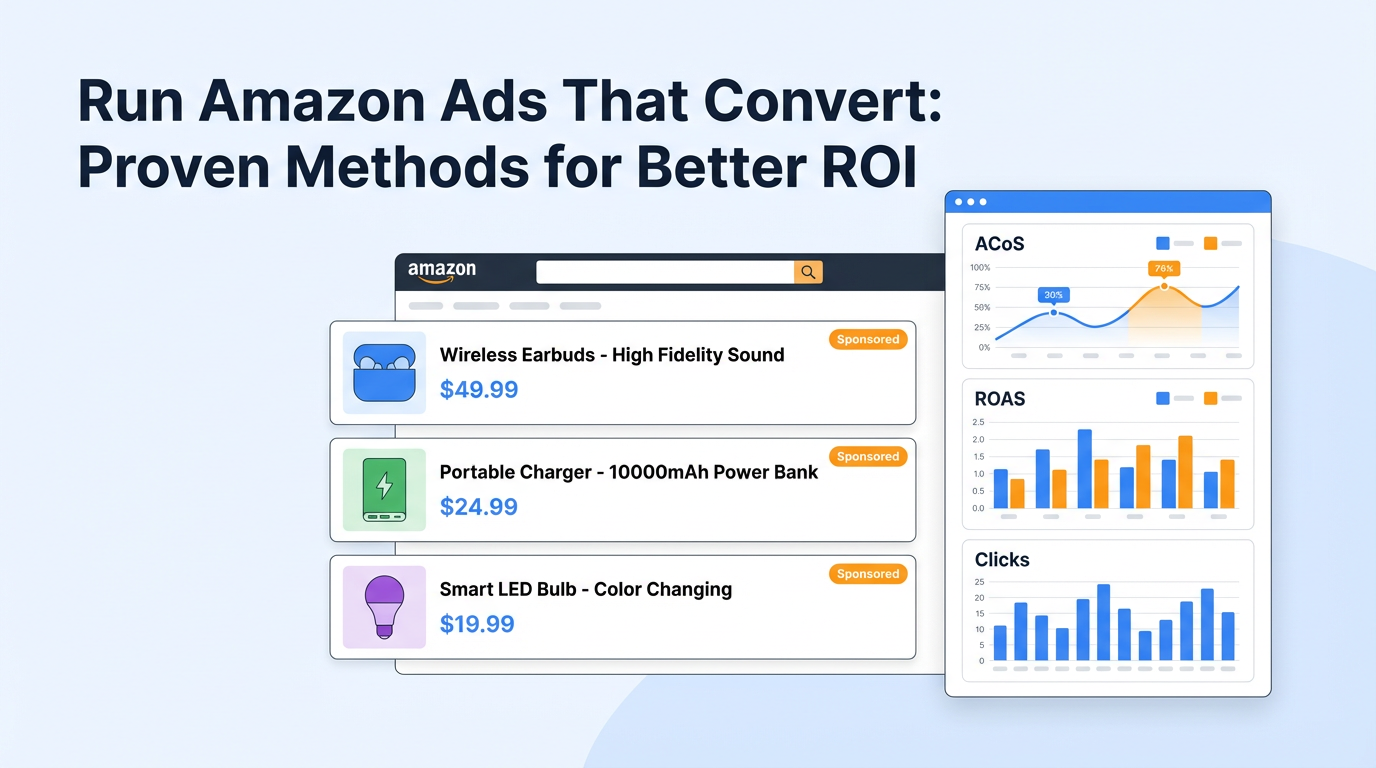
The numbers are staggering - Amazon now captures 50% of all product searches, nearly twice the volume on Google.
Success in this massive marketplace, which generated over $600+ billion in revenue in 2025, depends significantly on Amazon ads. The marketplace data reveals compelling trends: 75% of third-party sellers leverage Sponsored Products ads. These ads dominate the platform's advertising landscape and account for 78% of total Amazon ad spend.
Real results back these statistics. Small businesses report that 30% of their sales come directly from advertising. Many brands have achieved remarkable outcomes. The success stories include a 285% increase in ad-attributed impressions and an 89% boost in ad-attributed sales. A notable example shows how one company generated 80% of their new customer sales through Amazon ads across multiple years .
This piece will reveal proven strategies to boost your Amazon PPC performance and create sponsored ads that drive conversions. The content helps both newcomers to Amazon sponsored product ads and experienced sellers who want to enhance their Amazon advertising strategy. You'll learn the quickest way to improve ROI and protect your ad budget from unnecessary spend.
Understand the Amazon Ads Ecosystem
Amazon's advertising platform has grown into a sophisticated ecosystem that boosts sales through smart placement and targeting. Success depends on your understanding of its different parts and their interactions.
Types of Amazon ads: Sponsored Products, Brands, and Display
Sponsored Products are the foundations of Amazon advertising. These cost-per-click (CPC) ads promote individual product listings through images or interactive videos in search results and product pages. They achieve a click-through rate of 0.39% across all categories and perform better than traditional display advertising.
Sponsored Brands serve brand-registered sellers and vendors exclusively. These eye-catching banner-style ads showcase your brand logo, custom headline, and up to three products. The campaigns boost brand recognition by 23% compared to product-only advertising. They excel at building brand awareness while generating sales.
Sponsored Display rounds out the advertising options by reaching customers both on and off Amazon. Rather than using keywords, these ads target shoppers based on their shopping behaviour. You'll find them on Amazon's websites, mobile apps, and external platforms like Facebook, Netflix, and Google. The format utilises Amazon's first-party data and provides safe spaces for creative expression.
How Amazon PPC works
Amazon PPC runs on an auction system where advertisers pay only after shoppers click their ads. The process starts when a customer searches for a product. Amazon gathers relevant ads that target those keywords. The auction picks winners and their positions based on bid amount and ad relevance.
Amazon uses a second-price auction model: winners pay the second-highest bid rather than their maximum bid. A simple example shows how this works: Your $5.00 bid wins against a $4.00 bid, but you pay only $4.00 per click.
Two targeting options exist:
- Automatic targeting: Amazon's algorithm picks keywords from your listing content and shopper behaviour. It adjusts bids to maximise conversion.
- Manual targeting: You choose specific keywords or ASINs. This gives you more control but needs hands-on management.
Where your ads appear on and off Amazon
Ad placement varies by type and targeting settings. Sponsored Products show up at the top, alongside, or within shopping results and product pages. These ads now reach beyond Amazon to websites and apps in Amazon's publisher network.
Sponsored Brands appear at the top, side, and bottom of search results. These premium spots help capture shoppers who are ready to buy.
Sponsored Display ads reach the widest audience. They show up on Amazon's websites, product pages, and external platforms. Premium websites like Hearst Newspapers, Lifehacker, Mashable, and Raptive host these ads. Pinterest serves as a key partner to reach consumers early in their buying trip.
SellerSprite's Ads Insight tool helps research competitor strategies and their sponsored keywords to improve your targeting approach.
A solid grasp of this ecosystem helps you make smart decisions about ad types that match your goals and budget.
Set Clear Goals for Your Campaigns
The lifeblood of successful Amazon advertising is something many sellers overlook - clear campaign goals. Your ad campaigns can drain your budget and fall short without specific objectives.
Brand awareness vs. product sales
Your strategic approach to Amazon ads is different based on whether you want to build brand awareness or drive direct product sales.
Brand awareness campaigns help build familiarity with potential customers. These campaigns establish your presence as customers start to make purchase decisions. Statista reports show customers are 20% more likely to pay extra for brands with appealing images. On top of that, 79% of buyers prefer to purchase from brands whose values line up with their own.
For brand awareness, metrics that matter include:
- Ad recall and frequency
- New-to-brand metrics
- Impression share within your category
Product sales campaigns take a different approach by focusing on immediate conversion and revenue generation. These campaigns use more aggressive bidding strategies and target high-intent keywords. Their success depends on metrics like ACOS (Advertising Cost of Sale), ROAS (Return on Ad Spend), and conversion rate.
Choosing the right ad type for your goal
Amazon ad formats serve specific purposes in your marketing strategy:
Sponsored Products work best to boost product visibility and drive direct sales. These ads help businesses promote specific inventory or individual SKUs with customizable targeting options.
Sponsored Brands work well for building brand awareness and credibility. They display your logo, custom headline, and multiple products in premium spots. Brands that use all Sponsored Brand formats saw 79% of their sales come from new-to-brand customers.
Sponsored Display ads help with retargeting potential buyers or expanding reach beyond Amazon. These ads appear on third-party websites and apps. They make use of information from Amazon's audience insights to reconnect with shoppers who viewed but didn't buy your products.
New product launches work best with a combination of Sponsored Products and Sponsored Brands for maximum visibility. Inventory clearance might need aggressive Sponsored Products campaigns with competitive bidding.
Lining up goals with Amazon advertising strategy 2026
Amazon advertising works when business objectives match campaign execution. Regular discussions about campaign goals are essential since they measure success and often change with time.
Your campaigns need SMART (specific, measurable, achievable, relevant, and time-bound) objectives before launch. Your measurement strategy should track both priority and secondary goals.
Mature products in 2026 need sharp ROAS and ACOS through smart keyword targeting. A/B testing shows what appeals to audiences best, helping you optimise your ad spend.
Note that objectives change throughout your product lifecycle. New products might need higher ad spend for visibility. Eight-year-old products might focus more on profitability with break-even ACOS.
SellerSprite's Ads Insight tool gives practical information about sponsored keywords when you research competitor strategies. This helps refine your targeting approach.
Master Targeting and Keyword Strategy
The right keywords are the foundations of any successful Amazon advertising campaign. Your choice of targeting approach and keywords can determine if you waste ad spend or get profitable returns on investment.
Manual vs. automatic targeting
Amazon gives sellers two main targeting approaches for Sponsored Products campaigns. The automatic targeting lets Amazon's algorithm take control and picks relevant keywords from your product listing information. New sellers or those learning new market segments find this approach works best. Running both automatic and manual campaigns together has shown 23% more keyword coverage and 18% lower overall ACoS than manual-only strategies.
Manual targeting puts you in complete control of keyword selection and bid management. This works best if you know your high-converting keywords or need tight control over advertising spend. You can quickly adapt to market changes with manual campaigns, which is great for seasonal products or trending items.
Using keyword match types effectively
Your ads appear based on how a shopper's search lines up with your chosen keywords. Amazon has three match types for manual campaigns:
Broad match reaches the most people by showing your ads for variations, synonyms, and related terms. This helps you find new search terms but needs careful monitoring to avoid waste.
Phrase match brings more precision because the customer's search must have your exact keyword phrase in order, though words can appear before or after. Mid-funnel shoppers respond well to this balance of reach and relevance.
Exact match gives the tightest targeting and shows your ad only when search terms match your keyword exactly or use close variants like plurals. You'll reach fewer shoppers but get higher conversion rates.
Start with broad match to find high-performing terms after creating a campaign. Then move these winners to phrase or exact match to get better control.
Leveraging product targeting for competitor ASINs
ASIN targeting lets you place ads on specific product pages, beyond just keywords. This strategy helps you:
- Show your products on competitor pages to attract their potential customers
- Put your offerings next to complementary products for cross-selling
- Target competitor ASINs that have fewer or worse reviews than yours
- Show lower-priced alternatives beside higher-priced competitors
A product with Prime shipping can target non-Prime competitors to showcase its shipping advantage.
Using negative keywords to reduce wasted spend
Negative keywords stop your ads from showing up for specific search terms. This optimises campaign performance and saves your budget. You can choose between two negative match types:
Negative phrase blocks ads when searches contain your specified phrase (up to 4 words).
Negative exact prevents ads from showing when searches match your exact term (up to 10 words).
Regular checks of your Search Term Reports will help you find irrelevant or underperforming terms to add as negative keywords. This saves money and prevents keyword cannibalisation - when multiple campaigns compete for the same search terms.
Your campaign should start with automatic campaigns to gather data. Then refine with manual targeting and negative keywords. This method will help your Amazon PPC efforts improve and deliver better ROI as time goes on.
Optimise Bidding and Budgeting for ROI
Smart bidding and budget management are the foundations of successful Amazon ad campaigns. Fine-tuning these elements helps maximise ROI and prevents wasted ad spending.
Understanding CPC and dynamic bidding options
Cost Per Click (CPC) sets the amount you pay each time shoppers click your ads. Higher bids can secure better placements. Amazon's second-price auction model means you pay just one penny more than the second-highest bid. Your actual CPC often stays below your maximum bid.
Amazon gives you three bidding options to control your spending:
- Fixed bids: Your exact bid stays unchanged—perfect for aggressive campaigns that target competitive keywords
- Dynamic bids - down only: Amazon lowers your bid automatically when conversions seem unlikely, which saves money
- Dynamic bids - up and down: Bids increase up to 100% for promising placements and decrease when conversion chances look low
Most advertisers should start with "down only" as the safest option. The performance data you gather later might suggest trying "up and down" for keywords that perform well.
Setting daily budgets and bid adjustments
The daily budget sets your maximum daily spend. Amazon spends this budget quickly when good opportunities appear rather than spreading it throughout the day.
Amazon makes the most of high-traffic days by using unspent budget from slower periods. Your daily spend might double (or increase by 25% based on your settings) without exceeding monthly limits. A $100 daily budget could mean spending $90 on Monday and $110 on Tuesday.
Each campaign needs at least $10 daily, but choose an amount you can maintain long-term. Campaigns that run out of budget early might benefit from budget rules. These rules automatically increase spending during key periods or for campaigns that show strong results.
Using placement reports to refine strategy
Placement reports show how your campaigns perform in different locations. These reports help you find which spots—Top of Search, Product Pages, or Rest of Search—bring the best ROI.
The "Adjust Bids by Placement" feature lets you raise bids up to 900% for spots that convert well. Top of Search might show strong ROAS with slightly high ACoS. You can maintain visibility by increasing the bid multiplier by 50-100% while you work on keyword targeting.
Regular report monitoring helps move the budget from underperforming spots to those bringing better returns.
Track, Analyse, and Improve Performance
The final piece of the Amazon advertising puzzle shows how well your campaigns work. Your carefully crafted ads might not deliver results without proper tracking and analysis. Let's learn how to review and boost your campaigns.
Key metrics: ACoS, ROAS, CTR, and conversion rate
These four critical metrics help you assess campaign health:
Advertising Cost of Sales (ACoS) is your ad spend divided by ad revenue, expressed as a percentage. Lower ACoS means more profitable ads. You should aim for below 40%, while 30% or less would be ideal.
Return on Ad Spend (ROAS) tells you how many dollars you earn for every dollar spent on advertising. You calculate it by dividing total ad sales by total ad spend. A ROAS of 3 or higher shows excellent performance.
Click-Through Rate (CTR) shows how often customers click your ad after seeing it. Amazon's average CTR is 0.4%, with 0.5% or higher considered good. You need to take action right away if CTRs drop below 0.3%.
Conversion Rate (CVR) is the percentage of clicks that result in purchases. Amazon's healthy conversion rate averages 9.5% and varies by product category from 4% to 50%.
Using Amazon Ads reports to optimise
Amazon offers several specialised reports that help optimise performance:
- Search Term Report: Shows which search terms convert best
- Targeting Report: Shows how well your keywords work
- Placement Report: Shows where your ads perform best
- Performance Over Time Report: Tracks costs and results across different periods
Your campaign might need better product images, titles, and pricing if you see high impressions but few clicks. High clicks with few sales point to product detail pages that need work.
A/B testing creatives and landing pages
Amazon's Manage Your Experiments tool lets you test different versions of product detail pages to find what drives more sales. Better content can boost sales by up to 20%.
Your experiments work better when you
- Create test content that looks substantially different from existing content
- Run experiments for their full duration (8-10 weeks works best)
- Test multiple content types at once
A/B tests take time—Amazon needs at least 10 days before it starts collecting metrics. All the same, the results help take the guesswork out of optimising your listings.
When to scale or pause campaigns
Smart strategy, not emotion, should guide your decision to pause Amazon campaigns.
You should pause campaigns when:
- Your ad spend gets too high, and ACoS exceeds your account-level goal
- Your main product-level metric falls short, especially with high spend
- Your budget spreads too thin across too many campaigns
- Your CTR stays below 0.30%
Pausing doesn't mean permanent stopping. Keep your paused campaigns instead of deleting them because their historical data has value. When you restart, review your competitors to adjust your approach based on current market conditions.
Scaling works differently for different campaign types. Discovery campaigns need more clicks than exact match campaigns before you can judge their performance. Exact match campaigns can show scaling potential after just 10 clicks with conversion data.
Campaign performance analysis relies on informed decisions that continuously improve your Amazon advertising ROI.
Conclusion
Amazon advertising can deliver amazing results when you take a strategic approach. This piece explores the essential elements that make Amazon ads convert well and deliver strong ROI.
Your success with Amazon PPC depends on how well you grasp the ecosystem, set clear goals, and become skilled at targeting strategies. You need to optimise budgets and analyse performance regularly. These elements work together as a unified system rather than separate tactics to maximise your advertising results.
Keyword research creates the foundations of profitable campaigns. The right mix of automatic and manual targeting can give you informed decisions while you retain control over spending. Many sellers overlook negative keywords, but they substantially cut wasted ad dollars and make campaigns work better.
Your Amazon advertising decisions should always stem from data. Campaign metrics reveal the story of what works and what needs changes. A regular review of your ACoS, ROAS, CTR, and conversion rates will show where you can improve.
Start small, test what works, and then scale up. This measured approach saves your budget and builds profitable campaigns. Success with Amazon advertising takes time - quick wins are rare.
The competitive environment on Amazon never stays the same. Your strategy needs to adapt to keep your visibility and conversion rates strong as market conditions change. Be willing to test, learn, and adjust to stand out from competitors who stick to rigid approaches.
With these methods in your toolkit, you're ready to create Amazon ads that convert. Put these proven strategies to work today and watch your advertising ROI grow.
FAQs
Q1. What is a good conversion rate for Amazon ads?
A typical conversion rate for Amazon listings ranges from 10% to 15%. However, for Prime members, this rate can be significantly higher, often exceeding 74%. These high rates are due to the fact that many Amazon browsers are already in a buying mindset when they visit the platform.
Q2. How can I improve my Amazon ad conversion rate?
To boost your Amazon ad conversion rate, focus on optimising your product pages, reducing delivery times, conducting thorough keyword research, utilising A+ content, pricing competitively, strategically managing reviews and ratings, and implementing effective advertising strategies. Additionally, consider using A/B split testing to refine your approach.
Q3. What are some effective strategies to increase click-through rates (CTR) on Amazon?
To improve your Amazon CTR, optimise product images for visual appeal, refine your keyword targeting, enhance product descriptions, ensure competitive pricing, conduct A/B testing, increase positive reviews and ratings, leverage product videos, and build a comprehensive FAQ section. These strategies can help your listings stand out and attract more clicks.
Q4. How do I optimise my Amazon ad campaigns for maximum ROI?
To maximise ROI on your Amazon ad campaigns, align your key performance indicators (KPIs) with business goals, utilise first-party data, refine audience targeting, test different creatives and messaging, optimise landing pages, consolidate campaigns and accounts where appropriate, focus on what works best, and implement a multichannel approach to your digital marketing efforts.
Q5. When should I consider pausing or scaling my Amazon ad campaigns?
Consider pausing campaigns when ad spend is too high and ACoS exceeds your account-level goal, when your key product-level metrics aren't being met, when your budget is spread too thin across too many campaigns, or when CTR consistently falls below 0.30%. For scaling, exact match campaigns with positive conversion data after just 10 clicks may indicate readiness for expansion, while discovery campaigns typically need more clicks before making scaling decisions.